
A Bright Beginning of Togetherness — When Music, Family, and Television Became One Warm Invitation
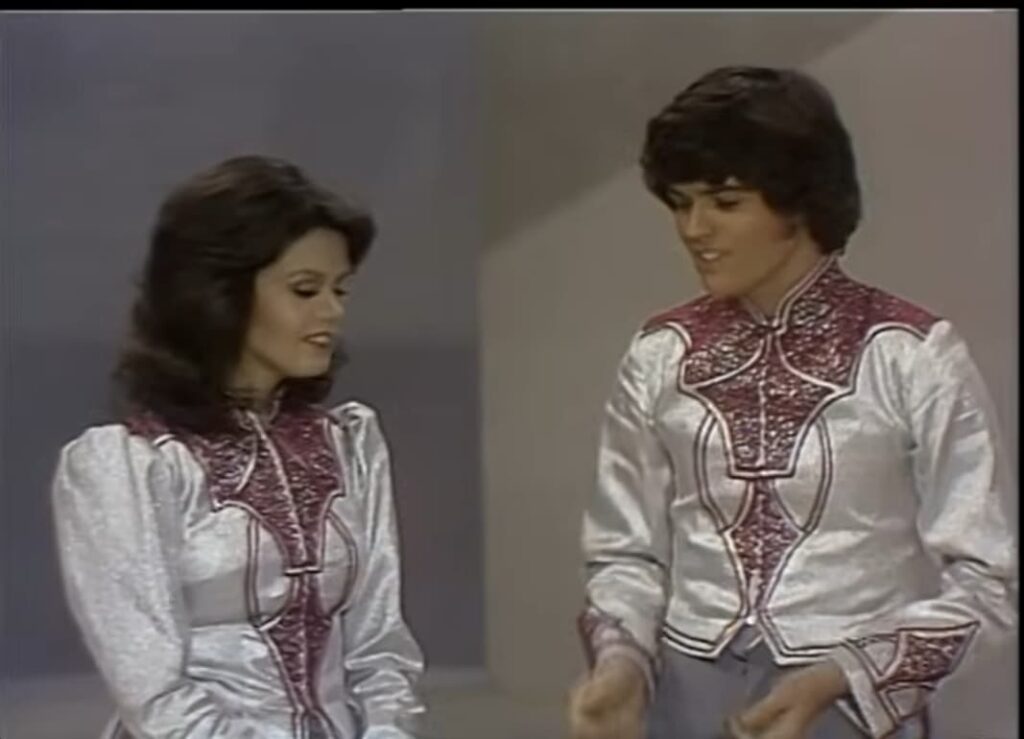
When “The Opening of the First Show” from the Donny & Marie first aired in January 1976 on ABC, it was more than just the introduction to a new television program—it was a carefully orchestrated moment that captured the spirit of an era yearning for comfort, familiarity, and wholesome charm. Featuring siblings Donny Osmond and Marie Osmond, the opening sequence quickly became iconic, setting the tone for a show that would go on to define light entertainment for a generation.
Although not a charting “song” in the traditional sense, the opening theme—often remembered through its cheerful refrain “I’m a little bit country, I’m a little bit rock ‘n’ roll”—held a cultural position just as significant as any hit single. It symbolized a bridging of musical identities: Donny’s polished pop sensibilities intertwined with Marie’s country roots. This contrast was not only musical but symbolic, reflecting a broader dialogue within American music during the mid-1970s, when genres were increasingly blending yet still held distinct emotional identities.
The success of The Donny & Marie Show was immediate and impressive. Premiering as a mid-season replacement, it quickly climbed into the Top 20 of the Nielsen television ratings, eventually becoming one of ABC’s most-watched programs during its run from 1976 to 1979. The opening sequence played a crucial role in this success—it was the audience’s first impression, a warm handshake extended through the screen.
Behind this seemingly effortless charm lay a carefully constructed narrative. Both Donny and Marie had already achieved individual success before the show. Donny, as part of The Osmonds, had dominated the early 1970s pop charts, while Marie had carved out her own identity in country music with hits like “Paper Roses,” which reached No.1 on the Billboard Hot Country Songs chart in 1973. Bringing them together in a variety format was a strategic move—one that capitalized on their contrasting yet complementary personas.
The opening performance encapsulates this dynamic beautifully. There is a sense of innocence, almost theatrical in its sincerity, as the two step into the spotlight. The choreography is simple, the smiles genuine, and the music unpretentious. Yet, beneath that simplicity lies a deeper resonance: a reminder of a time when entertainment sought not to challenge or provoke, but to comfort and unite.
What makes this opening particularly memorable is its emotional accessibility. It does not demand attention through spectacle; instead, it invites viewers into a shared space of familiarity. The lyrics, though lighthearted, carry an undercurrent of identity—of understanding where one comes from while embracing where one is going. In a decade marked by cultural shifts and uncertainties, this message held a quiet but powerful appeal.
There is also a strong sense of family embedded in the performance. The Osmond name itself had long been associated with wholesomeness and unity, and this show extended that image into millions of living rooms each week. The opening sequence, therefore, becomes more than just an introduction—it is a reaffirmation of values that many held dear: connection, simplicity, and the enduring power of music to bring people together.
Musically, the arrangement reflects the polished production style of 1970s television. Bright brass sections, clean vocal harmonies, and a steady rhythm create an atmosphere that feels both lively and reassuring. It is not groundbreaking, nor does it attempt to be. Instead, it succeeds in being exactly what it intends to be: inviting, memorable, and emotionally sincere.
Looking back, “The Opening of the First Show” stands as a time capsule of an era when television and music intersected in ways that felt deeply personal. It reminds us that sometimes, the most lasting impressions are not made through complexity, but through clarity of emotion and intention.
And as those opening notes play, even now, they seem to carry with them a gentle echo of evenings once spent in quiet anticipation—when a simple song could signal not just the start of a show, but the beginning of a shared moment.