
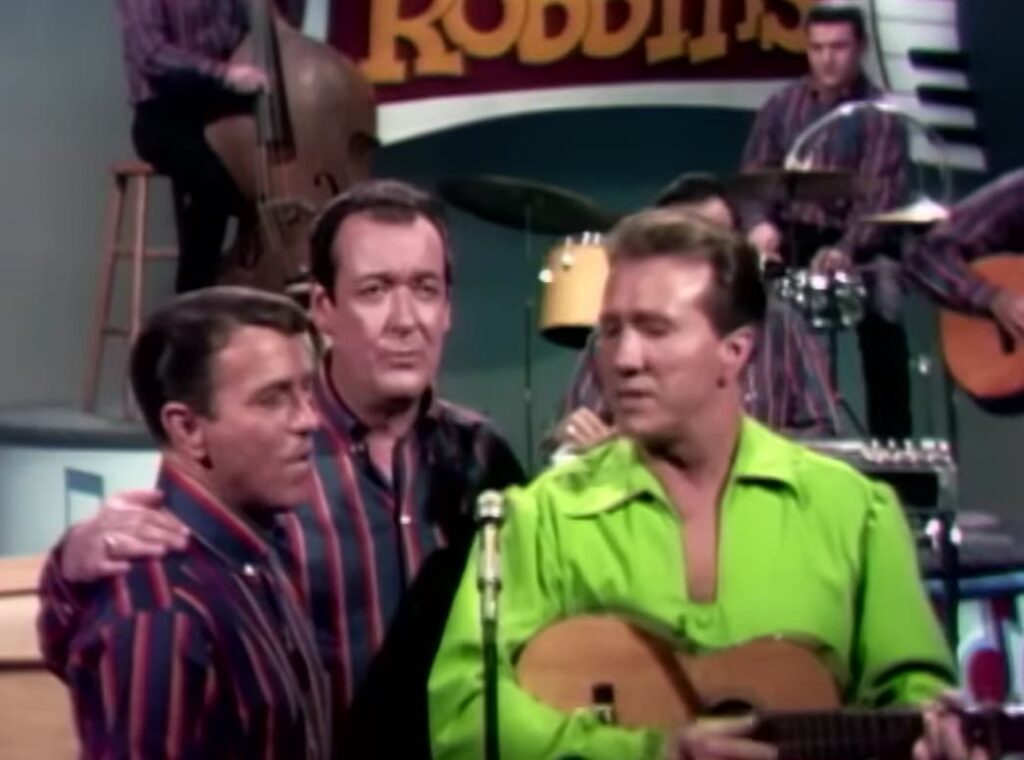
Marty Robbins – “Devil Woman” Live: A Classic Hit Comes Alive on Stage
“Devil Woman” is one of Marty Robbins’ most famous songs, showcasing a different side of the singer beyond classic Western ballads like “El Paso” and “Big Iron.” When performing this song live, Robbins didn’t need tales of cowboys or gunfights to captivate the audience. Relying solely on his signature voice and masterful storytelling, he transformed a perilous tale of romance into a performance brimming with character.
Released in 1962, “Devil Woman” quickly became an international success for Marty Robbins. The song was particularly popular in Australia, where it reached number one on the singles chart. This success further demonstrated Robbins’ appeal beyond the confines of country music; he had already cultivated a vast audience through his ability to blend country and pop with vivid, narrative-driven songwriting.
Marty Robbins and the Story Behind “Devil Woman” Unlike Western songs that often feature drifters wandering the desert, “Devil Woman” places Marty Robbins in a completely different kind of story. The protagonist is drawn into a romance that is as alluring as it is dangerous. The woman in the song is both captivating and terrifying; the man knows he is in trouble, yet he finds himself unable to break free.
That is precisely what makes the song so special. Robbins does not sing of a beautiful, perfect love; instead, he sings about human vulnerability in the face of an emotion that reason cannot control. Robbins’ vocal delivery is perfectly suited to this story. He does not need to shout to convey desperation. His smooth, calm, yet highly expressive tenor voice makes every line feel like the confession of a man who has realized he is trapped. “Devil Woman” in Live Performance
While the studio version offers a polished, accessible sound, live performances of “Devil Woman” truly showcase Marty Robbins’ command of the stage. He was not the type of artist who needed constant movement or exaggerated gestures to captivate an audience. His confidence was evident in his stance, his vocal delivery, and—above all—his ability to pace the song’s emotional arc. Marty could make a tale of a perilous romance feel intimate, and even a touch playful.
The music played a crucial role as well. A memorable melody allowed the song to instantly connect with listeners, while the performance retained a traditional country feel while possessing the broad appeal of a crossover hit. In one song, he might be a storyteller recounting tales of the American West; in the next, a man driven to desperation by a dangerous love affair. It was this ability to shift seamlessly between country, pop, ballads, and cinematic storytelling that established Robbins as one of the most versatile artists of his generation.