
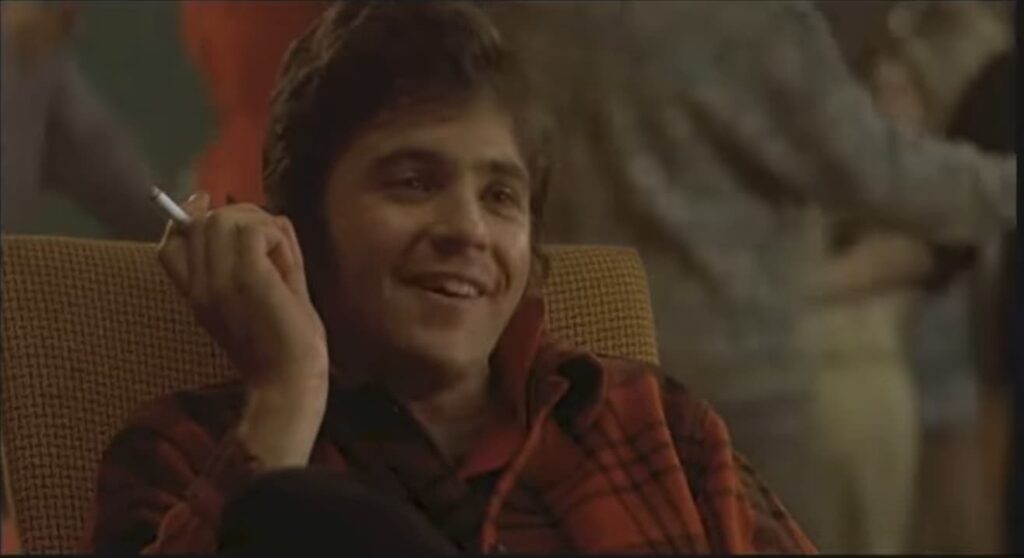
A coming-of-age story wrapped in music and longing, “That’ll Be The Day” captures the fragile moment when youthful dreams first collide with the reality of adulthood.
Released in 1973 alongside the British film of the same name, “That’ll Be The Day” occupies a unique place in the career of David Essex—not as a conventional chart single, but as part of a broader cultural moment that intertwined cinema, music, and memory. While the song itself was not issued as a major standalone hit and did not achieve notable chart positions, the film “That’ll Be The Day” became a critical and commercial success in the UK, helping to launch David Essex into mainstream recognition. It was, in many ways, the true beginning of his ascent—before the chart triumphs of “Rock On” (UK No. 3, US No. 5, 1974) and “Gonna Make You a Star” (UK No. 1, 1974) would define him as a pop figure.
Directed by Claude Whatham and written by Ray Connolly, the film is set in the late 1950s and early 1960s—a period when British youth culture was beginning to find its own voice. At the center of the story is Jim MacLaine, portrayed by David Essex, a restless young man raised by his single mother (played by Rosemary Leach), drifting through life with a quiet dissatisfaction he can neither fully understand nor escape. Alongside him appears Ringo Starr, whose presence adds an additional layer of authenticity to the film’s depiction of a changing musical landscape.
The title itself, “That’ll Be The Day”, inevitably echoes the 1957 hit by Buddy Holly, and this is no coincidence. The film—and by extension, its music—draws heavily on the early days of rock and roll, when artists like Holly symbolized a new kind of freedom. But in this context, the phrase takes on a more bittersweet meaning. It becomes less about youthful defiance and more about the quiet realization that not every dream will unfold as imagined.
What makes David Essex’s involvement in “That’ll Be The Day” so compelling is the way his performance blurs the line between character and persona. At this point in his career, he was not yet the polished pop star the world would soon come to know. There is a rawness here, an uncertainty that feels genuine. His portrayal of Jim MacLaine is not heroic, nor is it tragic in any grand sense—it is simply human. And that humanity is what gives both the film and its music their lasting resonance.
The success of the film led to its sequel, “Stardust” (1974), which continues Jim MacLaine’s journey into the world of music during the 1960s and 1970s. In many ways, the two films together form a kind of unofficial prelude to David Essex’s own rise in the music industry. Life and art seem to mirror each other, though never perfectly. The dreams depicted on screen are pursued, but not without cost.
Listening to the music associated with “That’ll Be The Day”, one is struck by its sense of atmosphere rather than its pursuit of chart success. It is less about individual songs and more about the mood they create—a world of dance halls, seaside towns, and late-night reflections. There is a certain stillness beneath the surface, as if everything is on the verge of changing but has not quite done so yet.
That sense of transition is perhaps the most enduring aspect of “That’ll Be The Day”. It captures a moment when youth begins to give way to experience, when the future feels both wide open and quietly uncertain. The optimism is still there, but it is tempered by something more reflective—a recognition that life rarely follows a straight path. Decades later, the film and its music remain a poignant reminder of that delicate balance between hope and reality. For David Essex, it was the starting point of a remarkable journey. For those who return to it now, it offers something deeper—a chance to revisit a time when everything seemed possible, even if not everything came to pass. And perhaps that is the true meaning of “That’ll Be The Day”—not a promise, but a question that lingers, long after the music fades.