
A humble patchwork of poverty and pride, where love becomes richer than anything money could ever buy
Few songs in the vast landscape of country music carry the quiet dignity and emotional clarity of Coat of Many Colors by Dolly Parton. First released in 1971 as the title track of her album Coat of Many Colors, the song reached No. 4 on the Billboard Hot Country Singles chart—a respectable achievement, though its true legacy would far surpass chart positions. Over time, it has come to be regarded not only as one of Parton’s most beloved recordings, but as one of the greatest country songs ever written, a deeply personal narrative woven from memory, hardship, and unwavering maternal love.
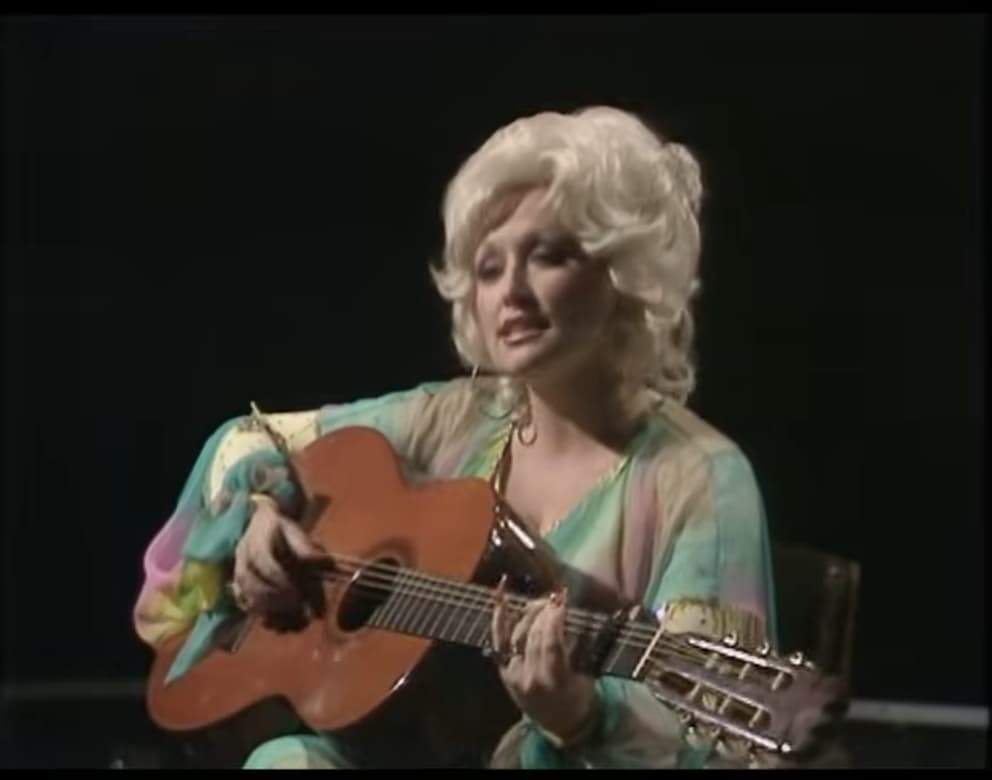
The 1979 performance on the BBC’s Parkinson show offers something rare and intimate—Dolly Parton alone, with her guitar and her story. There is no grand stagecraft, no elaborate arrangement. Instead, there is a quiet room, a listening audience, and a voice that carries both the innocence of childhood and the wisdom of reflection. In that setting, the song feels less like a performance and more like a confession gently shared.
The story behind “Coat of Many Colors” is rooted in Parton’s upbringing in rural Tennessee. As she often recounted, her family lived in deep poverty, and one winter, her mother stitched together a coat for her from a box of donated rags. As she sewed, she told young Dolly the biblical story of Joseph and his coat of many colors, imbuing the humble garment with a sense of pride and meaning. To a child, it became something magical—proof that love could transform even the simplest things into treasures.
Yet the outside world did not see it that way. When Dolly wore the coat to school, she was met with laughter and ridicule. It is in this moment that the song reveals its emotional core: the painful collision between innocence and reality. But rather than bitterness, the song offers something far more profound—a quiet resilience. “One is only poor only if they choose to be,” she sings, a line that has echoed through generations with both simplicity and depth.
In the 1979 Parkinson performance, there is a noticeable tenderness in Parton’s delivery. Her voice, clear and unadorned, carries the weight of lived experience. She does not rush the story; she allows each line to settle, as if inviting the listener to walk beside her through those childhood memories. The subtle shifts in her expression—at times warm, at times reflective—add layers to the narrative that no studio recording could fully capture.
Musically, the song remains rooted in traditional country and Appalachian folk influences. The melody is gentle, almost lullaby-like, reinforcing the sense that this is a story passed down, not just performed. There is a timelessness in its structure—no excess, no distraction—just a voice and a truth that feels universal.
What makes “Coat of Many Colors” endure is not merely its autobiographical nature, but its message. It speaks to the value of perspective, the quiet strength found in love, and the idea that dignity is not measured by wealth. In a world often preoccupied with appearances, the song reminds us of something far more enduring: the richness of the human spirit.
Watching Dolly Parton in that 1979 performance is like opening a window into another time—one where stories were told plainly, yet carried immense weight. It is a reminder that the most powerful songs are often the simplest ones, rooted in truth and delivered with sincerity.
Decades later, “Coat of Many Colors” remains a touchstone, not just in Parton’s career, but in the broader history of country music. It stands as a testament to her gift as a storyteller and as a keeper of memory. And perhaps, more than anything, it lingers because it feels real—like something remembered on a quiet evening, when the past returns not with regret, but with gratitude.