
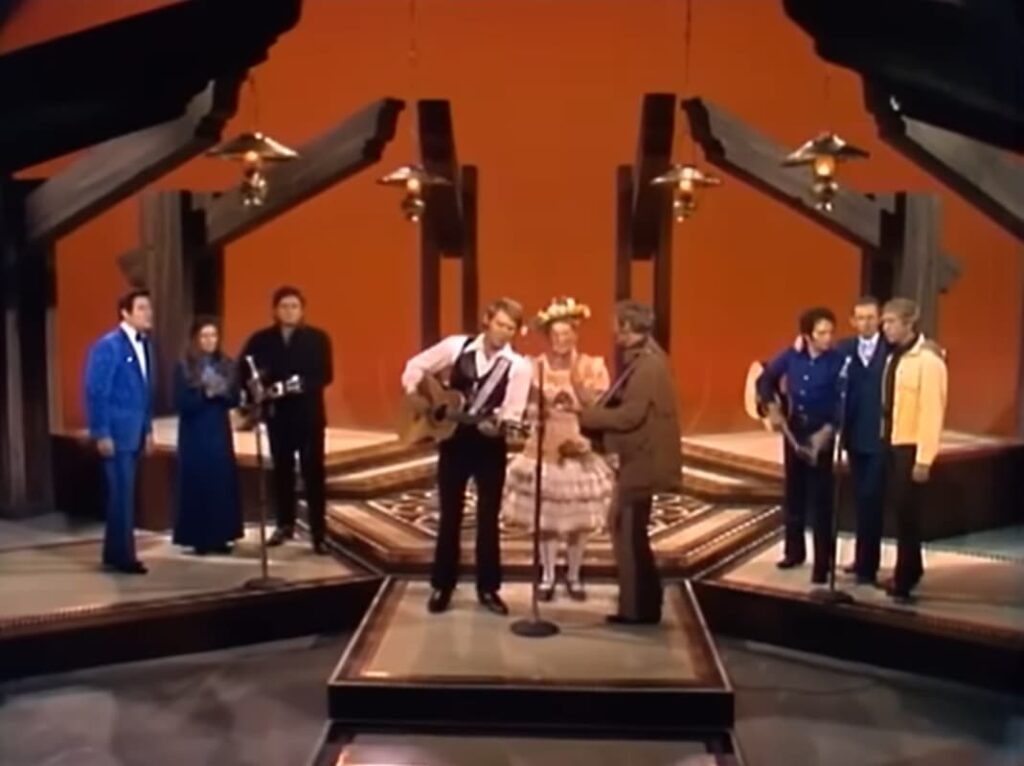
A rare gathering of voices, Glen Campbell, Merle Haggard, and Johnny Cash (Live 1972) captures a moment where friendship, artistry, and shared roots speak louder than any chart position.
There are performances that exist beyond the reach of rankings, beyond the neat columns of chart statistics—and the 1972 live appearance featuring Glen Campbell, Merle Haggard, and Johnny Cash belongs unmistakably to that realm. While no official single emerged from this collaboration to climb the Billboard charts, its significance lies elsewhere: in the convergence of three towering figures of country music at the height of their powers, sharing a stage not as competitors, but as companions bound by music and mutual respect.
By 1972, each of these artists had already carved an indelible mark. Johnny Cash, with his unmistakable baritone and moral gravitas, had redefined what it meant to be a country storyteller, scoring numerous No. 1 hits and earning widespread recognition through his television presence and live recordings such as At Folsom Prison. Merle Haggard, the poet of the working man, had built a catalog of deeply resonant songs—many of them chart-toppers on the country listings—capturing the struggles and quiet dignity of everyday life. And Glen Campbell, with his smooth voice and crossover appeal, had brought country music into mainstream consciousness, achieving success not only on country charts but also on the Billboard Hot 100 with songs like “Rhinestone Cowboy” (which would come a few years later, in 1975).
To witness these three figures together in a live 1972 setting is to step into a moment where the genre itself feels both rooted and expansive. The performance unfolds not as a formal concert, but almost as a conversation—one carried through song, glances, and the subtle interplay of voices that know each other’s language instinctively. There is an ease here, a sense that the stage is not a place of performance alone, but of gathering.
The musical selections, though varying depending on the specific setlist of the evening, reflect the shared vocabulary of classic country—songs of love, hardship, redemption, and memory. When Johnny Cash delivers a line, it carries the weight of conviction; when Merle Haggard follows, there is a grounded realism, a quiet acknowledgment of life’s complexities; and when Glen Campbell joins in, his voice adds a melodic clarity that lifts the entire moment. Together, they create something greater than the sum of their individual styles—a harmony not just of sound, but of perspective.
What makes this performance particularly compelling is its authenticity. There is no sense of spectacle for its own sake. The instrumentation remains traditional—acoustic guitars, subtle rhythm, perhaps a touch of steel—allowing the voices to remain at the forefront. In an era increasingly drawn toward production and polish, this simplicity feels almost sacred. It reminds us of a time when a song needed little more than truth and a voice willing to carry it.
Behind the scenes, the early 1970s were a period of both challenge and transformation within country music. The genre was expanding, reaching new audiences, while still holding tightly to its roots. Artists like Cash, Haggard, and Campbell stood at the crossroads of that evolution, each bringing something distinct, yet all grounded in a shared tradition. Their coming together on stage can be seen as a quiet affirmation of that tradition—a reminder that, even as music changes, its core remains human connection.
Listening now, decades removed from that 1972 moment, there is a profound sense of presence in the recording. One can almost hear the audience breathing between lines, feel the subtle shifts in tempo, the unspoken understanding between performers. It is not just a performance preserved—it is a moment lived again, each time the recording is revisited.
There is also a certain poignancy in knowing what time would bring. The years would carry each of these artists through further triumphs and trials, their voices aging, their perspectives deepening. Yet in this snapshot from 1972, they stand together in a kind of musical stillness—three voices, distinct yet united, sharing not only songs, but something far more enduring.
In the end, Glen Campbell, Merle Haggard, and Johnny Cash (Live 1972) is not defined by chart positions or commercial milestones. Its value lies in its sincerity, in the quiet camaraderie it reveals, and in the reminder that music, at its most powerful, is a shared experience. It is a gathering of voices that, even now, continue to echo—steady, familiar, and profoundly human.