
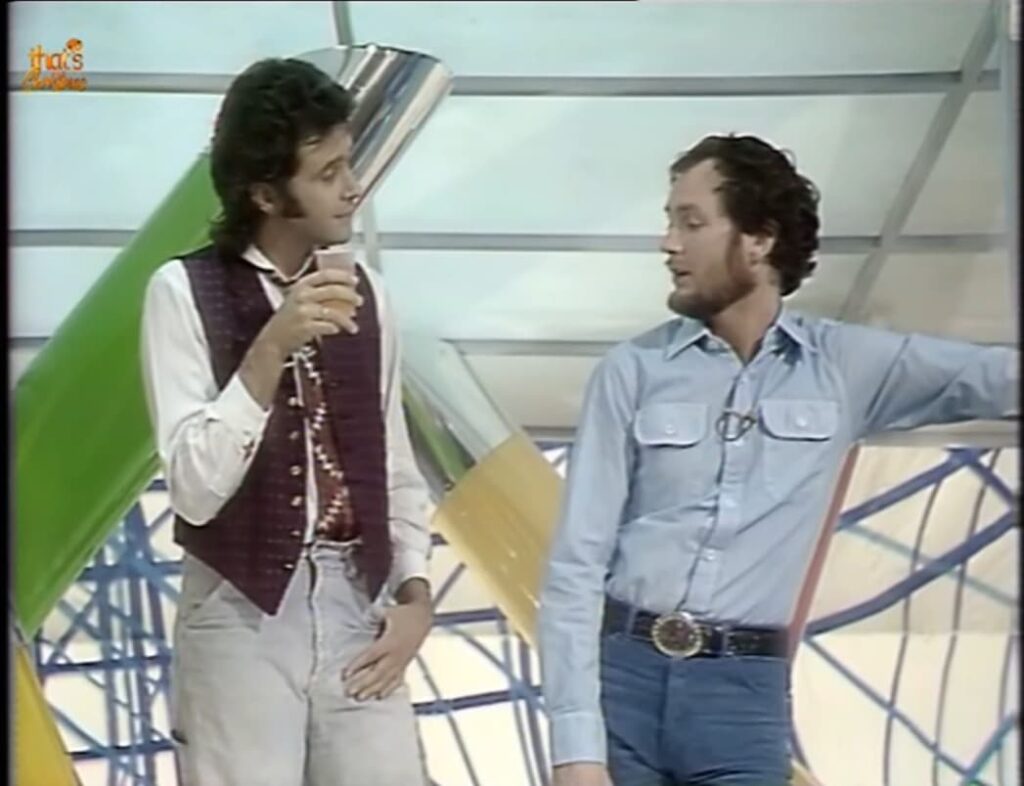
A quiet surrender to time and feeling, “Let It Flow” reveals a more reflective David Essex, where emotion is no longer resisted, but gently allowed to pass through like a fading memory.
By 1979, David Essex was no longer simply the striking young figure who had burst onto the scene with “Rock On” (UK No. 3, US No. 5, 1974) or the chart-topping warmth of “Hold Me Close” (UK No. 1, 1975). He had evolved—both musically and personally—into an artist more interested in mood and nuance than in immediate commercial impact. His appearance performing “Let It Flow” on “The Kenny Everett Video Show” (Season 2, Episode 6, broadcast on March 26, 1979) offers a revealing glimpse into this quieter, more introspective phase.
The song “Let It Flow”, though not released as a major chart single and therefore absent from official chart rankings, belongs to a period in Essex’s career where the emphasis shifted away from hit-making toward artistic expression. This was a time when British pop itself was undergoing subtle changes. The late 1970s, shaped by the aftershocks of glam rock and the emergence of new wave, created a space where artists like David Essex could explore a more personal sound—less flamboyant, more contemplative.
What makes this particular performance on “The Kenny Everett Video Show” so compelling is not merely the song itself, but the context in which it was delivered. The show, hosted by the irrepressible Kenny Everett, was known for its eccentric humor, rapid-fire sketches, and an almost surreal approach to entertainment. Within that lively, often chaotic framework, David Essex’s performance of “Let It Flow” feels almost like a pause—a moment where time slows, and something more inward is allowed to surface.
The song unfolds with a gentle, unhurried rhythm. There is no urgency in its arrangement, no attempt to overwhelm the listener. Instead, it leans into simplicity. The melody drifts rather than drives, and Essex’s voice—once associated with youthful urgency—now carries a softer, more measured tone. It is the voice of someone who has begun to understand that not everything in life can be controlled, and perhaps should not be.
Lyrically, “Let It Flow” speaks to acceptance. Not resignation, but a kind of quiet wisdom—the recognition that emotions, like time itself, cannot be forced into submission. They must be allowed to move, to change, to settle in their own way. This idea, though simple on the surface, resonates deeply. It reflects a shift from the restless ambition of youth toward something more reflective, more patient.
There is also an unspoken narrative behind this transformation. By 1979, David Essex had already experienced both the exhilaration of success and the pressures that come with it. The earlier years of his career were marked by rapid ascent, public attention, and the constant demand to maintain momentum. In “Let It Flow”, one senses a step back from that intensity—a willingness to let go of expectation and simply exist within the music.
Watching the performance on “The Kenny Everett Video Show”, there is a noticeable stillness in Essex’s presence. He does not perform with theatrical excess. Instead, he stands within the song, allowing it to unfold naturally. This restraint becomes its own form of expression—one that feels more enduring than any fleeting spectacle. In retrospect, “Let It Flow” may not be counted among the defining hits of David Essex’s career, but it reveals something perhaps more valuable: the artist behind the image. It shows a man willing to evolve, to soften, to embrace a quieter kind of truth. And in doing so, it offers a different kind of connection—one that does not rely on chart positions or commercial success.
Decades later, the performance remains quietly affecting. It captures a moment when music was not about proving anything, but about understanding something. The world around it may have been changing rapidly, but within those few minutes, there is a sense of calm—a reminder that sometimes, the most meaningful thing one can do is simply let things be. And so, “Let It Flow” endures—not as a hit, but as a feeling. A gentle, persistent reminder that not everything needs to be held tightly. Some things are meant to pass through us, leaving behind only the quiet knowledge that they were once there.