
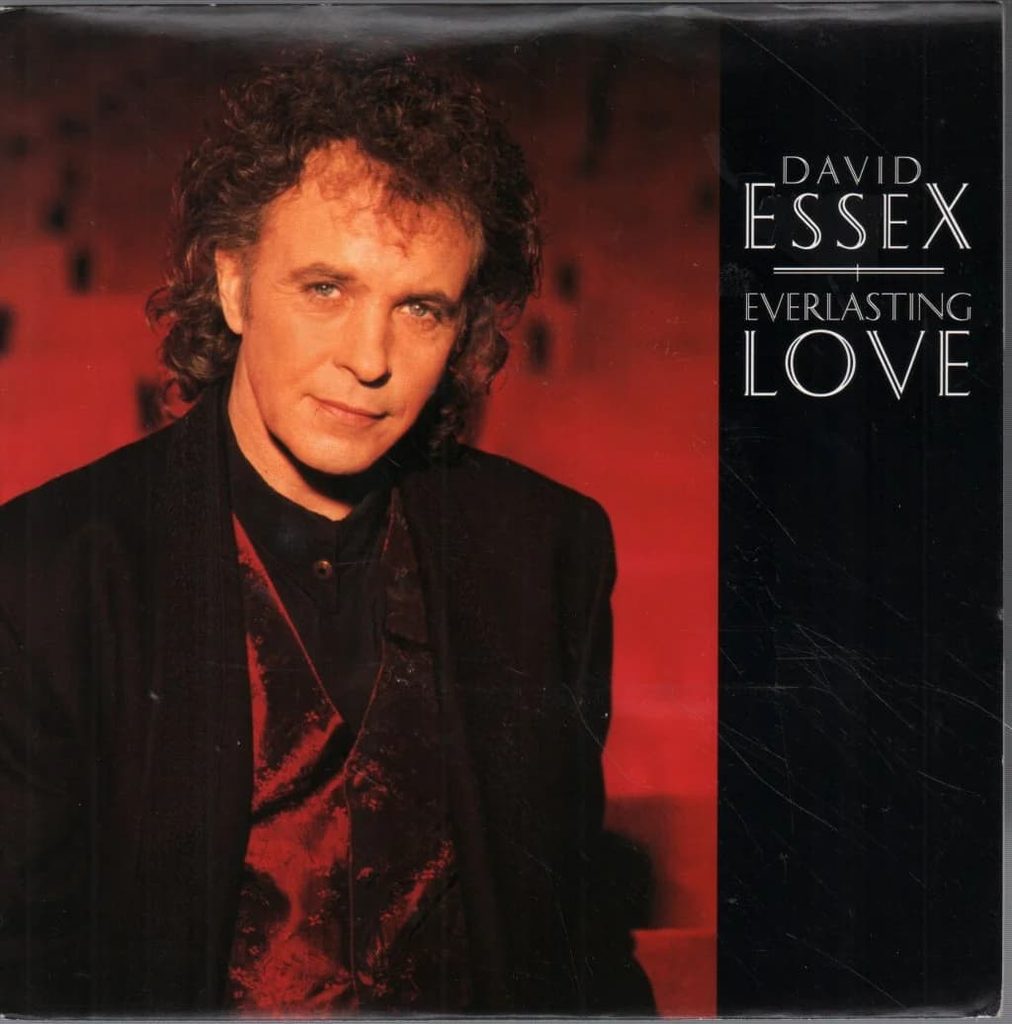
“Everlasting Love” gave David Essex a chance to revisit one of pop music’s most enduring promises, proving that a great song can travel through decades and still find a new voice to carry it forward.
When David Essex released his version of “Everlasting Love” in 1993, he was no longer the young star who had burst onto the British music scene twenty years earlier with “Rock On.” By then, Essex had already built an extraordinary career as a singer, songwriter, actor, and stage performer, scoring 19 UK Top 40 singles and two British No. 1 hits with “Gonna Make You a Star” in 1974 and “Hold Me Close” in 1975. His recording of “Everlasting Love” entered the UK Singles Chart in April 1993 and reached No. 80, making it a modest chart entry compared with the spectacular successes of his 1970s peak. Yet the song’s importance lies far beyond that position. It connected David Essex with one of the most remarkable compositions in the history of popular music, a song that had already survived more than a quarter of a century and had been reinvented by generation after generation.
“Everlasting Love” was originally written by Buzz Cason and Mac Gayden and first recorded by American singer Robert Knight in 1967. Knight’s original version reached No. 13 on the Billboard Hot 100 and No. 14 on the Billboard R&B chart, introducing a song built around one of popular music’s simplest and most powerful ideas: the hope that love might survive the passing of time. The song soon crossed the Atlantic, where British group Love Affair transformed it into a major success. Their version reached No. 1 on the UK Singles Chart in 1968, remaining at the top for two weeks and becoming the group’s biggest hit. By the time David Essex recorded it in 1993, “Everlasting Love” had already become something rare, a song that belonged not to one particular artist or decade, but to the wider memory of popular music.
That long history is what makes Essex’s interpretation particularly interesting. David Essex had always possessed a voice that carried personality before perfection. His greatest recordings were rarely about technical display. They depended on character, phrasing, and the feeling that he was singing directly to the listener rather than delivering a carefully polished performance. From the swagger of “Rock On” to the warmth of “Hold Me Close,” Essex understood how to make a song sound personal. When he approached “Everlasting Love,” he was not trying to erase the famous versions that had come before him. Instead, he brought the song into the world of a performer whose career had already travelled through glam rock, pop, film, theatre, and musical storytelling.
The meaning of “Everlasting Love” has always been remarkably straightforward, and perhaps that is one reason it has survived for so long. At its heart, the song is a promise. It speaks of a love strong enough to overcome separation, uncertainty, and the inevitable movement of time. There is nothing cynical about it. The song does not question whether lasting love is possible. It simply believes in it. In an age when popular music often celebrates heartbreak, disappointment, and relationships that burn brightly before disappearing, “Everlasting Love” offers something different: the hope that a person might find someone worth holding onto for a lifetime.
For David Essex, the song also arrived during an interesting period of his career. His major chart years had largely belonged to the 1970s and early 1980s, but Essex had never been an artist who depended entirely on the singles chart for his identity. He continued to work across music, theatre, and television, building a career that was broader than any single musical fashion. By 1993, he had already spent decades performing before audiences who had grown up with his music. A song about enduring love therefore carried a different emotional weight when sung by a man whose own career had already endured changing decades and musical revolutions.
The single may have reached only No. 80 in the UK, but chart positions do not always tell the full story of a recording. Sometimes a song’s value comes from the moment in an artist’s life when it is performed. “Everlasting Love” was not a desperate attempt by David Essex to recreate the glory of “Gonna Make You a Star” or “Hold Me Close.” It was part of the continuing journey of an artist who had already experienced fame, changing tastes, quieter years, and the remarkable challenge of remaining creatively active after the spotlight had moved elsewhere.
Listening to the song today, it is impossible not to think about the extraordinary life of the composition itself. “Everlasting Love” began with Robert Knight in 1967, became a British No. 1 with Love Affair, and continued to be rediscovered by artists across different decades. David Essex’s version became another chapter in that story. He was not the first singer to discover the song’s power, and he would not be the last.
Perhaps that is the secret hidden inside its title. Some songs become everlasting because the lyrics say they will. Others become everlasting because people keep returning to them. “Everlasting Love” has done both.
For David Essex, whose own career has always been filled with reinvention, the song was a natural meeting point between memory and the present. The record may not have climbed to the heights of his greatest hits, but it carried something those earlier successes could not possess: the weight of time. By 1993, the young man who had once sung “Rock On” was an established performer looking back across a career filled with unforgettable songs, films, stages, and audiences.
And perhaps that is why the promise inside “Everlasting Love” still feels so moving. Time changes the charts. It changes fashions, voices, and the faces on television. But every so often, a melody returns and reminds us that some feelings have never really gone away. David Essex added his own voice to that long journey, giving one of pop music’s most enduring songs another moment to live, another memory to hold, and another reason to believe that some songs truly do outlast the years.