
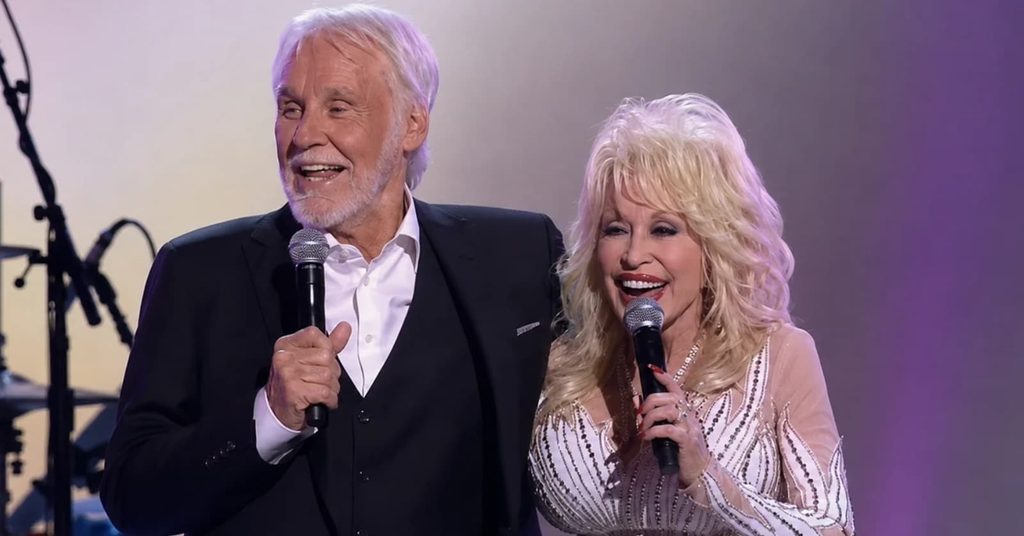
THE LAST TIME KENNY ROGERS AND DOLLY PARTON STOOD TOGETHER ON STAGE, A FORTY YEAR FRIENDSHIP ENDED WITH “ISLANDS IN THE STREAM”
On October 25, 2017, inside Bridgestone Arena in Nashville, Kenny Rogers and Dolly Parton walked onto the stage together for the final time. The occasion was All In for the Gambler: Kenny Rogers’ Farewell Concert Celebration, an all star event marking Rogers’ extraordinary career and his decision to retire from touring. What happened that night became far more than another appearance in a celebrated career. It became the final chapter of one of country music’s most beloved friendships. The two performed “You Can’t Make Old Friends,” Parton then sang “I Will Always Love You” directly to Rogers, and finally they returned together for “Islands in the Stream.” When the last notes faded, they took a final bow and left the stage together.
For a partnership that had lasted more than three decades, there was something almost perfectly circular about that final song. “Islands in the Stream”, written by Barry Gibb, Robin Gibb, and Maurice Gibb of the Bee Gees, had been released by Rogers and Parton in August 1983 as the first single from Rogers’ album Eyes That See in the Dark. The recording became an extraordinary crossover success, reaching No. 1 on the Billboard Hot 100, No. 1 on the country chart, and No. 1 on the Adult Contemporary chart. It was not merely a country duet. It was one of the defining pop recordings of the 1980s, and it transformed the professional relationship between two artists who had not known each other particularly well before the recording.
The story of how that partnership began is almost as interesting as the success that followed. When Rogers was preparing Eyes That See in the Dark, the material was largely written and produced by the Bee Gees and their collaborators. “Islands in the Stream” had originally been written with a different musical direction in mind. The Bee Gees had been working on the song for themselves, but it eventually became clear that Rogers could give it a different identity. The problem was that the recording needed a female voice.
Rogers had initially imagined another singer, but the collaboration eventually led him to Dolly Parton. Their first recording together created something neither artist could have completely predicted. Rogers had the deep, gravelly warmth of a voice shaped by years of country, pop, and folk music. Parton possessed a completely different vocal personality, bright and instantly recognizable, capable of sounding both playful and emotionally vulnerable within the same phrase.
Released in 1983, “Islands in the Stream” debuted at No. 48 on Billboard’s Hot Country Songs chart and climbed steadily to No. 1. On the Billboard Hot 100, it eventually reached the top position on the chart dated October 29, 1983, where it remained for two weeks. The song gave Rogers and Parton each another pop No. 1 and became one of the most successful country pop collaborations of its era.
But the record did something else that statistics cannot quite measure. It created a friendship. Kenny Rogers and Dolly Parton would go on to record together again, including the Christmas album Once Upon a Christmas in 1984 and the 1985 duet “Real Love.” Decades later, they reunited for “You Can’t Make Old Friends,” a song that seemed almost impossibly appropriate for two people whose friendship had survived changing fashions, changing careers, and the passing of time.
Released in 2013, “You Can’t Make Old Friends” became the title track of Rogers’ album of the same name. Written by Ryan Hanna King, Don Schlitz, and Caitlyn Smith, the song was released as a single and reached No. 57 on Billboard’s Country Airplay chart. It was also nominated for Best Country Duo/Group Performance at the 56th Annual Grammy Awards.
The title itself carries a weight that becomes difficult to ignore after October 2017. “You can’t make old friends.” There is something almost bittersweet in those words because an old friend is not simply someone who has been around for a long time. An old friend carries shared history. They remember earlier versions of us. They know the jokes, the failures, the triumphs, the ridiculous moments, and the difficult years that never appeared in the newspapers.
That was exactly what Rogers and Parton had become to one another. By the time they performed “You Can’t Make Old Friends” at Bridgestone Arena, their relationship had long since moved beyond the professional chemistry that first brought them together in 1983. Their public exchanges were often playful, sometimes mischievous, and frequently filled with the kind of teasing that only works when two people genuinely trust one another.
At the farewell concert, the two spoke together for approximately fifteen minutes, reminiscing and joking with the audience. Yet beneath the humor was something more serious. Parton became visibly emotional while speaking about Rogers and the place he held in her life. Rogers, meanwhile, was preparing to step away from the road after roughly six decades in entertainment. Then came “I Will Always Love You.”
For Parton, the song carried an especially complicated history. She had written it in 1973 as a farewell to Porter Wagoner, her longtime professional partner, when she decided to leave his television show and establish herself as a solo artist. She recorded it in 1973 and released it in 1974, and it became one of the most important songs of her career. At Rogers’ farewell concert, however, she was singing it for an entirely different reason. She performed “I Will Always Love You” directly to Kenny, turning the song into a personal expression of affection and farewell. Rogers sat and watched as his longtime friend sang one of the most famous songs she had ever written. The original meaning of the song had been about leaving someone while still loving and respecting them. In 2017, those words carried an entirely different kind of tenderness.
“Islands in the Stream.” The opening notes must have felt familiar before either singer had even said a word. More than thirty four years had passed since the original recording. Yet when Rogers and Parton stood together again, the chemistry remained remarkably natural. They knew exactly where the other voice would enter. They knew how to play with the phrasing. They knew when to smile, when to lean toward one another, and when simply to let the song carry the moment.
That familiarity is difficult to manufacture. The audience was not simply watching two stars perform a famous duet. They were watching two friends revisit the song that had introduced one of the most enduring musical partnerships in country pop history.
The significance of that final performance becomes even greater when viewed from the distance of time. Rogers died on March 20, 2020, at the age of 81. Parton would later remember him with enormous affection, describing the loss as leaving a piece of her heart with him. The 2017 performance therefore became the last surviving visual memory of them sharing a stage together. It was not designed as a memorial. Nobody knew that it would acquire that meaning. That is what makes the footage so affecting. There is no grand farewell speech between the two at the end of “Islands in the Stream.” Instead, they take their final bow together. The performance ends with a playful microphone drop, followed by an embrace as they disappear back into the lights.
The gesture is almost wonderfully characteristic of them. After all those years, they still knew how to make the audience smile. But underneath that final moment is something quieter. In 1983, “Islands in the Stream” sounded like the beginning of something. Two enormously successful singers discovering an unexpected chemistry and creating a record that would become a classic. In 2017, the same song sounded different. The melody had not changed, but the people singing it had lived another thirty four years. Their voices carried memory. The world around them had changed. The music business had changed. The technology had changed. Nashville had changed. They had changed. Yet the song remained.
And perhaps that is why the final performance of Kenny Rogers and Dolly Parton feels so much more moving than an ordinary farewell concert appearance. Their last shared stage was not built around sadness. It was built around gratitude, laughter, old stories, and one of the songs that had defined their friendship. The final image is therefore not really one of goodbye.It is two familiar voices meeting again in the middle of a song they had carried for decades, knowing exactly how to find each other when the music began. In that moment, “Islands in the Stream” was no longer simply a No. 1 hit from 1983. It had become a piece of shared history, preserved in one final performance before the lights went down.