
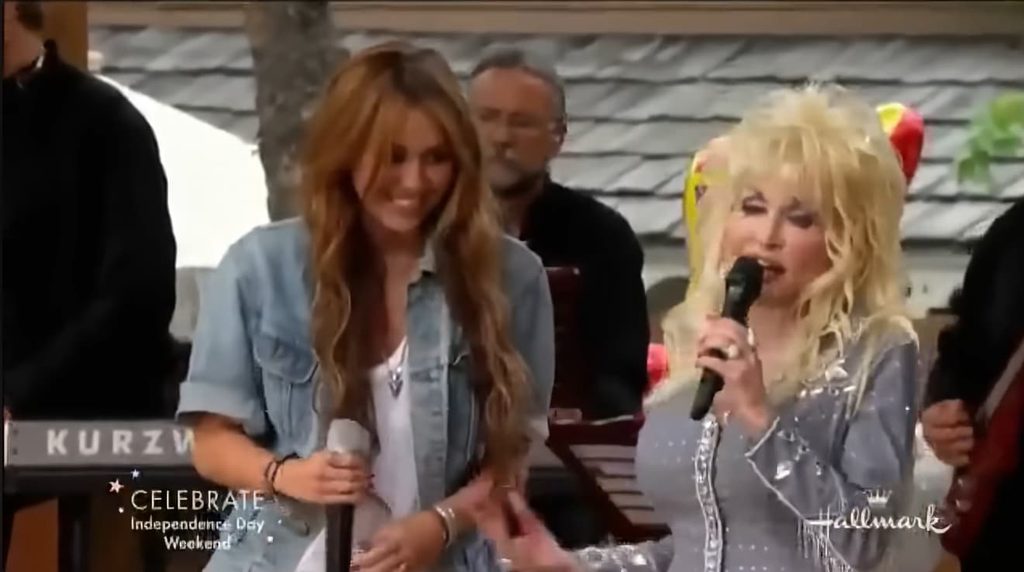
“Jolene” is a song about the fragile side of love, where jealousy, fear and devotion become one desperate plea, and in Miley Cyrus’s voice, Dolly Parton’s classic finds a new generation carrying the same old ache.
When Miley Cyrus sings “Jolene,” there is a particular tenderness in hearing her return to a song written by her godmother, Dolly Parton. It is more than a young singer covering an old country standard. It feels like one generation of a musical family reaching back toward another, with the younger voice discovering that some emotions never really become old. “Jolene” was originally written and recorded by Dolly Parton in 1973 and became one of the defining songs of her career. The single debuted at No. 98 on Billboard’s Hot Country Songs chart in November 1973 before climbing steadily to No. 1 in February 1974. It also reached No. 60 on the Billboard Hot 100 and later became a UK Top 10 hit, reaching No. 7 in 1976.
The history between Dolly Parton and Miley Cyrus makes their connection to this song especially meaningful. Dolly became Miley’s godmother after developing a close friendship with Miley’s father, Billy Ray Cyrus, in the early 1990s. She knew Miley from childhood and became a kind of musical aunt and mentor long before the younger singer became a global pop star. Dolly herself once described Miley as her “fairy godmother” relationship in the affectionate sense, while Billy Ray spoke of how valuable it was for his daughter to have someone like Dolly as a role model.
Their relationship eventually found its most natural language in music. In July 2010, when Miley was only 17, the two performed “Jolene” together at the 25th anniversary celebration of Dollywood. That performance was an early glimpse of how naturally their voices could meet. Miley already possessed the instinctive country phrasing inherited in part from growing up around her father’s music, while Dolly brought the lived experience and unmistakable vulnerability that had made the song famous in the first place. Their voices did not sound identical, and that was precisely what made the pairing interesting. One voice carried the wisdom of the songwriter; the other carried the urgency of someone discovering the song for herself.
Two years later, Miley returned to “Jolene” for her Backyard Sessions, a series of stripped down performances in which she sang favorite songs in a much more intimate setting. The “Jolene” performance was recorded in 2012 and released online on December 24, 2012. It was not a new studio single and therefore did not have a new Billboard chart debut under Miley’s name. That distinction is important. The chart history belongs to Dolly Parton’s original recording, while Miley’s version became famous primarily as a performance and video rather than as a conventional chart release.
What made Miley’s interpretation so striking was how little she needed to do. There was no elaborate pop production surrounding her. The arrangement allowed the melody and her voice to carry the emotional weight. At that point in her career, she was still widely associated with Hannah Montana and the Disney years, and the stripped down performance offered a different picture of the singer. Suddenly, the youthful pop star was standing inside one of country music’s most emotionally exposed songs, and she sounded remarkably comfortable there. Time later described the performance as a pivotal moment in which Cyrus demonstrated the depth of her voice beyond the image that had defined her early career.
Dolly Parton did not invent “Jolene” entirely from imagination. The emotional situation was inspired by a real incident involving her husband, Carl Dean, and a red haired bank teller who had developed a strong crush on him. Parton later explained that the situation was actually more playful and innocent than the anguish of the finished song suggests. Dean enjoyed the attention at the bank, and Dolly began joking about how frequently he seemed to need to visit. What began as a domestic joke became the emotional seed for one of the most recognizable songs in country music.
Parton once met a beautiful young girl who approached her for an autograph. The girl had striking red hair, fair skin and green eyes. When Parton asked her name, the child answered Jolene. Dolly immediately recognized the musical quality of the name and remembered it. She later combined that beautiful name and image with the story of the bank teller to create the fictional woman at the center of the song.
That small detail reveals much about Dolly Parton as a songwriter. She had an extraordinary ability to take ordinary experiences and turn them into stories that felt universal. A flirtation at a bank, a child’s unusual name, a moment of insecurity within a marriage: none of these things would necessarily seem like the beginning of a classic song. Yet Dolly transformed them into a three minute drama filled with fear, admiration and helplessness.
The genius of “Jolene” is that the narrator does not attack the other woman. She does not pretend to be stronger than she feels. Instead, she admits her fear. She looks at another woman and sees qualities she believes she herself lacks. That vulnerability is what makes the song so powerful. The narrator is not simply jealous. She is frightened because she knows that love can sometimes feel terribly fragile.
Musically, the song reinforces that feeling through simplicity. The repetitive guitar figure, the restrained country arrangement and the insistent rhythm create a sense of movement without overwhelming the vocal. The recording leaves enough space for Parton’s voice to sound almost conversational at times, as though she is telling someone a private story rather than performing for an audience. That economy is one reason the song has remained so adaptable across decades and genres. “Jolene” has subsequently been interpreted by artists as different as The White Stripes, Laura Marling, Miley Cyrus and Beyoncé, each finding something different inside Parton’s original story.
For Miley, however, the song carries an additional layer that other versions cannot quite possess. She is not simply another artist borrowing Dolly’s words. She is the songwriter’s goddaughter. She grew up knowing the woman who created the song, and she understood something about the person behind the voice. That relationship gives her performance an intimacy that is difficult to manufacture.
Their musical partnership continued long after the 2012 Backyard Sessions. Miley and Dolly performed “Jolene” together again on The Voice in 2016, with Pentatonix joining them, and their connection continued through other collaborations. Dolly later appeared on Miley’s 2017 album Younger Now on “Rainbowland,” while their relationship remained one of the most warmly recognized connections between two generations of American popular music.
Listening to Miley Cyrus and Dolly Parton’s “Jolene” today, the most moving quality is perhaps not the difference between their generations but what remains unchanged between them. The song still asks the same impossible question: what do you do when you love someone deeply enough to fear losing them?
That question does not belong to one decade or one style of music. It belongs to human nature. And perhaps that is why “Jolene” has endured for so long. Dolly Parton wrote it from a small, almost humorous incident in her married life, but she gave the song a much larger emotional life. Miley Cyrus later took those same words and revealed that their meaning had not disappeared with time. In her voice, the song became a bridge between eras, between country tradition and modern pop, between godmother and goddaughter. Some songs survive because they are famous. Others survive because people recognize themselves in them. “Jolene” belongs to the second kind. It reminds us that behind the glamour of music, behind the careers and the stage lights, there are still very ordinary human feelings: love, insecurity, admiration, fear and the quiet hope that the person we love will choose to stay.