
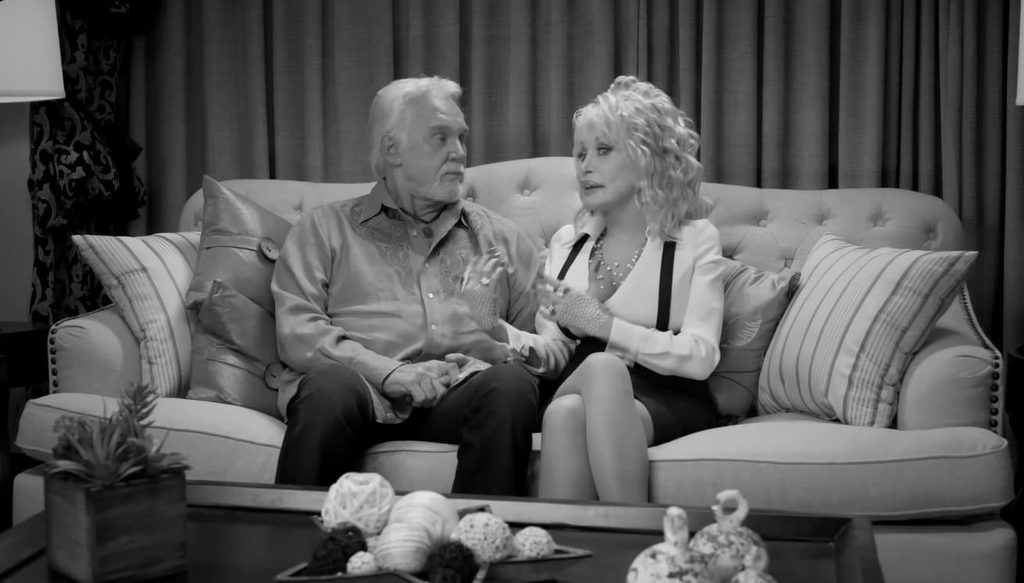
“You Can’t Make Old Friends” is a tender meditation on a friendship shaped by decades of shared memories, reminding us that some bonds become so deeply woven into our lives that no new friendship can truly replace them.
Released as a digital single on September 3, 2013, “You Can’t Make Old Friends” brought Kenny Rogers and Dolly Parton together for one of the most poignant recordings of their long musical relationship. The song was later sent to country radio on November 4, 2013, and reached No. 57 on Billboard’s Country Airplay chart. It also climbed to No. 28 on Billboard’s Digital Song Sales chart. More importantly, the song arrived at a remarkable point in Rogers’ career. His album You Can’t Make Old Friends was released on October 8, 2013, the same year he was inducted into the Country Music Hall of Fame and received the CMA Willie Nelson Lifetime Achievement Award.
There was something almost destined about bringing these two voices together for this particular song. Kenny Rogers and Dolly Parton had already spent decades creating one of country music’s most beloved partnerships. Their greatest shared success, of course, was “Islands in the Stream,” the 1983 duet that became a No. 1 hit on both the Billboard Hot 100 and the country chart. They later recorded “Once Upon a Christmas” together in 1984 and reunited for “Real Love,” which reached No. 1 on Billboard’s country chart in 1985. By the time “You Can’t Make Old Friends” appeared in 2013, nearly three decades had passed since their previous major studio duet.
Yet this was not simply a reunion designed to recreate the magic of “Islands in the Stream.” Something much more personal was happening. The new song was written specifically with Rogers and Parton in mind by Don Schlitz, Caitlyn Smith and Ryan Hanna King. Schlitz was already one of Nashville’s most respected songwriters, best known for writing “The Gambler,” the signature song that had become inseparable from Rogers’ identity. The story of how the song came together is particularly touching. Rogers had encountered Ryan King, who told him about visiting Rogers’ farm in Georgia as a child. King finished his recollection with the phrase that would become the title: you can’t make old friends. Rogers immediately recognized the emotional weight of those words and passed the idea to Schlitz, who wrote the song almost immediately.
That origin gives the song a quality that cannot be manufactured by a record company. It began with a memory. And memory is really the heart of “You Can’t Make Old Friends.” The song asks an unusually difficult question: what happens when someone who has been beside you for so many years is no longer there? The opening thought is already unsettling. It is not about losing an acquaintance or saying goodbye after a brief chapter of life. It is about losing the person who has known your history, your mistakes, your triumphs and the stories you no longer have to explain.
That is why the song feels so different from the glamorous duets Rogers and Parton had recorded earlier. “Islands in the Stream” was youthful, romantic and irresistibly polished. “Real Love” carried the warmth of two performers who understood how beautifully their voices could blend. But “You Can’t Make Old Friends” looks backward. It is concerned with time itself.
There is a quiet sadness in that perspective.
By 2013, Kenny Rogers was 75, and he had lived through more than half a century of popular music. His career had crossed country, pop, rock, gospel and adult contemporary music. He had been a member of The First Edition, achieved enormous solo success, appeared in films and television, and become one of the most recognizable voices in American music. Dolly Parton, meanwhile, had established herself as one of country music’s greatest songwriters and performers. They were no longer young artists wondering what the future might hold. They were looking back at everything they had already experienced.
Rogers’ familiar, weathered baritone does not try to hide the passage of time. There is a softness in his delivery, a slight grain around the edges that makes the words feel lived in. Parton’s voice, with its unmistakable brightness and emotional precision, answers him almost like a conversation between two people who already know what the other is thinking. The arrangement wisely avoids excessive production. The song needs room to breathe. It is the history between the voices that provides the drama.
Parton herself understood immediately what the song meant. She said the recording made her emotional because the lyrics seemed to summarize the relationship she and Rogers shared, while also extending beyond their friendship to friendships of every kind. Rogers likewise described the song as being written for the two of them and acknowledged how poignant it was because it asked what one would do when the other was gone.
When people have known each other for decades, friendship becomes more than companionship. It becomes a form of memory. An old friend remembers versions of you that nobody else remembers. They know the person you were before success, before disappointment, before age changed the shape of everyday life. They remember the jokes, the difficult years, the celebrations, the people who came and went. A new friendship may be wonderful, but it begins without that shared history.
You can make new friends. You can meet extraordinary people at any stage of life. But you cannot manufacture decades of shared experience. Time has to do that work for you. This is also why the song became especially moving in retrospect. Rogers and Parton performed it together at the All in for the Gambler: Kenny Rogers’ Farewell Concert Celebration in Nashville in October 2017, an event that marked the end of Rogers’ touring career. Their performance of “You Can’t Make Old Friends” proved to be their final performance together.
Knowing what happened afterward inevitably changes the way the recording is heard. Kenny Rogers died on March 20, 2020, aged 81. Parton’s tribute the following day revealed just how deeply their friendship had mattered to her. She spoke not simply of losing a celebrated musical partner, but of losing a true friend. That is when “You Can’t Make Old Friends” stops feeling like merely a nostalgic country ballad and becomes something closer to a farewell that neither singer could have fully understood when they recorded it.
There is a strange quality to certain songs: they acquire new meanings as life moves forward. A song recorded in 2013 can sound completely different after 2020. The words remain the same, the melody remains the same, but experience changes the listener. What once sounded like a thoughtful reflection on friendship can later sound like a goodbye. And perhaps that is why this particular duet has endured so strongly.
Kenny Rogers and Dolly Parton did not need “Islands in the Stream” again. They had already given the world that moment. With “You Can’t Make Old Friends,” they gave us something quieter and, in some ways, more valuable: a musical portrait of two people who had traveled through decades of life together and understood that their friendship itself was the story. There is no grand romantic ending here. No dramatic declaration. Only gratitude for the years already lived and an awareness that time eventually asks everyone to say goodbye. The beauty of “You Can’t Make Old Friends” lies precisely in that restraint. It does not try to defeat time. It accepts that time is what made the friendship precious in the first place.
And when Rogers and Parton sing together, their voices seem to carry all those years between them. You hear the warmth of “Islands in the Stream,” the laughter of old performances, the familiarity of two musicians who no longer need to prove anything, and beneath it all, the quiet knowledge that some friendships become part of who we are. Some songs remind us of a love we once had. Some remind us of a place we can no longer return to. “You Can’t Make Old Friends” reminds us of something perhaps even more fragile: the people who were there when our memories were being made. And once those years are gone, you may find new companions, new stories and new songs. But you cannot make old friends.