
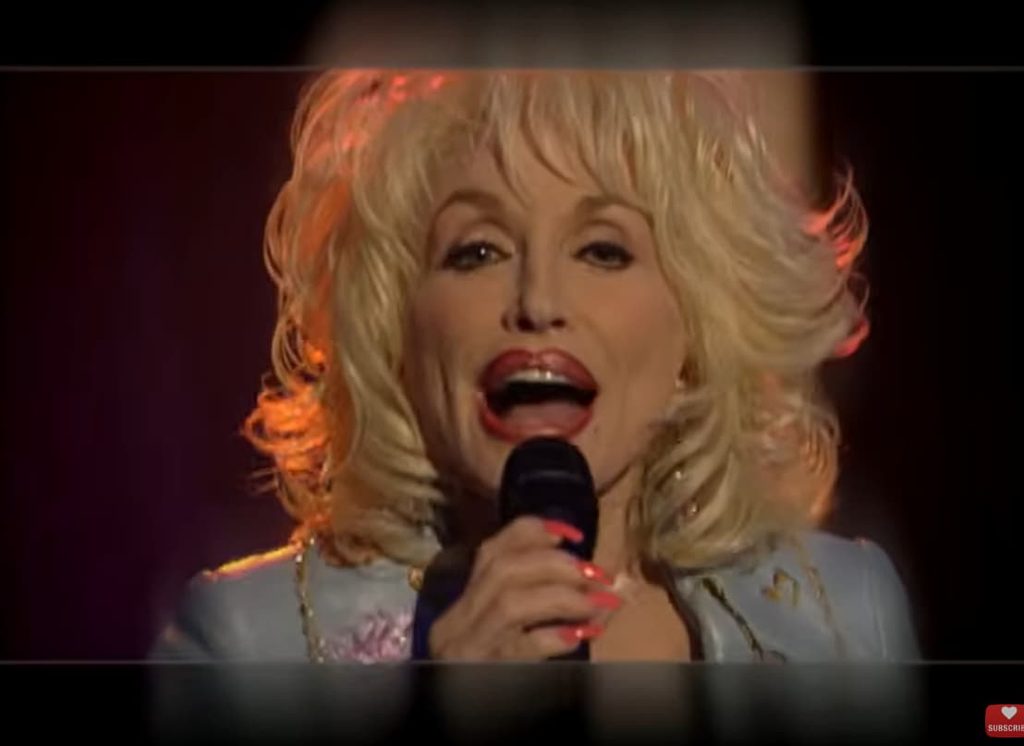
Dolly Parton turned Bread’s delicate classic “If” into something entirely her own, proving that a truly great love song can change its clothes without losing its heart.
When Dolly Parton recorded “If” for her 2002 album Halos & Horns, she chose a song that had already become one of the most beloved romantic ballads of the early 1970s. Written by David Gates and originally recorded by his group Bread, “If” had been a major American hit in 1971, reaching No. 4 on the Billboard Hot 100. More than thirty years later, Dolly approached the song from a completely different musical direction. Instead of preserving its soft rock atmosphere, she transformed it into an uplifting bluegrass inspired performance, driven by acoustic instruments and the unmistakable brightness of her voice.
Released as the second UK single from Halos & Horns on October 7, 2002, Dolly’s version reached No. 73 on the UK Singles Chart, entering and peaking there on October 19. It was not a major chart success, but the recording was never really about chasing a hit. By 2002, Dolly had entered one of the most creatively satisfying periods of her later career, returning to the acoustic sounds of her Appalachian roots through a remarkable trilogy of albums: The Grass Is Blue, Little Sparrow, and finally Halos & Horns. The latter album was released on July 9, 2002, and featured twelve songs written by Dolly herself alongside two famous covers: “If” and Led Zeppelin’s “Stairway to Heaven.”
What makes Dolly’s interpretation of “If” so interesting is that she deliberately refused to copy the original. She loved Bread’s music, but she recognised that the song could live in another musical world. Dolly explained that she and her musicians gave it a more upbeat bluegrass feeling, believing that a genuinely strong song should be able to survive different arrangements and styles. Her version features banjo, dobro, mandolin, fiddle, bass fiddle, guitars, and drums, replacing the gentle soft rock atmosphere of the original with the sound of musicians playing together in a much more organic setting.
The lyrics of “If” remain one of the simplest declarations of devotion ever written. The song imagines love through a series of impossible comparisons, searching for language large enough to describe an emotion that cannot easily be measured. David Gates wrote the song with extraordinary tenderness, but Dolly’s voice changes its emotional colour. Where the original feels intimate and almost fragile, her interpretation brings warmth, optimism, and a touch of mountain music. She does not sing the song as though she is afraid love might disappear. She sings it with the confidence of someone celebrating the miracle of having found it.
That spirit suited the world of Halos & Horns perfectly. Dolly produced the album herself and recorded it with musicians who were closely connected to her touring world, rather than building the record around an army of famous session players. She described the process as relaxed and almost spontaneous, allowing the musicians to contribute ideas naturally. The result was an album that felt less polished in the commercial sense but more alive emotionally. “If” became one of its most surprising moments because listeners familiar with the Bread original suddenly heard a song they thought they knew travelling down an entirely different road.
Her performance of “If” during this period also reflected a broader artistic revival. Dolly had spent much of the previous decade away from the demanding routine of major touring, but the Halos & Horns Tour in 2002 brought her back to the road for her first major concert tour in ten years. The shows were deliberately simpler than the large productions of her earlier career, focusing on bluegrass, folk, country music, storytelling, and the sound of live instruments. It was a return not only to touring but to a musical identity that had always been part of her, long before Hollywood films, crossover hits, and international superstardom.
Looking back, “If” may not stand beside “Jolene,” “Coat of Many Colors,” “I Will Always Love You,” or “9 to 5” as one of Dolly Parton’s defining signature songs. Yet that is precisely why it remains so interesting. It reveals her instinct as an interpreter and her lifelong curiosity about music. She heard a famous soft rock ballad and imagined banjos. She heard David Gates’ quiet melody and discovered a bluegrass rhythm inside it.
That is the beauty of Dolly Parton’s “If.” The song reminds us that great music does not belong to one decade, one arrangement, or even one voice. Sometimes all it takes is an artist with enough imagination to hear an old melody differently and enough confidence to let it become something new. In Dolly’s hands, “If” did not simply return as a cover. It found another life, another landscape, and another voice capable of making an old promise of love feel wonderfully alive once again.