
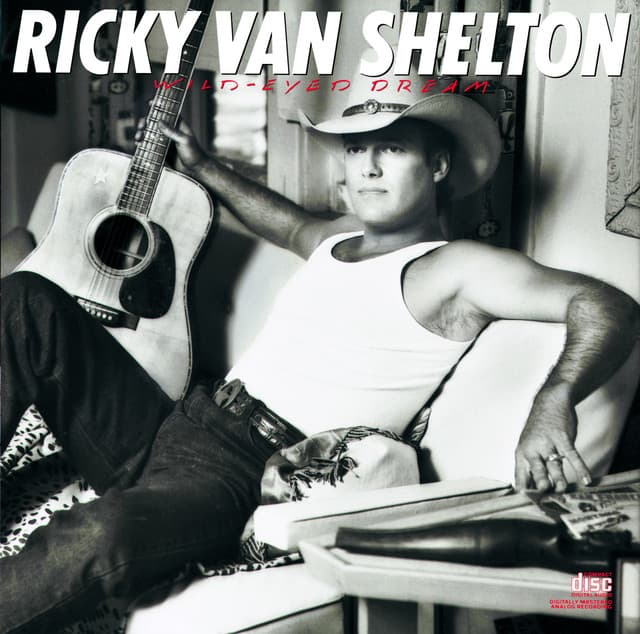
“Life Turned Her That Way” became one of Ricky Van Shelton’s defining recordings, a song of compassion that asks us not to judge a wounded heart without understanding the road that brought it there.
When Ricky Van Shelton released “Life Turned Her That Way” in late 1987, he was still a remarkably new voice in mainstream country music. Yet within a few months, the song would become his second No. 1 hit on Billboard’s Hot Country Singles chart, reaching the top for one week on March 19, 1988. It also reached No. 1 on Canada’s RPM Country Tracks chart. The song came from Shelton’s debut album, Wild-Eyed Dream, and its success helped confirm that the young Virginia singer was becoming one of the leading voices of the late 1980s country revival.
But the story of “Life Turned Her That Way” began long before Ricky Van Shelton stepped into a recording studio. The song was written by the legendary Harlan Howard, one of country music’s greatest songwriters, and was first recorded by Little Jimmy Dickens in 1965. Its most successful early version came from Mel Tillis, whose 1967 recording reached No. 11 on Billboard’s Hot Country chart. Over the years, the song attracted the attention of artists including George Jones, Charley Pride, Ernest Tubb, Conway Twitty, and others. Yet it was Ricky Van Shelton who finally carried the song all the way to No. 1.
The reason lies partly in the song itself. “Life Turned Her That Way” is not a conventional heartbreak song. The narrator is not angry with the woman he loves, even though she has become distant and difficult to understand. Instead, he asks the listener to look beyond her behaviour and consider what she may have endured. The song’s central message is one of compassion: perhaps she was not always this way. Perhaps life itself changed her.
That idea gives the song a quiet emotional power. Country music has often told stories about people who drink too much, leave too soon, love the wrong person, or make choices they later regret. But Harlan Howard did something more thoughtful here. He removed the instinct to judge. The woman at the centre of the song is not condemned. She is understood.
Ricky Van Shelton had the perfect voice for that kind of material. His rich, deep baritone carried the influence of traditional country music, particularly the sounds associated with George Jones, Merle Haggard, and the classic singers who had come before him. Yet Shelton never sounded like a museum piece. In the late 1980s, when country music was welcoming a new generation of artists while rediscovering its traditional roots, his voice felt both familiar and fresh.
His recording of “Life Turned Her That Way” was produced by Steve Buckingham, who helped shape Shelton’s early sound. Rather than overwhelming the song with elaborate production, the arrangement allowed the melody and Shelton’s voice to remain at the centre. He sings with restraint, and that restraint makes the performance more moving. There is no unnecessary drama. Shelton does not force the sadness of the song. He simply lets the words unfold.
The success of the single was also an important step in his remarkable rise. Shelton’s debut album Wild-Eyed Dream had already produced the No. 1 hit “Somebody Lied.” After “Life Turned Her That Way” reached No. 1, the next single, “Don’t We All Have the Right,” would also top the country chart. Suddenly, Ricky Van Shelton was no longer simply a promising newcomer. He had become one of country music’s most successful new stars.
Yet “Life Turned Her That Way” remains particularly special because it revealed something important about Shelton’s musical instincts. He understood the value of an older song. Wild-Eyed Dream included several songs that had already been recorded by earlier country artists, including Merle Haggard’s “Working Man’s Blues.” Shelton belonged to a generation of performers who could look back at the great country songbook without simply copying it. He knew that an old song could become new again when placed in the right voice.
Looking back now, the title itself carries a wisdom that becomes more powerful with time. Life turned her that way. Four simple words explain so much. People are shaped by disappointment, love, loss, betrayal, loneliness, and experiences that remain invisible to everyone else. We often see what a person has become without knowing what they have survived.
That is the quiet greatness of “Life Turned Her That Way.” Ricky Van Shelton did not need to turn it into a dramatic spectacle. The song already contained its own truth. In his voice, it became one of the defining country recordings of 1988 and one of the songs that helped establish him as a major star.
For a few minutes, the song asks us to stop judging and start wondering what happened before we arrived. And in country music, few questions have ever been asked with more tenderness.