
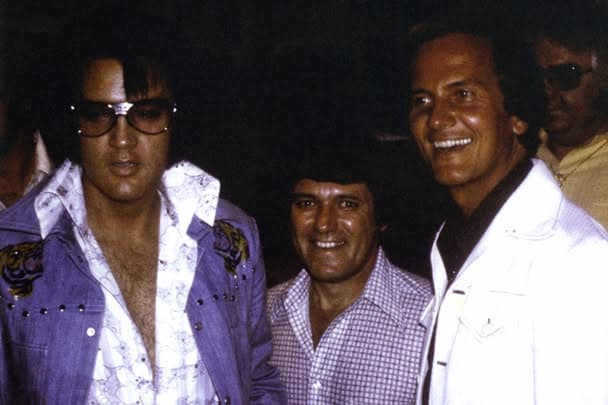
When Pat Boone Outpaced Elvis: NME’s Surprise Poll Reflects the 1957 Music Landscape
It sounds almost impossible now, but on October 4, 1957, a British music poll placed Pat Boone ahead of Elvis Presley at the height of the rock ’n’ roll explosion. The annual NME Readers’ Poll named Boone the World’s Outstanding Popular Singer, while Elvis was placed second in that category. For a moment, the man whose name would soon become permanently attached to the title “King of Rock ’n’ Roll” was not the favorite singer in the eyes of NME readers. Yet the result becomes even more fascinating when the complete list is examined. Elvis was still recognized as the World’s Outstanding Musical Personality, showing that his enormous cultural impact was already undeniable even while Boone had the edge in the singer category. It was a perfect snapshot of 1957, when popular music was changing faster than anyone could quite understand.
Pat Boone was hardly an outsider who had somehow wandered into Elvis’s territory. At just 23, he was already one of the biggest recording stars in America. His clean cut appearance, polished voice and carefully presented image gave him extraordinary mainstream appeal, while songs such as “Love Letters in the Sand” and “Don’t Forbid Me” had made him a dominant presence on the charts. In fact, 1957 was an enormous year for Boone. “Love Letters in the Sand” became one of his signature records, and his popularity extended well beyond teenagers. He could appeal to parents as easily as young listeners, making him a fascinating counterpart to Elvis, whose performances were generating both excitement and controversy. The NME result therefore reflected two different visions of what a young American male star could represent.
Elvis, meanwhile, was in the middle of one of the most extraordinary years of his career. “All Shook Up” had dominated the American charts, “Jailhouse Rock” was released in September, and his first major Hollywood successes had turned him into something much larger than a recording artist. In Britain, his music was equally powerful. The 1957 NME records show just how significant his presence had become, and the poll’s decision to name him World’s Outstanding Musical Personality confirmed that readers recognized something about Elvis that went beyond singing alone. His voice, movements, appearance, records, films and public image were all becoming part of a new kind of celebrity.
The contrast between the two men is what makes the result so fascinating today. Boone represented polish, romance and accessibility, while Elvis represented rebellion, physical energy and the rapidly changing sound of rock ’n’ roll. Yet the two were not simply enemies competing for the same audience. Their careers actually crossed paths. Boone later recalled meeting Elvis before either had reached the level of fame they would soon achieve. According to Boone’s recollection, the encounter took place before “Heartbreak Hotel” had made Elvis a national star. Boone watched the young performer walk onto a stage and immediately command the teenagers in the room. Boone then had to follow him. It was an early glimpse of the phenomenon Elvis was about to become.
And there was an intriguing musical irony to their competition. Both men were capable of taking songs from other musical traditions and bringing them to enormous mainstream audiences. Boone had major success with material rooted in rhythm and blues, often presenting it in a smoother pop style. Elvis did something almost opposite, taking blues, country and rhythm and blues influences and fusing them into a sound that felt dangerous and new to many listeners. Their records therefore existed within the same rapidly expanding marketplace, but they spoke to different ideas of what popular music could be. In 1957, there was room for both.
The rest of the NME poll makes the picture even more revealing. The King Brothers and The Stargazers were the top two British vocal groups, while The Platters were named the World’s Outstanding Vocal Group. Doris Day won Favourite American Female Singer, Alma Cogan was Favourite British Female Singer, and Tommy Steele was named British Musical Personality. These choices reveal a musical world that was much broader than the simplified story we sometimes tell today about 1957 being the year Elvis conquered everything. Rock ’n’ roll was exploding, but traditional pop, vocal groups, skiffle and established entertainers were still enormously important to British listeners.
That is why October 4, 1957 deserves to be remembered. It was not really the day Elvis Presley was defeated. It was the day a changing musical world briefly placed Pat Boone at the top of one of Britain’s most influential popularity polls while giving Elvis another distinction that perhaps mattered even more in the long run. Boone had the title of World’s Outstanding Popular Singer. Elvis had World’s Outstanding Musical Personality. Within a few years, history would make the difference between those two titles look enormous. But on that particular day, the polished young singer from Nashville had something the rebellious young man from Memphis did not: first place in the NME’s singer poll. And for one fascinating moment in 1957, Pat Boone was standing just ahead of Elvis Presley.