
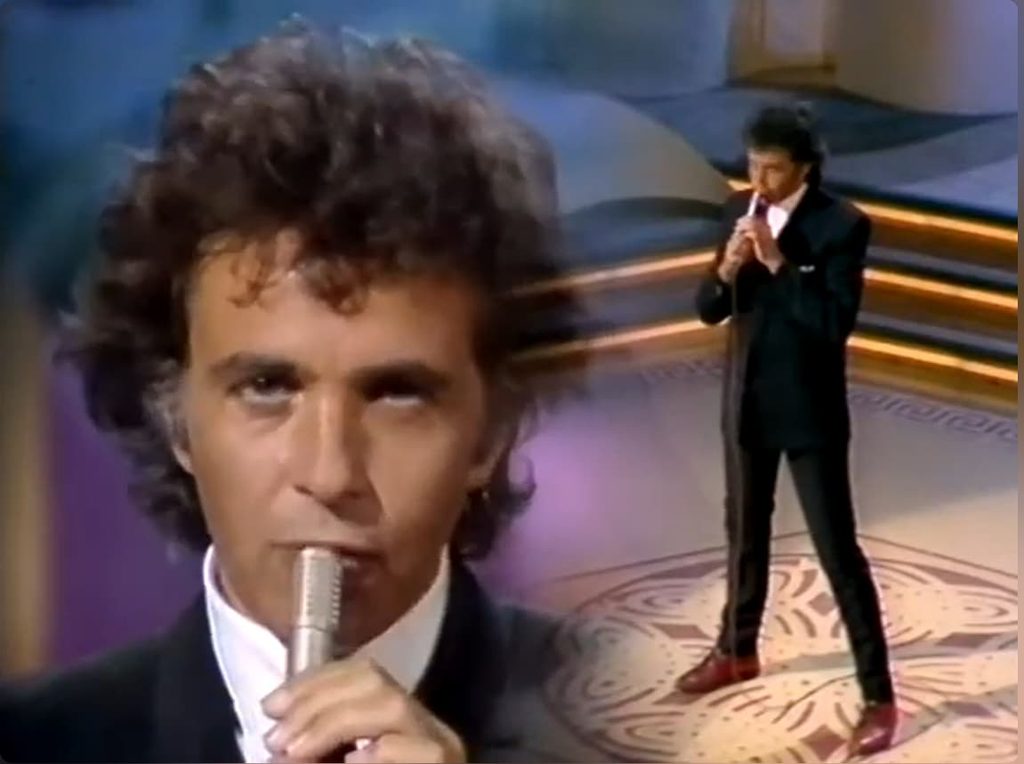
A Beautiful Television Moment That Captured David Essex Between The Romance Of A Winter’s Tale And The Quiet Intimacy Of The Smile
On 4 June 1983, David Essex appeared on The Val Doonican Music Show, bringing two very different songs from his recent career to one of Britain’s most familiar television stages: “The Smile” and “A Winter’s Tale.” The appearance came at an interesting point in Essex’s career. His enormous success of the 1970s was already part of British popular music history, yet he was continuing to evolve rather than simply recreate the sound that had made him famous. Television remained an important part of that journey, allowing audiences to see not only the records but the performer behind them. Contemporary television listings confirm Essex’s appearance on the programme in this period, while his official website still receives messages from fans specifically recalling his performance of “The Smile” on the Val Doonican show around June 1983.
“A Winter’s Tale” already carried a remarkable history by the time Essex performed it for Val Doonican’s audience. Released in December 1982, the song became one of his most successful later singles, reaching No. 2 on the UK Singles Chart in January 1983. Written by Mike Batt, with lyrics by Tim Rice, it presented Essex in a softer and more mature setting than some of the dramatic pop records that had defined his earlier career. Its winter imagery, romantic atmosphere and gentle arrangement gave him another song that could live comfortably on television, where expression and presence mattered as much as the recording itself. Contemporary television records show that Essex was heavily associated with the song throughout this period, including a Top of the Pops appearance in December 1982.
Then there was “The Smile,” a song that revealed a more intimate side of Essex. Written and produced by Mike Batt, it was released in May 1983 and followed the success of A Winter’s Tale. Rather than relying on the grand romantic sweep of his earlier hits, “The Smile” is quieter and more personal, built around the small but powerful moment of noticing someone across a crowded room and being affected by a simple smile. It reached No. 52 on the UK Singles Chart, spending six weeks on the chart. In retrospect, its modest chart performance almost disguises how distinctive the recording is. The song belongs to a period when Essex was exploring a more reflective sound, and his television performance allowed that understated quality to come forward.
The contrast between the two songs makes the Val Doonican Show appearance particularly interesting. “A Winter’s Tale” had the familiarity of a major recent hit, a song that many viewers had already heard repeatedly during the previous winter. “The Smile,” meanwhile, represented something newer and less immediately familiar. Essex could move between the two without losing the personality that had made him such a distinctive performer. He had always possessed an unusual ability to appear both larger than life and remarkably approachable, and that quality worked especially well on television. There was a natural warmth to seeing him in the company of Val Doonican, another entertainer whose career had been built around an intimate relationship with the television audience.
The timing also places Essex at an intriguing crossroads. The dazzling run of the 1970s had included “Rock On,” “Gonna Make You a Star,” “Hold Me Close,” “Stardust” and “Oh What a Circus.” Those songs had established him as a major British recording artist, while his work in film and musical theatre had given him a career far beyond the singles chart. Yet the early 1980s were different. Music was changing rapidly, the visual language of pop was beginning to transform with the arrival of MTV, and artists from the previous decade were being challenged to find new ways of remaining relevant. Essex responded not by abandoning his identity, but by allowing his songwriting and performances to become more mature and restrained.
There is something especially appealing about seeing “A Winter’s Tale” and “The Smile” together because they reveal two sides of the same artist. One looks back through the glow of memory, wrapped in the atmosphere of winter and romance. The other finds emotion in something much smaller, a glance, a smile and the sudden awareness that another person has caught your attention. Neither song required Essex to shout for attention. His voice and presence did the work. That subtlety is perhaps why a fan writing on his official guest book decades later specifically singled out “The Smile” from the Val Doonican performance around June 1983 as a favourite.
Looking back at the footage now, the performance feels like a little time capsule from 1983, when David Essex was no longer the young sensation who had first appeared in the early 1970s, but was still searching for new colours within his music. “A Winter’s Tale” had just carried him back into the UK Top 3, while “The Smile” offered something quieter and more personal. Together, they show an artist refusing to stand still. The setting may have been a familiar Saturday night television programme, but David Essex brought with him more than two songs. He brought the sound of a career changing with the times, while still retaining the warmth, romance and unmistakable personality that had made audiences remember him in the first place.