
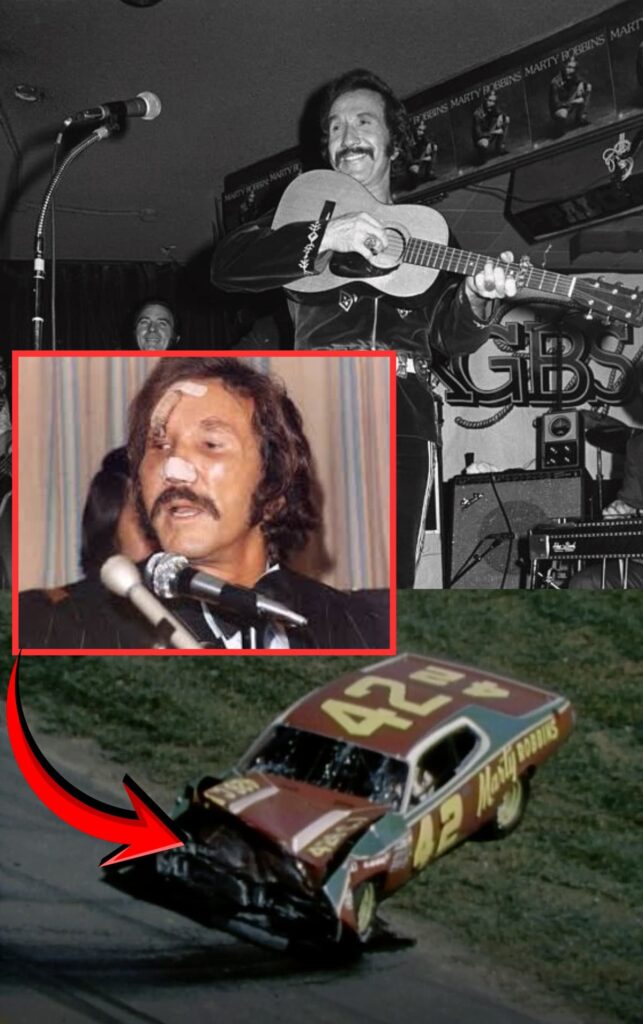
In two seconds between steel and silence, Marty Robbins chose mercy over survival—and carried that choice for the rest of his life
There are moments in music history that do not begin with a song, but eventually find their way into one. The story of Marty Robbins at Charlotte Motor Speedway in October 1974 is one of those moments—raw, immediate, and far removed from the calm precision of a recording studio. It was not a chart entry, nor a radio release, yet it reveals something essential about the man who gave the world “El Paso”—a song that reached No. 1 on the Billboard Hot 100 in 1960 and later won the Grammy Award for Best Country & Western Recording.
By 1974, Robbins was already a figure of quiet legend in country music. His voice had traveled through ballads of love, regret, and consequence, always with a storyteller’s patience. But beyond the microphone, there was another life—one that unfolded at over 160 miles per hour, where decisions were not shaped by melody, but by instinct. Racing was never a passing interest for him; it was something closer to necessity, even after his body had begun to protest.
Five years earlier, in 1969, Robbins suffered a serious heart attack. It was a moment that might have ended another man’s ambitions, or at least redefined them. Instead, he became one of the early patients to undergo triple coronary bypass surgery, a procedure still relatively new at the time. The expectation was clear: slow down, step away, preserve what remained. But Robbins returned to racing within months, carrying not just the physical scars, but a quiet defiance that would come to define him just as much as his music.
On that October day in Charlotte, the race unfolded like any other—until it didn’t. Traveling at nearly 160 miles per hour, Robbins found himself in a situation that offered no time for reflection, only reaction. Ahead, another driver—Richard Childress—was vulnerable, caught in a moment that could have ended differently. To Robbins’ right, there was only the wall. To his left, the possibility of collision.
Two seconds. That was all.
In those two seconds, Robbins made a decision that would leave a permanent mark—not just on his body, but on the story that followed him. He chose the wall. The impact was severe. He suffered 37 stitches to his face, broken ribs, a broken tailbone, and two black eyes. The scar between his eyes would never fully disappear. It remained, long after the race had ended, long after the headlines faded—a quiet reminder of a moment that could not be undone.
Richard Childress would later say, “If Marty hadn’t crashed into the wall, I probably wouldn’t be here today.” It is a statement that carries weight not easily measured. In music, Robbins often sang about choices—about men standing at the edge of consequence, forced to act with incomplete certainty. In Charlotte, he lived one of those songs.
There is something deeply consistent in this, if one listens closely enough. “El Paso” tells the story of a man who returns, knowing the cost. It is not a tale of heroism in the traditional sense, but of inevitability, of a choice made despite understanding what it will bring. Robbins, the singer, understood that kind of narrative. Robbins, the driver, embodied it.
What does a man owe a stranger in two seconds? There is no lyric that fully answers that question. No melody that can resolve it. But Robbins offered something close—not in words, but in action.
In the years that followed, he continued to record, to perform, to race. The scar remained, visible and unspoken. It was not something he needed to explain. Like the best songs he ever recorded, it did not demand attention. It simply existed, carrying its meaning quietly.
And perhaps that is the truest connection between the man and his music. Not the success, not the charts, not even the enduring popularity of his recordings—but the understanding that life, like a song, is often defined not by its beginning or its end, but by the choices made in between.