
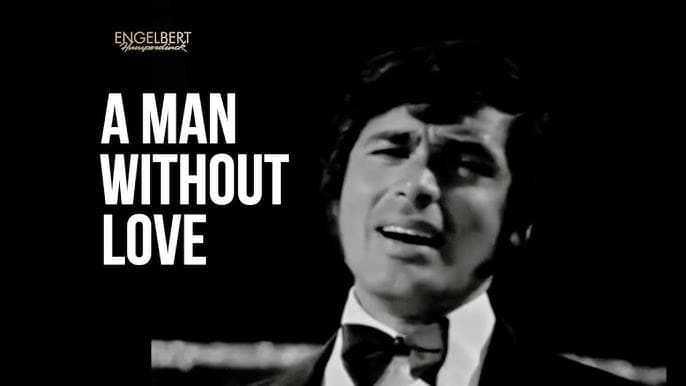
A voice caught between longing and resignation—“A Man Without Love” lingers where heartbreak learns to live without answers
When Engelbert Humperdinck released “A Man Without Love” in 1968, it carried with it the quiet weight of a melody already proven elsewhere, yet newly reborn in a voice that seemed to understand sorrow without needing to dramatize it. The song reached No. 2 on the UK Singles Chart, while climbing to No. 19 on the Billboard Hot 100 in the United States, further establishing Humperdinck as one of the defining vocalists of late 1960s popular music. It also achieved significant success across Europe, reinforcing the song’s broad emotional reach.
The origins of “A Man Without Love” trace back to the Italian composition “Quando m’innamoro,” written by Roberto Livraghi and Anna Identici, with English lyrics later adapted by Barry Mason. Yet what Humperdinck brought to the piece was not simply interpretation, but atmosphere. His phrasing stretched each line just enough to let the emotion settle, never rushing, never forcing. It is this patience that gives the song its lasting presence.
By the time of its release, Humperdinck had already found immense success with ballads that leaned into romantic melancholy. But “A Man Without Love” feels different in its stillness. It does not plead. It does not attempt to win anything back. Instead, it accepts the absence at its center. The title itself suggests not just loss, but a condition—a state of being that has quietly taken hold.
The arrangement reflects this emotional restraint. The orchestration rises and falls with measured elegance, allowing space for the vocal to remain the focal point. Strings swell, but never overwhelm. The rhythm remains steady, almost unchanging, as if mirroring the passage of time when nothing seems to shift. There is no dramatic climax—only a gradual deepening of feeling.
Listening closely, one begins to notice how the song avoids clear resolution. There is no turning point where hope re-enters. Instead, there is a kind of recognition that settles in. Love, once present, has receded, and what remains is the echo of its absence. Yet even within that absence, there is a strange form of continuity. The feeling does not disappear. It simply changes shape.
Decades later, the song found an unexpected resurgence when it was featured prominently in the first episode of Moon Knight on Disney Plus. Introduced to a new generation in a completely different context, the track retained its emotional core while taking on new layers of meaning. In that setting, its sense of disorientation and quiet longing felt almost cinematic, as though the song had always belonged to moments where identity itself feels uncertain.
And yet, returning to the original recording, there is nothing theatrical about it. It remains grounded, personal, and unadorned in its intent. Humperdinck does not reach outward to explain the feeling. He inhabits it, allowing it to exist without justification.
There is something enduring in that approach. Over time, many songs attempt to resolve the emotions they present, to offer closure or clarity. “A Man Without Love” does neither. It simply remains, steady and unchanged, much like the feeling it describes.
And perhaps that is why it continues to resonate. Not because it answers anything, but because it recognizes something quietly familiar—the understanding that some absences are not meant to be filled, only carried.