
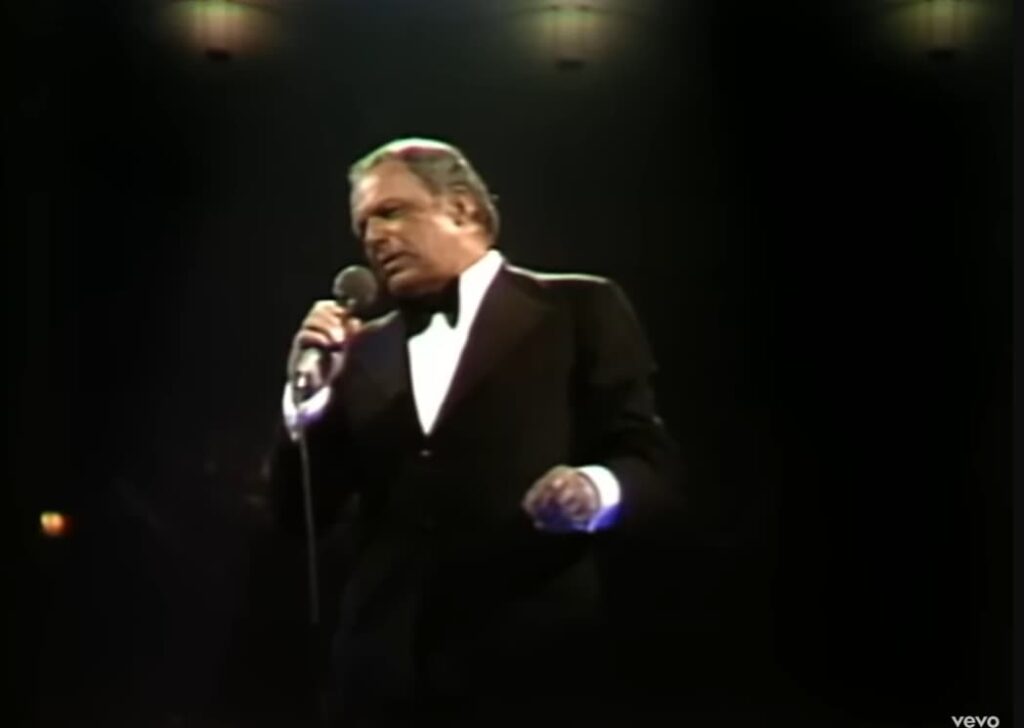
A man stands before a lifetime of choices and does not ask forgiveness, only remembrance—each note carrying the weight of a life lived on his own terms.
When Frank Sinatra stepped onto the stage at Madison Square Garden in 1974 and delivered “My Way”, it was no longer simply a song—it had become a personal statement so deeply associated with him that the line between performer and narrative had almost disappeared. Originally released in 1969 on the album “My Way”, the song reached No. 5 on the UK Singles Chart and, perhaps more tellingly, remained on that chart for an extraordinary 75 weeks, one of the longest runs in British chart history. In the United States, it reached No. 27 on the Billboard Hot 100, though its cultural impact would far exceed its chart position.
By 1974, Frank Sinatra had already lived several careers within a single lifetime—big band vocalist, solo pop icon, film actor, and, by then, a figure who seemed to exist slightly outside the normal passage of time. The concert at Madison Square Garden came after his brief retirement in the early 1970s, making the performance feel less like a routine appearance and more like a return, a reaffirmation of presence. And at the center of that return stood “My Way.”
The story behind the song itself adds another layer of meaning. The melody was adapted from the French song “Comme d’habitude,” composed by Claude François and Jacques Revaux. It was Paul Anka who acquired the rights and rewrote the lyrics specifically for Sinatra, crafting a narrative that would match his persona—a man reflecting on his life with a mixture of pride, regret, and acceptance. The result was not merely a translation, but a transformation. The song became distinctly American, distinctly Sinatra, and ultimately, universal.
In the 1974 live performance, there is a noticeable shift from the studio version. The orchestration is fuller, the tempo slightly more deliberate, allowing each line to settle with greater weight. Sinatra does not rush through the lyrics. He inhabits them. There are moments where his voice carries a roughness that had deepened with age, but rather than diminishing the performance, it adds something essential—credibility. This is no longer a young man declaring independence. It is a seasoned figure looking back, aware of both triumphs and missteps, yet unwilling to rewrite any part of the story.
The audience at Madison Square Garden responds not with interruption, but with attention. There is a shared understanding that this is not just another song in the setlist. It is the culmination. As Sinatra reaches the closing lines, there is a sense that the performance is not only about the past, but about how that past is being remembered in the present moment. The applause that follows feels less like celebration and more like acknowledgment.
What gives “My Way” its enduring power is its refusal to simplify a life into neat conclusions. The lyrics speak of regrets, but they do not dwell on them. They acknowledge mistakes, but they do not apologize for them. Instead, the song offers something more complex—a kind of measured acceptance. And in Sinatra’s live delivery, that acceptance feels earned. It is not performed for effect. It is presented as fact.
Looking back, the 1974 Madison Square Garden performance stands as one of the most definitive interpretations of “My Way.” It captures Sinatra at a point where the distance between the man and the myth had narrowed. There is no attempt to separate them. Instead, they coexist, each informing the other.
In the years that followed, “My Way” would be sung by countless artists, each bringing their own perspective to its lyrics. Yet the version performed by Frank Sinatra in 1974 remains singular. Not because it is technically perfect, but because it feels complete. It carries with it the sense of a journey that has already been lived, even as it continues to unfold.
And in that moment, standing under the lights of Madison Square Garden, Sinatra does something rare. He does not ask the audience to admire him. He simply tells his story. And by the time the final note fades, it no longer belongs only to him. It becomes something shared—quiet, reflective, and enduring.
 Music Legend