
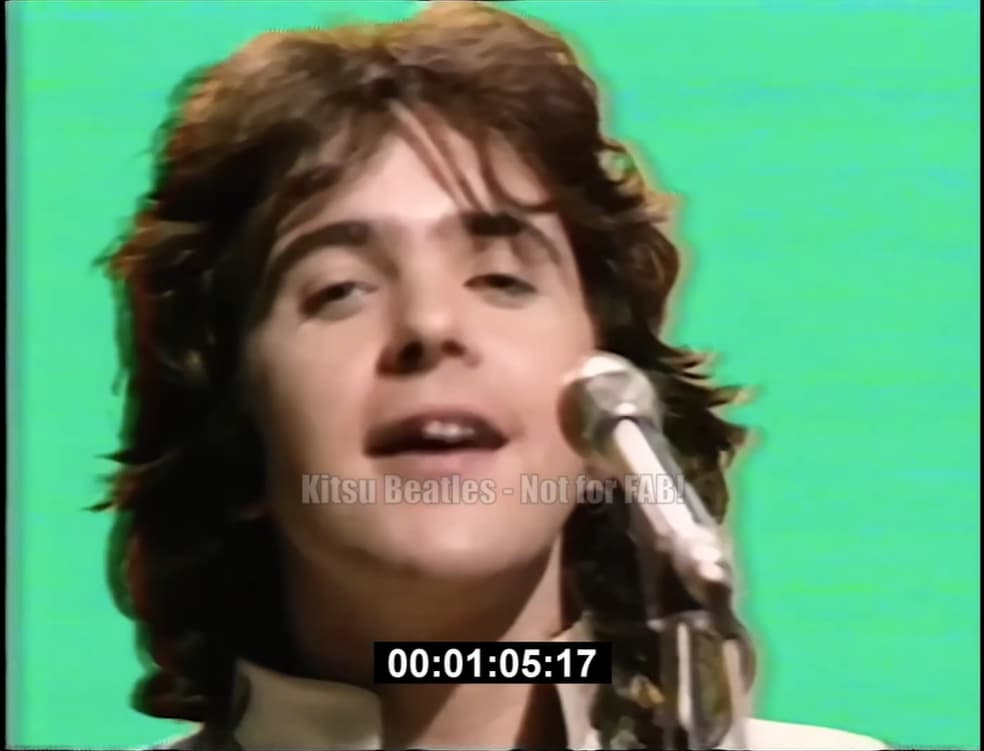
A dream dressed in melody—“Gonna Make You a Star” captures the fragile line between ambition and illusion, shining brightly in David Essex’s voice
When David Essex appeared on Top of the Pops on November 21, 1974, performing “Gonna Make You a Star,” he stood at the very height of his commercial success. The song had already climbed to No. 1 on the UK Singles Chart, where it remained for three weeks, becoming one of the defining hits of that year. It was a moment when glam rock, pop accessibility, and theatrical presence converged—and Essex found himself right at the center of it.
Released from his album “David Essex” (1974), the track followed the success of earlier hits like “Rock On” (which reached No. 5 in the UK and No. 5 on the Billboard Hot 100 in 1973) and “Hold Me Close” (another UK No. 1 in 1975). But “Gonna Make You a Star” occupies a unique place in his catalog. It is not just a song about fame—it is a song about the promise of fame, the seduction of it, and perhaps the quiet uncertainty that lingers beneath that promise.
Written by David Essex himself, the song unfolds like a conversation—part encouragement, part persuasion. The lyrics speak directly to someone on the edge of possibility, someone being told that greatness is within reach. Yet there is an ambiguity in that reassurance. Is it genuine belief, or is it something more performative? That tension gives the song its depth.
In the Top of the Pops performance, this duality becomes even more apparent. Essex presents himself with confidence—his voice steady, his presence controlled—but there is also a sense of awareness, as though he understands the very machinery of stardom he is singing about. He is not just inside the moment; he is observing it as it unfolds.
Musically, “Gonna Make You a Star” carries a distinctive arrangement. The rhythm is smooth, almost hypnotic, driven by a groove that leans into soul influences while maintaining a pop structure. The instrumentation is layered but never overwhelming, allowing Essex’s vocal to remain at the forefront. There is a warmth in the production, a polished sheen that reflects the era without becoming dated.
What makes the performance particularly compelling is its restraint. Unlike many glam-era acts that relied heavily on visual spectacle, Essex keeps the focus on the song itself. His delivery is measured, allowing the lyrics to resonate without excess. This approach creates a sense of intimacy, even within the broader setting of a televised performance.
The cultural context of 1974 adds another layer to the song’s meaning. This was a time when the idea of becoming a “star” was both more accessible and more mysterious. Television shows like Top of the Pops played a crucial role in shaping public perception, turning performers into household names almost overnight. Within that environment, “Gonna Make You a Star” feels almost self-referential—a song about the very process it is participating in.
There is also a subtle melancholy beneath the surface. While the lyrics speak of elevation and recognition, the tone suggests an awareness that such moments are fleeting. Stardom, as the song gently implies, is not a fixed destination but a passing phase—bright, captivating, and ultimately transient.
Listening now, the song carries a sense of nostalgia that extends beyond its melody. It recalls a time when music television had a certain simplicity, when performances were direct, unfiltered, and grounded in the moment. There is no need for elaborate staging or digital enhancement—only the artist, the song, and the audience.
In David Essex’s voice, “Gonna Make You a Star” becomes more than a statement of ambition. It becomes a reflection on what it means to be seen, to be recognized, and to navigate the space between aspiration and reality.
And as the performance concludes, there is no grand declaration—only the lingering echo of a promise, one that feels both certain and uncertain at the same time.
A star is made, perhaps. But the question of what that truly means remains, quietly, long after the music fades.