
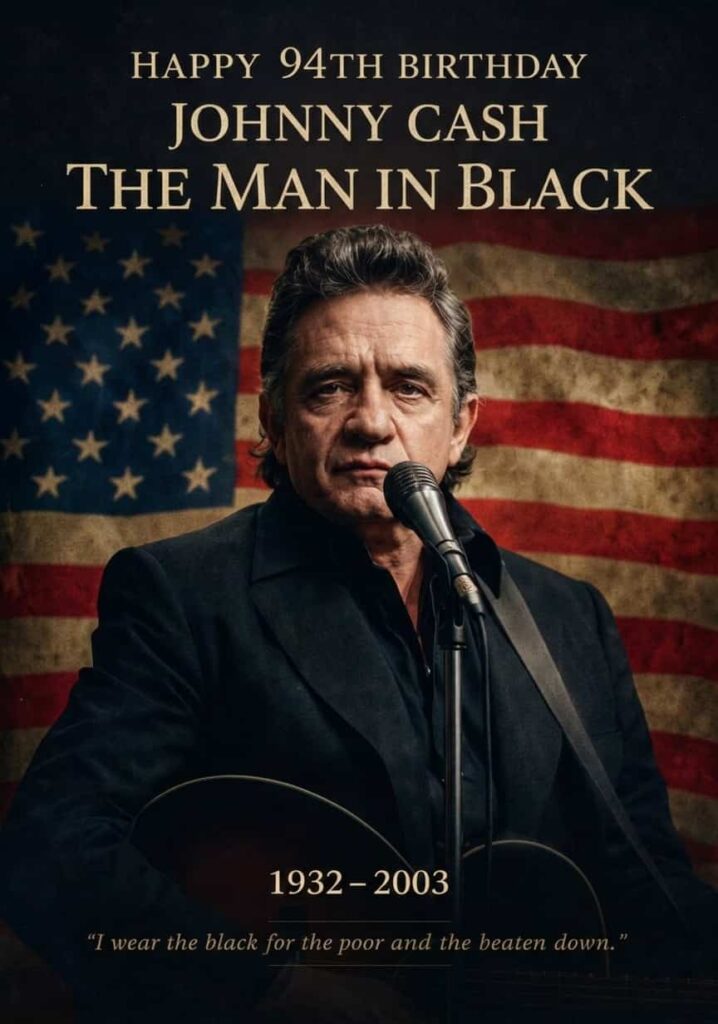
A Song About Regret, Redemption, and the Man in Black Who Faced His Own Truth
Today marks the birthday of Johnny Cash, born February 26, 1932, in Kingsland, Arkansas. Few names in American music carry the same weight. Known worldwide as “The Man in Black,” he sold more than 90 million records, was inducted into the Country Music Hall of Fame in 1980 and later into the Rock and Roll Hall of Fame in 1992, an honor granted to only a rare few artists who shaped multiple genres. His voice, steady and unvarnished, became one of the most recognizable sounds of the twentieth century.
Cash rose to prominence at Sun Records in the 1950s alongside Elvis Presley, Jerry Lee Lewis, and Carl Perkins. Songs like “I Walk the Line” and “Folsom Prison Blues” established him as a bold new presence in country music. By the time he released the live albums “At Folsom Prison” in 1968 and “At San Quentin” in 1969, he had become a symbol of empathy for the forgotten and the incarcerated, a singer who stood close to the margins of society and sang without judgment.
Yet if one performance defines the final chapter of his life, it is “Hurt.” Released in 2002 on the album “American IV: The Man Comes Around,” and produced by Rick Rubin, the song was originally written by Trent Reznor of Nine Inch Nails. In Cash’s hands, it became something else entirely. His weathered baritone carried lines about loss and self reflection with devastating honesty. The accompanying video, filmed inside the fading House of Cash museum in Hendersonville, Tennessee, showed an aging legend confronting memories, regrets, and the passage of time.
When “Hurt” reached a new generation of listeners, it did not feel like a comeback. It felt like a confession. The trembling piano, the stark acoustic guitar, and that unmistakable voice turned the song into a farewell long before his passing in September 2003. Many who watched that video for the first time remember the quiet that followed. It was not just a performance. It was a life laid bare.
Birthdays have a way of bringing back small details. A vinyl record spinning in a living room. A late night radio broadcast playing “Ring of Fire” from the album “Ring of Fire: The Best of Johnny Cash.” The steady rhythm of “A Boy Named Sue” drawing laughter from a crowd. And of course, the image of Cash dressed in black, standing under a single spotlight, guitar held close, singing as if the words cost him something real.
He was never a polished vocalist in the traditional sense. He did not rely on elaborate ornamentation. What he offered was conviction. His songs carried the weight of faith, struggle, love, and human frailty. Whether recording gospel hymns, country standards, or stark reinterpretations of contemporary rock songs, he approached each with the same moral gravity.
On this birthday, it is worth remembering that Johnny Cash was not merely a country singer. He was a chronicler of the American spirit. He sang for prisoners, for workers, for wanderers, for believers and doubters alike. His music spoke plainly about sin and redemption, about loyalty and loss. And in doing so, he gave listeners permission to confront their own stories.
As the years pass, the records remain. The crackle of an old LP or the digital clarity of a remastered track both carry that familiar voice forward. Today, many return once more to “Hurt” or to “I Walk the Line,” letting those songs fill a quiet room and stir memories that never quite fade.
 Music Legend