
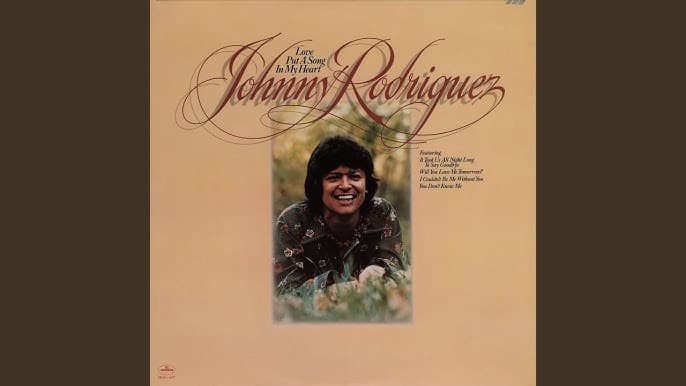
A Quiet Mirror of Regret, Where Love Is Measured by the Life One Cannot Fully See
When Johnny Rodriguez recorded “Sometimes I Wish I Were You,” he was working within a period that would define his place in country music history—a time when his voice, youthful yet deeply expressive, seemed to carry both confidence and vulnerability in equal measure. The song, released in 1975 as part of the album “Just Get Up and Close the Door,” did not achieve the same chart-topping success as some of his earlier hits, but it remains one of the more introspective pieces in his catalog, reflecting a depth that often reveals itself more clearly with time.
By 1975, Johnny Rodriguez had already established himself as one of country music’s most compelling new voices. With No. 1 hits like “Ridin’ My Thumb to Mexico” and “That’s the Way Love Goes,” he brought a fresh emotional tone to the genre—one that blended traditional country themes with a subtle, almost conversational delivery. In “Sometimes I Wish I Were You,” that quality is fully realized. The song does not rely on dramatic storytelling or sweeping arrangements. Instead, it unfolds quietly, allowing the listener to step into a perspective rarely explored so directly.
The premise of the song is deceptively simple. It imagines what it might feel like to be the other person in a relationship—to see oneself from the outside, to understand the weight of one’s own actions through another’s eyes. This shift in perspective gives the song its emotional core. It is not about blame, nor is it about self-pity. It is about awareness—an acknowledgment that love is not always experienced equally, and that understanding often comes too late.
The writing behind “Sometimes I Wish I Were You” reflects a kind of emotional maturity that was becoming more prominent in country music during the mid-1970s. While earlier eras often framed relationships in more definitive terms—right or wrong, faithful or unfaithful—this song exists in a more ambiguous space. It recognizes that people can care deeply for one another and still fail to fully understand each other.
In his performance, Johnny Rodriguez leans into that ambiguity. His voice carries a softness that never quite resolves into certainty. There is no dramatic climax, no moment where the emotion is pushed to its limits. Instead, the song maintains a steady, reflective tone, as though the thoughts it expresses are still being formed even as they are spoken.
There is something particularly striking in the way Rodriguez handles phrasing. He allows certain lines to linger just slightly longer, giving them a sense of weight without ever forcing them. This restraint creates a feeling of intimacy, as though the listener is not hearing a performance, but a quiet confession.
Musically, the arrangement supports this mood with subtlety. Gentle instrumentation—steel guitar, soft rhythm, understated backing—provides a framework that never distracts from the central emotion. It is a sound that feels grounded, familiar, yet never predictable.
The meaning of “Sometimes I Wish I Were You” extends beyond the immediate context of a relationship. It speaks to a broader human experience—the desire to understand how one is perceived, to step outside oneself and see the impact of one’s actions more clearly. This idea, though rarely expressed so plainly, resonates in ways that deepen over time.
Unlike songs that offer resolution or closure, this one leaves the question open. What would change if that understanding were possible? Would it lead to reconciliation, or simply to a deeper awareness of what has already been lost? The song does not attempt to answer. It simply presents the thought and allows it to remain.
In the larger arc of Johnny Rodriguez’s career, “Sometimes I Wish I Were You” may not stand as his most commercially recognized work, but it holds a quiet significance. It reveals an artist willing to explore emotional complexity without relying on convention, to trust that subtlety can carry as much meaning as any grand gesture.
As the final notes fade, there is no sense of finality. The song does not conclude so much as it settles, leaving behind a lingering reflection. And in that reflection, it offers something rare—a moment of stillness, where understanding feels just within reach, yet never fully grasped.
It is in that space, between knowing and not knowing, that Johnny Rodriguez finds the true voice of the song—one that does not demand to be heard loudly, but stays quietly, long after the music has ended.