
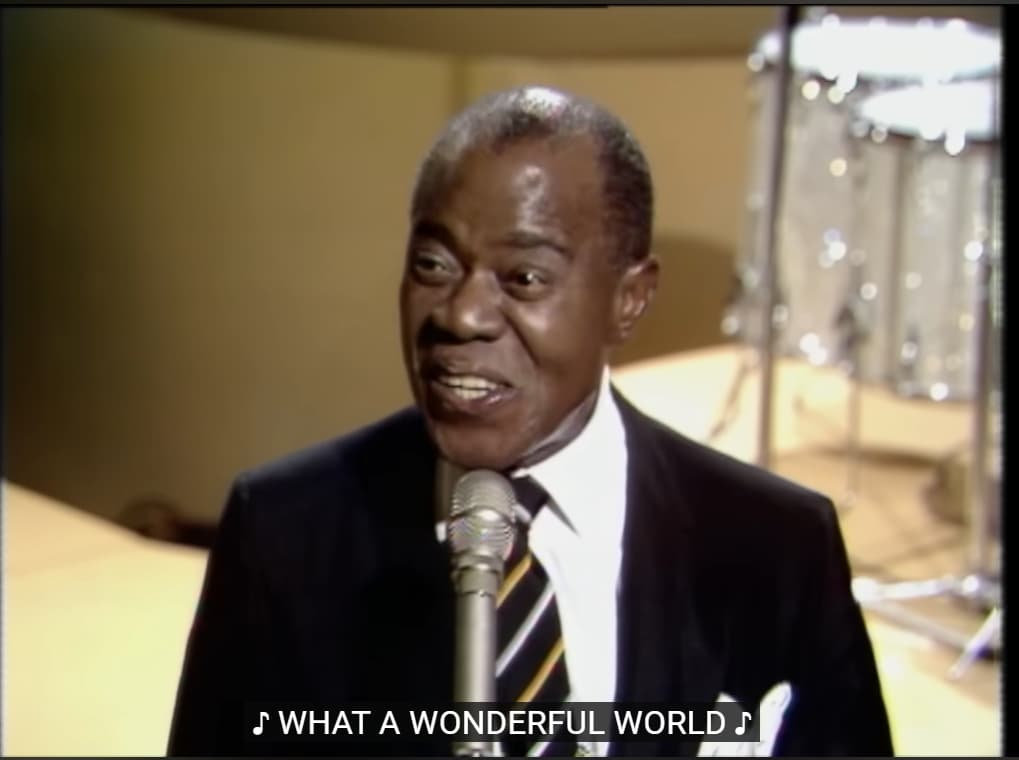
A gentle meditation on life’s quiet beauty, where simple moments become profound reminders of hope and humanity.
When Louis Armstrong recorded “What a Wonderful World” in 1967, it was not conceived as a chart-dominating hit, but rather as a soft-spoken counterpoint to a turbulent era. Released as a single that same year, the song achieved remarkable success in the United Kingdom, reaching No. 1 on the UK Singles Chart, while initially receiving a more muted response in the United States. Yet over time, its legacy would far surpass its early commercial trajectory, becoming one of the most beloved and enduring recordings in modern music history.
The story behind “What a Wonderful World” is rooted in intention as much as artistry. Written by Bob Thiele and George David Weiss, the song was designed specifically for Armstrong—a man whose voice carried both the gravel of hardship and the warmth of deep humanity. At a time when headlines were dominated by conflict, division, and uncertainty, the song offered something radically different: a quiet affirmation of life’s beauty. Armstrong did not sing it with grandeur or flourish; instead, he delivered each line with a tenderness that felt almost conversational, as if sharing a personal reflection rather than performing for an audience.
Musically, the arrangement is understated yet elegant. Gentle strings, soft brass, and a measured tempo create a space where the voice can breathe. And within that space, Armstrong’s phrasing becomes the true instrument. His voice—weathered, unmistakable—transforms simple observations into something deeply affecting. When he sings of trees of green or skies of blue, it is not merely descriptive; it is reflective, as though each image carries with it a lifetime of memory and meaning.
What makes “What a Wonderful World” so enduring is its sincerity. There is no irony, no hidden complexity. The song does not deny the existence of hardship; rather, it chooses to focus on what remains beautiful despite it. In doing so, it becomes more than a piece of music—it becomes a philosophy. A reminder that even in difficult times, there are moments worth noticing, worth holding onto.
For listeners, the song often unfolds slowly, revealing its depth over time. It may begin as a pleasant melody, something familiar and comforting. But with each passing year, each new experience, its meaning deepens. It becomes tied to personal memories—quiet mornings, shared glances, the passage of time marked not by grand events but by small, significant details. In this way, Armstrong’s recording transcends its era, speaking to something universal and timeless.
The journey of the song itself mirrors this gradual recognition. Though not an immediate success in the United States, it found new life decades later, particularly after being featured in the 1987 film Good Morning, Vietnam. From that point on, it reached a broader audience, becoming synonymous with reflection, nostalgia, and a kind of enduring optimism that feels increasingly rare.
In the broader context of Louis Armstrong’s career, “What a Wonderful World” stands apart from his earlier jazz recordings. Known for his groundbreaking trumpet playing and vibrant interpretations, Armstrong here adopts a quieter role. Yet it is precisely this restraint that gives the song its power. There is no need for virtuosity; the emotion lies in the delivery, in the subtle inflections that only a lifetime of experience can provide.
Over the years, countless artists have covered “What a Wonderful World,” but none have captured the same balance of fragility and strength that Armstrong achieved. His version remains definitive, not because it is flawless, but because it is human. It carries within it the imperfections, the warmth, and the quiet wisdom of someone who has seen much and still chooses to believe in beauty.
And perhaps that is why the song continues to resonate so deeply. It does not demand attention; it invites reflection. It does not seek to overwhelm; it gently reminds. In a world that often feels hurried and uncertain, “What a Wonderful World” offers a moment of stillness—a chance to pause, to look around, and to recognize the quiet miracles that persist.
Long after the final note fades, the feeling remains. Not as a grand declaration, but as a quiet certainty: that even in the midst of everything, there is still something wonderful to be found.