
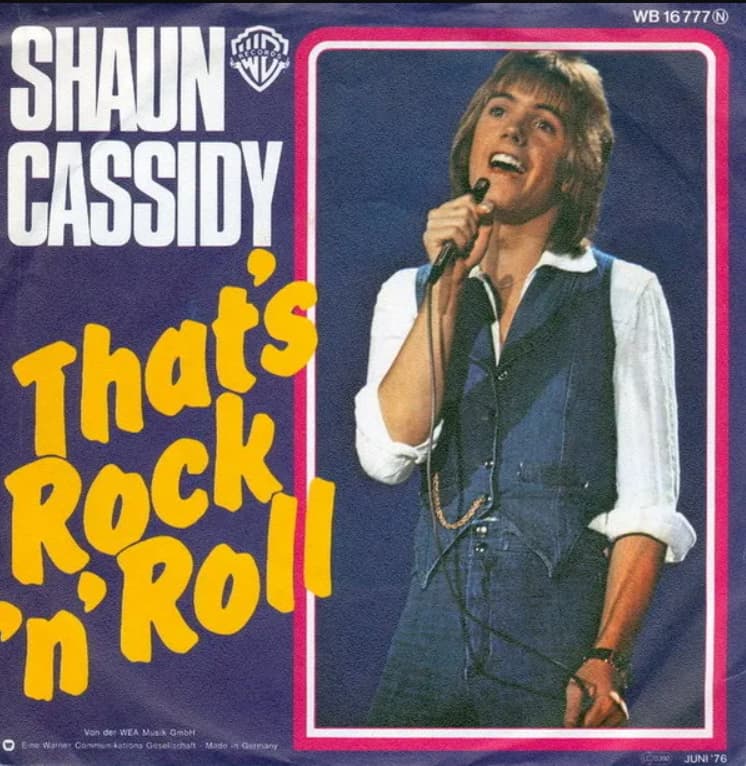
A bright declaration of youth and freedom, capturing a moment when music itself felt like a promise rather than a memory
Released in 1977, “That’s Rock ’N’ Roll” marked a defining moment in the career of Shaun Cassidy, a song that did not merely introduce him as a pop star but placed him squarely at the center of American youth culture at a time when innocence and excitement still coexisted comfortably on the radio. The single rose swiftly to No. 1 on the Billboard Hot 100, holding the top position for one week in July 1977, and also reached No. 1 on the Billboard Adult Contemporary chart. Its commercial success was immediate and undeniable, but its deeper significance lies in how naturally it captured the spirit of its era.
Written by Eric Carmen, already well known for his melodic instincts and emotional clarity, the song was originally intended for his own use. Yet in Cassidy’s hands, it became something else entirely. The track found its true voice in Cassidy’s youthful tone, which carried neither irony nor self consciousness. He sang as if discovering the joy of music in real time, and that sense of discovery became the song’s emotional engine.
At its core, “That’s Rock ’N’ Roll” is not a complex song. It does not attempt philosophical depth or lyrical sophistication. Instead, it embraces simplicity with confidence. The lyrics speak of girls, cars, radio waves, and the feeling of freedom that arrives when a favorite song comes on at just the right moment. This directness is not a weakness. It is the point. Rock music, as presented here, is not a genre to be analyzed but a feeling to be lived.
Musically, the song balances polished pop production with the rhythmic drive of classic rock. The piano introduction immediately signals brightness, followed by a steady beat that feels designed for open roads and summer nights. The arrangement never overwhelms the vocal. Everything serves the melody, and the melody is unforgettable. This careful balance allowed the song to cross generational lines at the time of its release, appealing to younger listeners while remaining accessible to those who valued melody and structure.
For Shaun Cassidy, the song arrived at a crucial moment. Already visible through television and teen media, he stood at the intersection of celebrity and musicianship. “That’s Rock ’N’ Roll” validated him as more than a face. It proved that his appeal could be carried by a song strong enough to stand on its own. His vocal delivery is relaxed yet assured, never straining for effect. There is an ease in his phrasing that suggests joy rather than performance, and that authenticity became central to the song’s success.
The meaning of the song has evolved gently over time. What once felt like a celebration of the present now carries a reflective glow. The references to radio, cruising, and shared musical moments evoke a period when music was experienced collectively, when songs arrived through speakers rather than screens. The track has become a reminder of how music once structured everyday life, not as background noise but as an event.
Within the broader landscape of late seventies pop, “That’s Rock ’N’ Roll” stands apart for its optimism. This was a decade marked by stylistic change and cultural uncertainty, yet the song refuses cynicism. It insists that joy is enough. That belief, expressed so plainly, is perhaps why the song continues to resonate.
Looking back, Shaun Cassidy did not need to redefine rock music with this recording. He simply needed to remind listeners of why it mattered in the first place. “That’s Rock ’N’ Roll” succeeds because it understands that music does not always need to explain itself. Sometimes it only needs to be felt. And in that feeling, preserved across decades, the song continues to speak with warmth, clarity, and a quiet confidence that time has only deepened.