
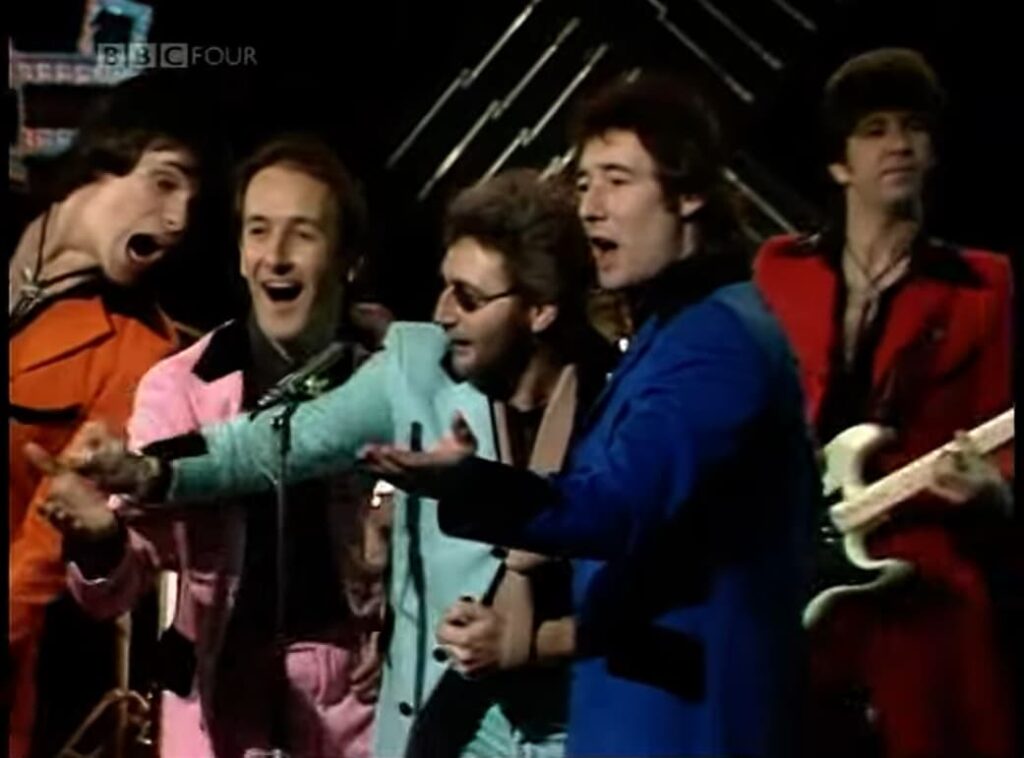
A Christmas Broadcast of Old Memories, Where Doo-Wop Echoes Met the Warm Glow of Late Seventies Television
On December 25, 1978, amid the festive glow of holiday television, Showaddywaddy stepped onto the stage of Top of the Pops to perform “I Wonder Why” — a song that, even at the time, carried the unmistakable scent of an earlier era. Originally recorded by Dion and the Belmonts in 1958, the song had been a Top 40 hit in the United States, peaking at No. 22 on the Billboard Hot 100. Two decades later, Showaddywaddy’s revival brought it back into the public ear, where it climbed to No. 2 on the UK Singles Chart in late 1978, becoming one of the band’s most successful releases and a defining moment in their long run of nostalgic hits.
By the late 1970s, Showaddywaddy had carved out a unique place in British pop music. While the musical landscape was shifting rapidly — punk had already shaken the establishment, and new wave was beginning to redefine the sound of youth — this Leicester-based group chose a different path. They looked backward, not forward, drawing deeply from the well of 1950s rock and roll and doo-wop. Their success was not accidental. It was built on an understanding that music, at its core, is memory — and that certain melodies never truly fade.
“I Wonder Why”, in their hands, became more than a cover. It was a careful reconstruction of a feeling. The arrangement remained faithful to the original’s doo-wop structure — the layered harmonies, the gentle sway of rhythm, the conversational tone of the lead vocal — but there was also a subtle shift. Where Dion and the Belmonts had delivered the song with the immediacy of youth, Showaddywaddy approached it with a sense of reflection, as though they were not just singing the song, but remembering it.
The Christmas Day performance on Top of the Pops adds another layer to this interpretation. There is something inherently nostalgic about that setting — families gathered around the television, the year drawing quietly to a close, music serving as both entertainment and companionship. In that moment, Showaddywaddy did not simply perform a hit single. They offered a bridge between generations, connecting the late 1950s to the late 1970s in a way that felt natural, almost effortless.
Behind the scenes, the band’s decision to record “I Wonder Why” was consistent with their broader artistic identity. Throughout their career, they had embraced revivalism, bringing classic songs back into the charts with a sincerity that avoided parody. Their success with this approach — including multiple Top 10 hits — demonstrated that there was still a strong appetite for the sounds of an earlier time, even in an era defined by change.
The meaning of the song itself remains deceptively simple. At its heart, “I Wonder Why” is a meditation on love — its unpredictability, its quiet persistence, its ability to shape thought and feeling without offering clear answers. The repeated question in the title is never fully resolved. It lingers, much like the emotions it describes, suggesting that some aspects of human experience resist explanation.
In Showaddywaddy’s version, that question takes on an added dimension. It becomes not only a reflection on love, but also on memory. Why do certain songs stay with us? Why do certain moments return, unbidden, years later? The performance does not attempt to answer these questions. Instead, it allows them to exist, carried gently by harmony and rhythm.
Watching that 1978 performance now, one is struck not by spectacle, but by atmosphere. The stage, the lighting, the presence of the band — all of it feels grounded, unpretentious, almost intimate despite the scale of the broadcast. There is a sense that the music is enough, that it does not need to compete with anything else.
And perhaps that is the enduring legacy of Showaddywaddy’s “I Wonder Why”. It reminds us that music does not always need to move forward to remain relevant. Sometimes, it simply needs to return — to revisit, to recall, to reconnect. In doing so, it becomes something more than a song. It becomes a companion to memory itself, quietly asking questions that never quite fade, and offering, in return, the comfort of recognition.