
A revival of youthful spirit, where the echoes of early rock ‘n’ roll return not as nostalgia, but as something still alive and refusing to fade
When Showaddywaddy released “Hey Rock And Roll” in 1974, it arrived not as a reinvention, but as a celebration—an unapologetic return to the roots of a sound that had already begun to drift into memory. The single climbed to No. 2 on the UK Singles Chart, confirming that even in the mid-1970s, long after the first wave of rock ‘n’ roll had passed, its heartbeat remained strong, waiting for the right voices to bring it back into the light.
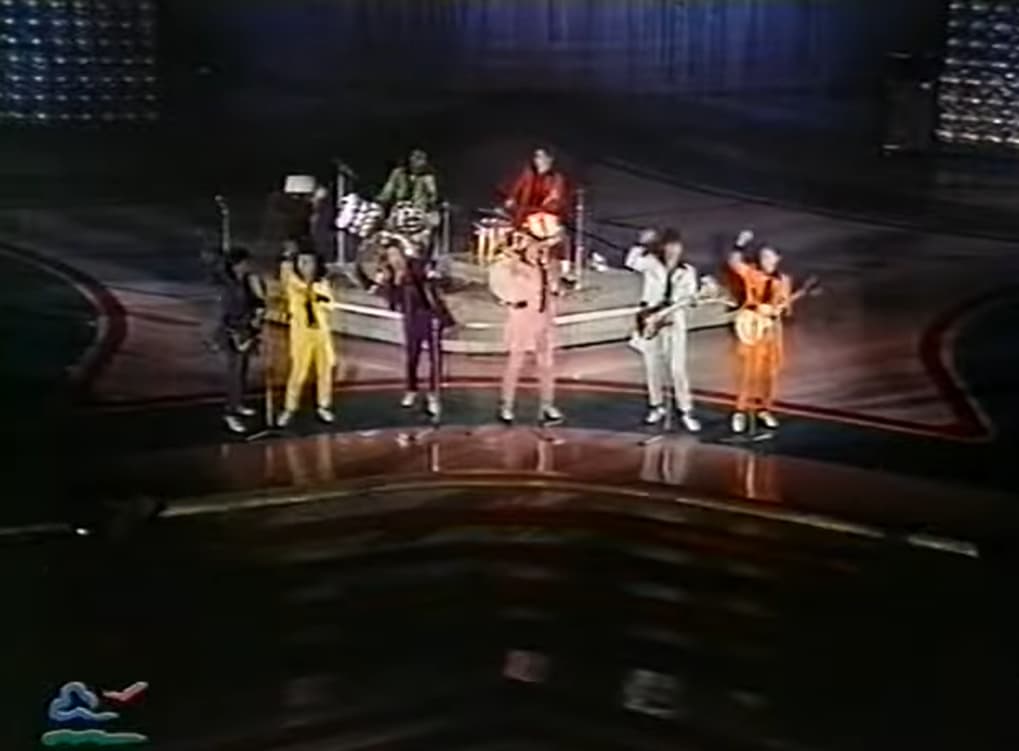
By the time of their performance on East German television on October 14, 1978, Showaddywaddy were no longer simply a band riding a trend. They had become, in many ways, caretakers of a musical tradition. While much of the world was moving toward disco, progressive experimentation, or harder-edged rock, this Leicester group stood firmly in another place entirely—one built on harmonies, rhythm, and the unmistakable pulse of 1950s rock ‘n’ roll.
And yet, there was nothing outdated about it.
“Hey Rock And Roll” carries an energy that feels immediate, almost urgent in its simplicity. From the opening bars, driven by a steady beat and layered vocals, the song does not ask for attention—it takes it. There is no complexity in its structure, no hidden meaning waiting to be uncovered. Instead, it offers something far more direct: joy, movement, and the shared language of music that once defined an entire generation.
The story behind the song reflects this spirit.
Written by Terry Bradford, the track was designed to capture the essence of early rock ‘n’ roll without imitation. It was not about copying the past, but about understanding why that past mattered—why a simple chord progression, a driving rhythm, and a chorus that invites participation could still resonate years later. Showaddywaddy understood that at its core, rock ‘n’ roll was never about technical brilliance. It was about feeling.
And in their hands, that feeling remained intact.
The 1978 television performance adds another layer to the song’s meaning. Set against the backdrop of a divided Europe, music in that moment carried a quiet significance beyond entertainment. There is something striking about watching Showaddywaddy perform “Hey Rock And Roll” in East Germany—a place where Western pop culture did not always flow freely. And yet, there it is: the rhythm, the harmonies, the unmistakable spirit of a genre born decades earlier, crossing boundaries without resistance.
It becomes clear, in that setting, that the song is not just about rock ‘n’ roll as a style, but as a shared experience.
There is a certain honesty in the way Showaddywaddy present themselves. Matching outfits, synchronized movements, and tightly arranged vocals—all of it could easily feel theatrical. But it never does. Because beneath the surface, there is genuine affection for the music they are playing. They are not performing for irony or reinvention. They are performing because they believe in it.
And that belief carries through every note.
Lyrically, “Hey Rock And Roll” does not attempt to tell a complicated story. It does not need to. Its message is embedded in its title—a call, almost a reminder, of something that once brought people together without effort. There is a sense that the song is reaching backward and forward at the same time, connecting moments that might otherwise remain separate.
What makes it endure is precisely this lack of pretense.
In an era where music often sought to evolve by becoming more intricate or more polished, Showaddywaddy chose instead to hold onto something simple. And in doing so, they revealed a truth that is easy to overlook: that simplicity, when carried with sincerity, does not diminish over time.
It strengthens.
The East German performance, in particular, captures this idea beautifully. There is no grand staging, no overwhelming production. Just a band, a song, and an audience that responds—not because they are being asked to, but because the music itself invites it.
And perhaps that is the lasting meaning of “Hey Rock And Roll.”
It is not a song about the past, even though it draws from it. It is a reminder that certain sounds, certain feelings, do not belong to any one era. They remain, waiting to be rediscovered, to be played again, to be felt once more.
And when Showaddywaddy step onto that stage in 1978, they are not looking back.
They are proving, quietly but unmistakably, that rock ‘n’ roll never truly left.