
A revival of old rock and roll romance, where youthful nights return beneath a softer, more forgiving moon
When Showaddywaddy released “Under The Moon Of Love” in 1976, they were not introducing something entirely new—they were breathing life back into a sound that had already lived, faded, and quietly waited for its return. Originally recorded by Curtis Lee in 1961, the song had only reached modest success in its first incarnation. But in the hands of Showaddywaddy, it found a second life, rising all the way to No. 1 on the UK Singles Chart in early 1977 and becoming one of the defining hits of the band’s career.
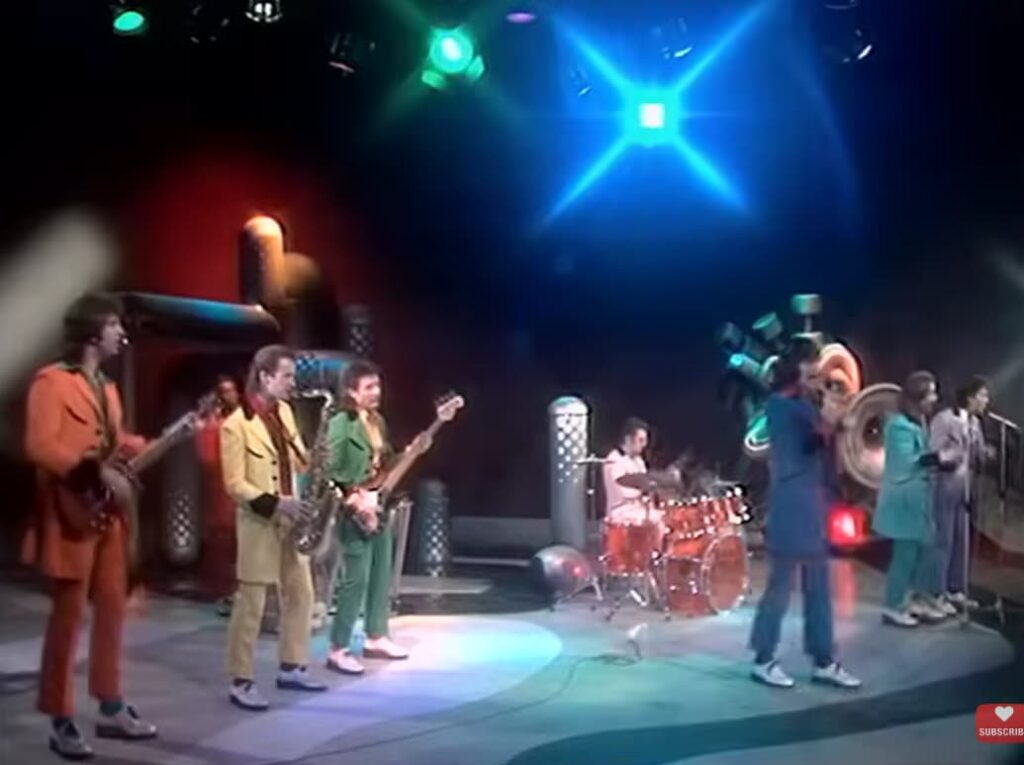
By the time they performed it on TopPop, the song had already secured its place in the hearts of listeners. Yet the performance itself adds something that recordings alone cannot provide—a sense of presence, of immediacy, of seeing a band fully aware of the joy they are creating.
There is something quietly remarkable about how Showaddywaddy approached music. Emerging in the 1970s, a decade often associated with experimentation and change, they chose instead to look backward—not out of reluctance, but out of affection. Their sound drew heavily from the rock and roll and doo wop traditions of the late 1950s and early 1960s, a time when songs were often simpler, melodies more direct, and emotions expressed without complication.
“Under The Moon Of Love” captures that spirit perfectly.
From the very first notes, there is a sense of familiarity, as though the song belongs not to a single moment, but to many. The melody carries an easy warmth, supported by harmonies that feel both polished and natural. The rhythm moves with a gentle confidence, never rushing, never demanding attention—simply inviting the listener to follow along.
And then there is the image at the center of it all: two people meeting beneath the moonlight, where the world seems briefly suspended. It is not an elaborate scene. There are no dramatic twists or hidden meanings. Just a quiet moment, shared between two people, made meaningful by its simplicity.
In Showaddywaddy’s version, that simplicity becomes its strength.
Watching the TopPop performance, one notices how the band leans into the song’s sense of ease. There is no attempt to modernize it beyond recognition, no effort to reshape it into something more complex. Instead, they honor its original character while adding their own presence—slightly fuller instrumentation, tighter harmonies, a touch more energy, but always within the boundaries of what the song asks for.
This balance is not easy to achieve.
To revive a song without losing its essence requires restraint, and Showaddywaddy understood that instinctively. They did not treat the past as something to be improved upon, but as something to be preserved and shared. And in doing so, they allowed “Under The Moon Of Love” to resonate with a new generation, while still holding onto the qualities that made it meaningful in the first place.
There is also a deeper layer to consider. By the mid-1970s, the world had already changed in ways both subtle and profound. Music, like everything else, had grown more complex, more varied, sometimes more distant. And yet, songs like this offered a return—not to a specific time, but to a feeling.
A feeling of clarity.
Of knowing exactly what a moment means while it is happening.
Of understanding that not everything needs to be explained to be felt.
Over the years, “Under The Moon Of Love” has remained a quiet presence, resurfacing in memories, in playlists, in the background of conversations that drift toward the past. It does not demand attention, but it rewards it. And perhaps that is why it endures.
Because it reminds us of something easily forgotten—that some of the most meaningful moments are also the simplest. A song, a melody, a night beneath the moon, and the unspoken understanding that such moments, while fleeting, leave something lasting behind.
In the end, Showaddywaddy did more than revive a song.
They preserved a feeling.
And in doing so, they ensured that “Under The Moon Of Love” would continue to shine—not brightly, not overwhelmingly—but with a steady, familiar glow that never quite fades.