
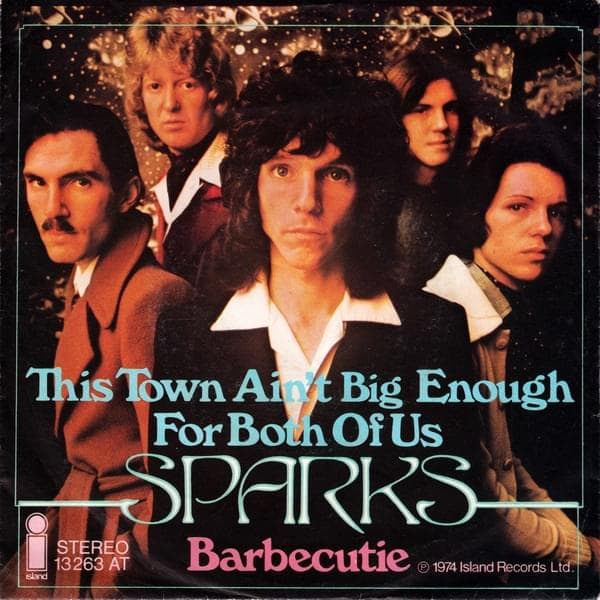
A Theatrical Cry of Ego and Survival, Where Pop Becomes Drama and Rivalry Becomes Art
In 1974, “This Town Ain’t Big Enough for Both of Us” by Sparks arrived like nothing else on the radio—bold, eccentric, and unapologetically dramatic. Released as the lead single from the album “Kimono My House”, the song surged to No. 2 on the UK Singles Chart, becoming the band’s biggest commercial success, while also making a modest impact in the United States. Yet chart positions alone fail to capture what truly happened when this record emerged. It did not simply climb—it disrupted.
Written by Ron Mael and delivered with startling intensity by his brother Russell Mael, the song broke away from conventional pop structures of the time. The early 1970s were already rich with experimentation, yet Sparks managed to carve out a space that felt entirely their own. Where others sought smoothness or rebellion, they offered something stranger—a collision of operatic vocals, glam rock energy, and lyrical surrealism that bordered on theatrical absurdity, yet somehow remained emotionally gripping.
The origins of “This Town Ain’t Big Enough for Both of Us” are rooted in deliberate exaggeration. Ron Mael has often described the lyrics as intentionally overblown, drawing loosely from the imagery of Western films where two rivals cannot coexist in the same space. But instead of presenting a literal duel, the song transforms that idea into something abstract—an emotional standoff, filled with tension, pride, and an almost operatic sense of urgency.
From the very first notes, the song refuses to behave. There is no gradual introduction, no easing into melody. It begins abruptly, almost confrontationally, as though the listener has stepped into the middle of a scene already in motion. Russell Mael’s falsetto does not merely sing—it pierces, rising sharply above the dense instrumentation with a kind of theatrical urgency that feels both controlled and unpredictable. It is a voice that demands attention, not through volume, but through intensity.
Musically, the arrangement is equally striking. The pounding piano, layered guitars, and sudden dynamic shifts create a sense of constant movement, as though the song itself cannot remain still. There is a tension woven into every measure, a feeling that something is always about to happen, even when it never quite resolves in the expected way. This unpredictability becomes part of its identity.
What makes “This Town Ain’t Big Enough for Both of Us” endure is not just its uniqueness, but its emotional undercurrent. Beneath the theatrical surface lies something deeply human—the fear of being overshadowed, the need to assert one’s place, the quiet desperation that can exist behind outward confidence. The phrase itself becomes symbolic, not just of rivalry, but of identity. Who gets to remain? Who must leave? And what does it mean to fight for space in a world that often feels too small?
The success of the song in the UK, where it nearly reached the top of the charts, speaks to its resonance with listeners who were perhaps ready for something different—something that did not fit neatly into existing categories. It became a defining moment for Sparks, establishing them not just as musicians, but as artists willing to challenge expectations.
Looking back now, there is a certain fascination in how the song continues to feel fresh, even decades later. It does not belong entirely to its time. Its theatricality, once considered unusual, now feels almost prophetic in an era where genre boundaries are increasingly fluid. Yet it remains anchored in its original moment, carrying with it the energy and unpredictability of the mid-1970s.
In the broader context of “Kimono My House”, the song serves as a kind of gateway—an introduction to a world where pop music is not confined by simplicity, but expanded by imagination. The album itself would go on to be regarded as one of the most innovative releases of its time, but it is this track that remains its most immediate and unforgettable expression.
There is something quietly remarkable about how Sparks approached their craft. They did not seek to comfort the listener. They invited them into something unfamiliar, something slightly disorienting, yet undeniably compelling. And in doing so, they created a song that feels less like a recording and more like a moment—sudden, intense, and impossible to ignore.
Even now, when the opening lines of “This Town Ain’t Big Enough for Both of Us” return, they carry with them that same sense of urgency. Not nostalgia, exactly—but recognition. A reminder that music, at its most daring, does not simply reflect the world as it is. It reshapes it, even if only for a few unforgettable minutes.