
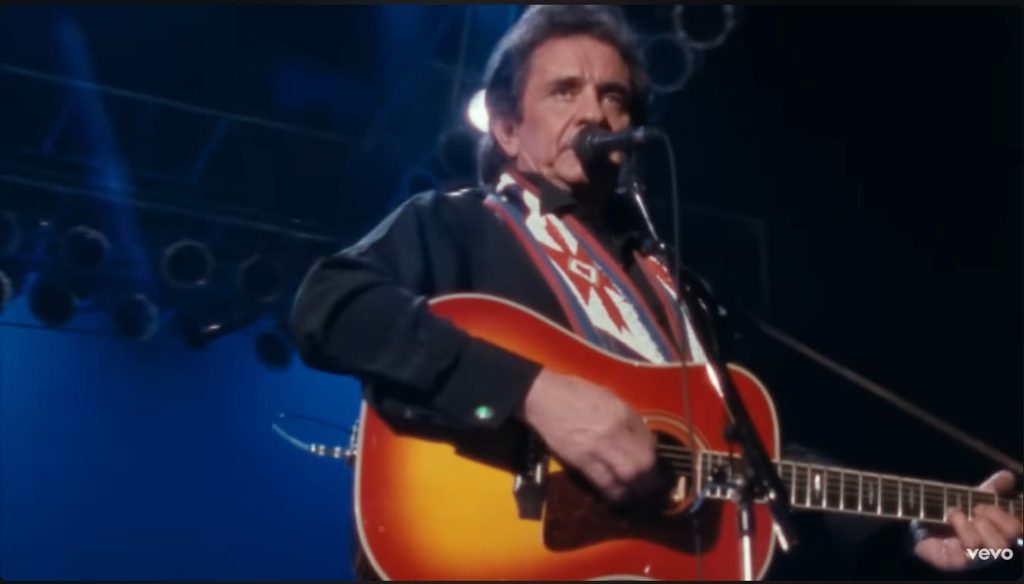
When The Highwaymen sang “Folsom Prison Blues,” four legendary voices stepped into Johnny Cash’s darkest musical world, and the song suddenly carried the weight of an entire generation of country music.
“Folsom Prison Blues” had belonged to Johnny Cash since he first recorded it for Sun Records in 1955, but when The Highwaymen performed it, the song took on an entirely different dimension. The supergroup, formed by Johnny Cash, Willie Nelson, Waylon Jennings, and Kris Kristofferson, had already brought together four men whose individual careers had shaped country music for decades. Cash was not simply singing one of his signature songs beside three famous friends. He was standing among artists who had each lived through their own battles with Nashville, fame, independence, and the long road of American music. That is why a performance of “Folsom Prison Blues” by The Highwaymen feels so compelling. The song remained Johnny Cash’s story, but the presence of Willie, Waylon, and Kris made it sound like something larger, a gathering of four outlaws around one of country music’s most famous prison walls.
The history of “Folsom Prison Blues” reaches back to 1955, when Johnny Cash recorded the song at Sun Studio in Memphis. Released as a single in December 1955, it became one of the first major successes of his career, reaching No. 4 on Billboard’s country chart in 1956. The song helped establish the unmistakable Cash sound, combining country music, blues, and the driving rhythm of a train song. Yet its greatest chapter came more than a decade later. On January 13, 1968, Cash performed two shows for inmates at Folsom State Prison in California, recording the concerts for what would become the legendary album At Folsom Prison. The live version of “Folsom Prison Blues” became an even bigger success than the original, spending four weeks at No. 1 on Billboard’s Hot Country Songs chart and reaching No. 32 on the Billboard Hot 100. The album itself reached No. 1 on the U.S. country album chart and climbed to No. 13 on the Billboard 200, helping transform Cash into an international figure far beyond the boundaries of country music.
The song’s power has always come from its extraordinary simplicity. Cash sings as a prisoner who hears a train moving somewhere beyond the prison walls, carrying free people toward places he can no longer reach. He knows he is responsible for his fate, yet that knowledge does not make the sound of freedom any easier to bear. The train becomes more than a train. It becomes a symbol of everything that continues without him. Other people are travelling, eating, laughing, and living while he remains trapped behind the walls. It is a song about punishment, certainly, but it is also about regret and the unbearable knowledge that life goes on elsewhere.
When The Highwaymen performed the song, that sense of experience became impossible to ignore. Johnny Cash carried the authority of the original story. His voice had always sounded as though it belonged naturally to the world of prisons, trains, lonely highways, and men who had made mistakes they could not undo. But beside him stood Willie Nelson, whose relaxed phrasing could make even the hardest lyric sound strangely human; Waylon Jennings, whose voice carried the stubborn independence of the outlaw movement; and Kris Kristofferson, the poet who understood better than most how to find complicated lives inside a few carefully chosen words. Their voices did not blend in the polished manner of a conventional vocal group. They were too individual for that. Instead, they collided and complemented one another, like four different roads meeting at the same crossroads.
The performance also carried the history of The Highwaymen themselves. Their first album, Highwayman, released in 1985, reached No. 1 on Billboard’s Top Country Albums chart, proving that the idea of bringing these four giants together was far more than a novelty. Their second studio album, Highwayman 2, released in 1990, reached No. 4 on the country album chart, and by then the four men had developed the easy chemistry of musicians who understood one another without needing to explain themselves.
Looking back, The Highwaymen’s “Folsom Prison Blues” is especially moving because it reminds us that Johnny Cash never had to leave his past behind to move forward. He could return to a song he had written decades earlier and sing it beside three friends who represented their own chapters of country music history. The young man who recorded the song at Sun Records in 1955 had become an elder statesman, but the dark rhythm of the train still carried the same sense of longing.
Perhaps that is what makes the performance so memorable. Four legendary men stood together, but the song still belonged to the lonely prisoner listening to a train disappear into the distance. And for a few minutes, Johnny Cash, Willie Nelson, Waylon Jennings, and Kris Kristofferson made that old train whistle sound as though it was still echoing through the walls of Folsom, carrying with it all the years that had passed and all the freedom that remained just beyond reach.