
A defiant anthem of hard-earned clarity—“Won’t Get Fooled Again” stands as a warning that revolutions may change faces, but not always the truth beneath
By the time The Who performed “Won’t Get Fooled Again” at Shepperton Studios in 1978, the song had already secured its place as one of the defining statements of 1970s rock—both musically and philosophically. Originally released in June 1971 as the climactic track of the album “Who’s Next”, the single reached No. 9 on the UK Singles Chart and climbed to No. 15 on the US Billboard Hot 100. Yet even at the moment of its release, chart positions felt almost secondary. This was not simply another hit record. It was a declaration.
Written by Pete Townshend, “Won’t Get Fooled Again” emerged from the remains of an ambitious, unfinished project known as Lifehouse—a concept that sought to merge music, technology, and audience participation into something far ahead of its time. When that larger vision collapsed under its own weight, what remained were fragments of its ideas, distilled into songs that carried both its ambition and its disillusionment. Among them, this track stood tallest.
At its core, “Won’t Get Fooled Again” is often mistaken for a song of rebellion. In truth, it is something far more complicated. The famous closing line—“Meet the new boss, same as the old boss”—does not celebrate change; it questions it. It reflects a growing skepticism toward the cycles of power, where promises of transformation often lead back to familiar outcomes. Written in the shadow of the social upheavals of the late 1960s, the song captures a moment when idealism began to confront reality.
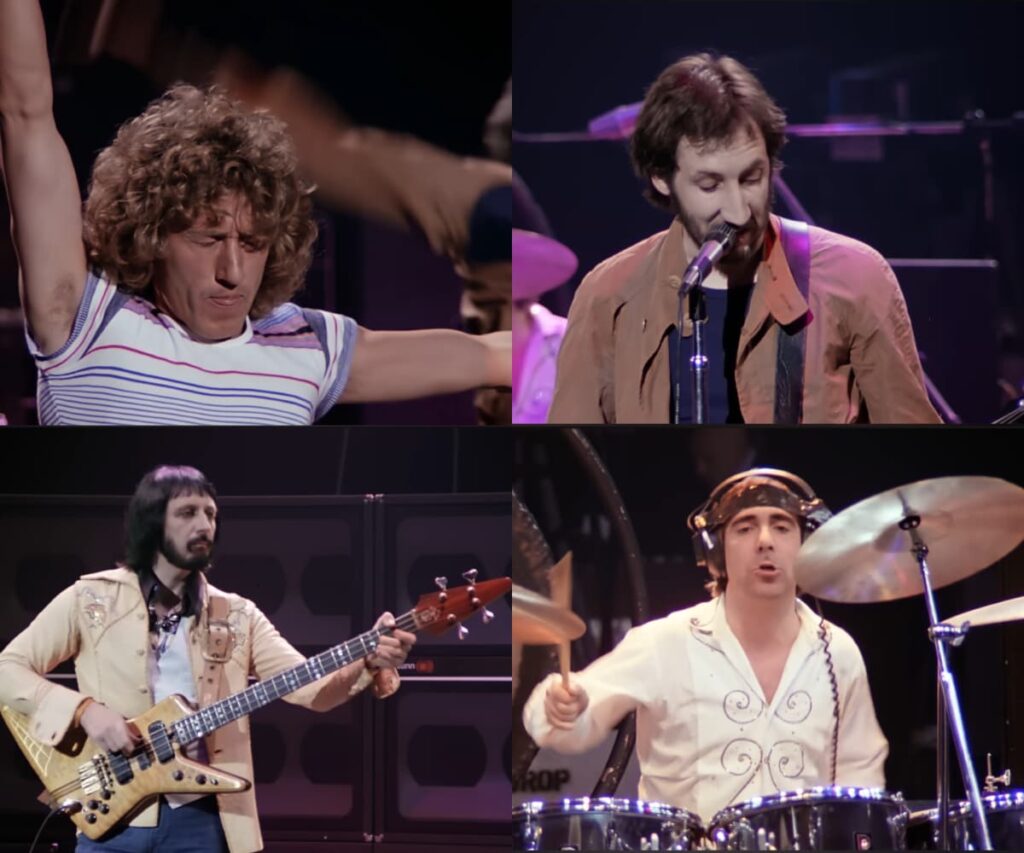
The 1978 performance at Shepperton Studios adds a deeper layer to this understanding. Filmed for The Kids Are Alright, it would become one of the last recorded appearances of drummer Keith Moon, whose presence had always been central to the volatile, electrifying identity of The Who. There is something almost unspoken in that performance—a sense that time, once so expansive, had begun to narrow.
Musically, the song remains a masterclass in controlled intensity. The opening synthesizer sequence—innovative for its time—creates a sense of anticipation that feels almost mechanical, as if something inevitable is approaching. When the band finally enters, the release is immediate and overwhelming. Roger Daltrey delivers the vocals with a force that borders on confrontation, while John Entwistle anchors the chaos with a steady, unshakable presence. And then there is Keith Moon, whose drumming feels less like rhythm and more like momentum itself—unpredictable, relentless, impossible to ignore.
The climactic scream near the song’s end has become one of the most recognizable moments in rock history. But it is not simply a display of vocal power. It feels like a release of everything that has been building beneath the surface—the frustration, the realization, the quiet understanding that change is rarely as pure as it first appears.
Watching that 1978 performance now, one cannot escape the weight of hindsight. The energy is still there, undeniable and urgent, but it carries with it a different resonance. What once felt immediate now feels reflective. The questions the song raises have not disappeared; if anything, they have grown more relevant with time.
There is a certain honesty in that endurance. “Won’t Get Fooled Again” does not offer comfort. It does not promise resolution. Instead, it presents a truth that is difficult to ignore—that awareness often comes at the cost of innocence. And once that awareness is gained, it cannot be undone.
In the end, the performance at Shepperton Studios is not just a document of a band at their peak. It is a moment suspended between past and future, between certainty and doubt. The Who do not attempt to resolve that tension. They simply play through it, with all the force they have left.
And perhaps that is why the song still lingers. Not because it answers anything, but because it understands the question too well.
 Music Legend