
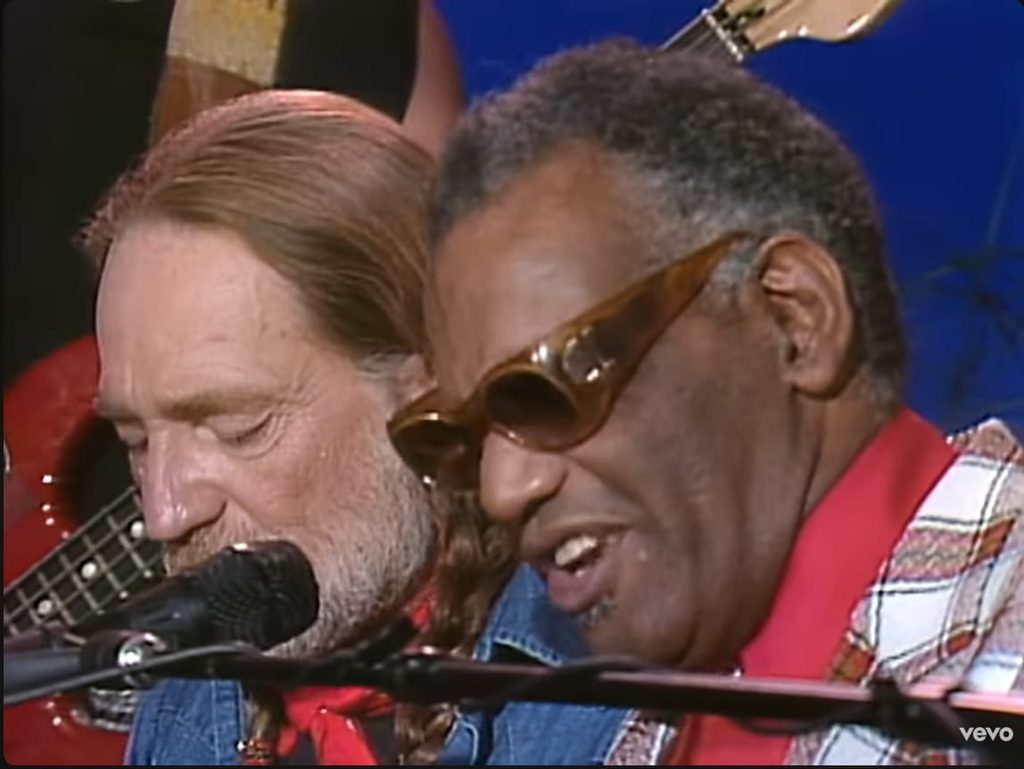
“Seven Spanish Angels” turns a doomed Western love story into a haunting meditation on devotion, sacrifice and the hope that love can survive even when life itself cannot.
Released in November 1984, “Seven Spanish Angels” became one of the most memorable country duets of the 1980s, bringing together two extraordinary voices from very different musical worlds, Ray Charles and Willie Nelson. The single first entered the Billboard Hot Country Singles chart at No. 84 on December 15, 1984, then climbed steadily through the winter before reaching No. 1 for one week in March 1985. It remained on the country chart for an extraordinary 27 weeks, and became the biggest country chart success of Ray Charles’s career. The song came from Charles’s 1984 album Friendship, a country oriented project built around collaborations, and it was also included on Willie Nelson’s 1985 compilation Half Nelson.
There is something almost cinematic about “Seven Spanish Angels” from the very first notes. Written by Troy Seals and Eddie Setser, the song was conceived as a tribute to the dramatic Southwestern storytelling tradition associated with Marty Robbins, particularly the atmosphere of “El Paso.” The writers wanted a song that carried the flavour of the old Western ballads, with lovers, danger, pursuit and death woven into a story that felt larger than ordinary life. According to accounts of its creation, Setser suggested the title “Seven Spanish Angels,” and the two writers developed the story around the image of seven heavenly figures watching over two lovers caught in a violent struggle. Their inspiration was deliberately rooted in the classic Western songs that had once filled country radio and jukeboxes, yet the finished song had a spiritual quality that made it feel more like a tragic folk legend than a simple cowboy story. (Wikipedia)
The path that brought the song to Ray Charles and Willie Nelson is just as fascinating. The writers initially got the song to Willie Nelson, who was interested in recording it. But producer Billy Sherrill, who was working on Ray Charles’s Friendship project, heard the song and immediately recognized its potential. Sherrill proposed that Charles and Nelson record it together, creating a pairing that seemed unusual on paper but proved extraordinarily natural in the studio. Nelson was already deeply associated with outlaw country, Western imagery and the Texas musical tradition, while Charles had spent decades moving effortlessly between soul, rhythm and blues, gospel, pop and country. His connection with country music was hardly new: more than two decades earlier, his landmark 1962 album Modern Sounds in Country and Western Music had demonstrated just how naturally his voice could inhabit country material. By the time he recorded “Seven Spanish Angels,” Charles was not entering country music as an outsider. He was returning to a musical language he had understood for much of his career.
The recording itself works because neither singer tries to dominate the other. Ray Charles takes the first verse, establishing the story with his rich, soulful phrasing, while Willie Nelson takes the second, bringing his unmistakable nasal, weathered voice into the narrative. Charles handles the early choruses, with Nelson joining toward the ending. The contrast is beautiful. Charles sounds deeply dramatic without becoming theatrical, while Nelson seems almost conversational, as if he has been telling these kinds of stories all his life. Their voices are different enough to create tension, yet similar enough in emotional directness that the duet never feels forced. The production by Billy Sherrill leaves space for the two singers and allows the song’s Southwestern atmosphere to emerge through restrained country instrumentation and subtle Latin influences.
At the centre of “Seven Spanish Angels” is a story of two lovers attempting to escape a posse that is pursuing them back toward Texas. The man eventually runs out of ammunition and is killed, while the woman takes his gun and continues fighting before meeting the same fate. Above them, the seven Spanish angels become a spiritual presence, watching over the couple and ultimately carrying the fallen woman into the afterlife. It is a tragic story, but the song does not treat death as the final meaning. Instead, death becomes the point at which the lovers are reunited somewhere beyond the violence of the physical world. That is what gives the song its unusual emotional balance. It is heartbreaking, certainly, but it is also strangely peaceful. The violence belongs to the world below. The angels belong to another world entirely.
There is also a fascinating piece of songwriting history hidden inside the recording. “Seven Spanish Angels” originally contained an additional section explaining more explicitly why the angels appeared and what happened to the lovers after their deaths. Producer Billy Sherrill decided that this extended passage should be removed, partly because he felt it made the record too long and interrupted the song’s momentum. That decision left the finished version more mysterious. Instead of explaining everything, the record allows the listener to imagine what happened beyond the final scene. In many ways, that restraint makes the song more powerful. The listener is left with an image rather than a complete explanation, and the emotional space between those final moments is where much of the song’s haunting quality lives.
The success of the single was remarkable. “Seven Spanish Angels” became Ray Charles’s only No. 1 on the Billboard Hot Country Singles chart, making the achievement particularly significant in a career already filled with historic accomplishments. It also became his most successful country single and one of the defining recordings of his later career. For Willie Nelson, the song fitted naturally into a period when he was at the centre of the country music world, helping bring traditional Western storytelling to audiences who were equally comfortable with country, rock, folk and the emerging Americana sensibility.
What makes the record especially memorable, however, is not simply the chart position. It is the sense of age and experience in the two voices. By 1984, both Ray Charles and Willie Nelson had already lived through extraordinary careers. They were not young singers trying to manufacture a dramatic story. They sounded like men who understood that songs about love, loss and mortality become more meaningful when life has given you enough experience to recognize their truth. Charles’s voice carries the ache of gospel and soul, while Nelson’s phrasing carries the dust and loneliness of the American highway. Together, they give the song an emotional gravity that a younger pair of singers might have struggled to create.
That is why “Seven Spanish Angels” has lasted. Beneath the Western imagery, the Spanish angels and the gunfire, the song is ultimately about something very simple: two people who refuse to abandon one another. Their world is closing in around them, yet their devotion remains intact. They cannot escape their fate, but they can face it together. The song turns that idea into something almost spiritual, suggesting that love can continue even when earthly life comes to an end.
There is a particular kind of nostalgia in hearing the record now. It belongs to an era when country songs could still unfold like miniature films, complete with landscapes, characters, danger and moral weight. “Seven Spanish Angels” does not rush to the chorus or depend on a fashionable production trick. It takes its time telling a story. The listener is asked to picture the valley, the soldiers, the lovers, the smoke and finally those seven angels watching from above. That patience is part of what gives the song its enduring power.
And perhaps the most moving thing of all is the meeting of Ray Charles and Willie Nelson. Two artists who had travelled very different musical roads found themselves standing inside the same old American story. One brought the soul of gospel and rhythm and blues. The other brought the lonely poetry of Texas and the open road. Together, they transformed a Western ballad into something universal.
“Seven Spanish Angels” reached No. 1 on the country chart in 1985, but its real achievement cannot be measured by a number. It became a song people remembered because it made tragedy sound beautiful without pretending that tragedy was painless. It gave death a spiritual dimension, gave love a final act of courage, and gave two extraordinary voices a story worthy of both.
Years later, the opening notes still seem to carry the atmosphere of an old Western film playing somewhere in the distance. Then Ray Charles begins to sing, Willie Nelson answers, and the story unfolds again. The lovers are still running. The angels are still watching. And for a few minutes, time seems to stand still around one of the most haunting country duets ever recorded.