
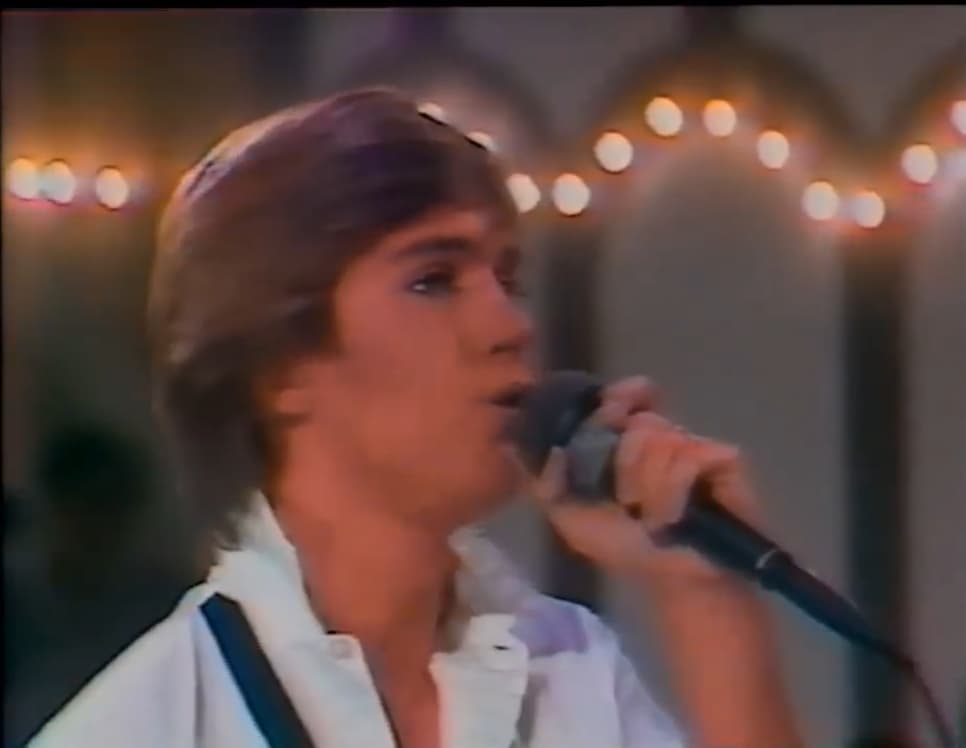
A fleeting glimpse of young love, where longing meets distance and lingers like a memory that refuses to fade
In 1980, when Shaun Cassidy stepped onto the stage in Mexico to perform “Heaven in Your Eyes,” the moment carried more than just the energy of a live show. It reflected a particular chapter in his career—one that stood between the fading echoes of teen idol stardom and the quiet search for something more lasting, more personal.
Originally released in 1980 as part of the album “Wasp”, “Heaven in Your Eyes” did not achieve significant chart success in the United States or the United Kingdom. Unlike his earlier hits such as “Da Doo Ron Ron” (No. 1 on the Billboard Hot 100 in 1977), this song moved in a more subdued space, both commercially and musically. Yet its importance lies not in numbers, but in what it reveals about Shaun Cassidy at that particular moment in time.
Produced by Todd Rundgren, the album “Wasp” marked a deliberate departure from the polished, radio friendly sound that had defined Cassidy’s earlier success. Rundgren, known for his willingness to challenge conventional pop structures, brought a darker, more introspective tone to the project. Within that framework, “Heaven in Your Eyes” emerges as one of the more emotionally accessible tracks—still gentle, still melodic, but carrying an undercurrent of distance and reflection.
The live performance in Mexico adds another dimension to the song. There is a visible connection between performer and audience, yet also a subtle sense of separation. Cassidy sings not with the exuberant certainty of his earlier years, but with a more measured presence. The voice remains clear, but the delivery feels more restrained, as though shaped by experience rather than expectation.
Lyrically, “Heaven in Your Eyes” speaks of an idealized love—something seen, perhaps briefly, and held onto long after the moment has passed. The imagery is simple, yet it carries weight. The idea of “heaven” within someone’s eyes suggests not just admiration, but a kind of emotional refuge, a place where everything feels momentarily complete.
What gives the song its quiet power is the tension between that ideal and reality. There is no resolution offered, no assurance that the feeling will last. Instead, the song lingers in that fragile space where longing and memory begin to overlap. It does not try to resolve the emotion. It allows it to remain, unresolved, much like certain moments in life that resist closure.
By 1980, the cultural landscape had shifted. The late 1970s wave of teen idols had begun to recede, replaced by new sounds and new voices. For Shaun Cassidy, this transition was inevitable. What makes this period compelling is how he responded—not by clinging to what had already brought success, but by stepping into something less certain.
The performance of “Heaven in Your Eyes” reflects that transition. There is no attempt to recreate past triumphs. Instead, there is a quiet acceptance of change, expressed through a song that values sincerity over spectacle. The arrangement remains understated, allowing the emotional core to surface without distraction.
Watching or listening to this performance now, one becomes aware of how time reshapes both music and the people who create it. The song itself may not have dominated the charts, but it captures something more subtle—the moment when an artist begins to look inward rather than outward.
There is also a sense of stillness within the song, a willingness to pause rather than rush forward. It invites the listener to reflect, to remember, to revisit emotions that may have been set aside but never entirely forgotten.
In the end, “Heaven in Your Eyes” is not defined by its commercial impact. It is defined by its atmosphere, its restraint, and its quiet honesty.
And in that 1980 performance in Mexico, Shaun Cassidy offers something that goes beyond nostalgia. He offers a glimpse into a moment of transition—where youth begins to give way to reflection, and where a simple melody becomes a space for memory to settle, gently and without demand.