
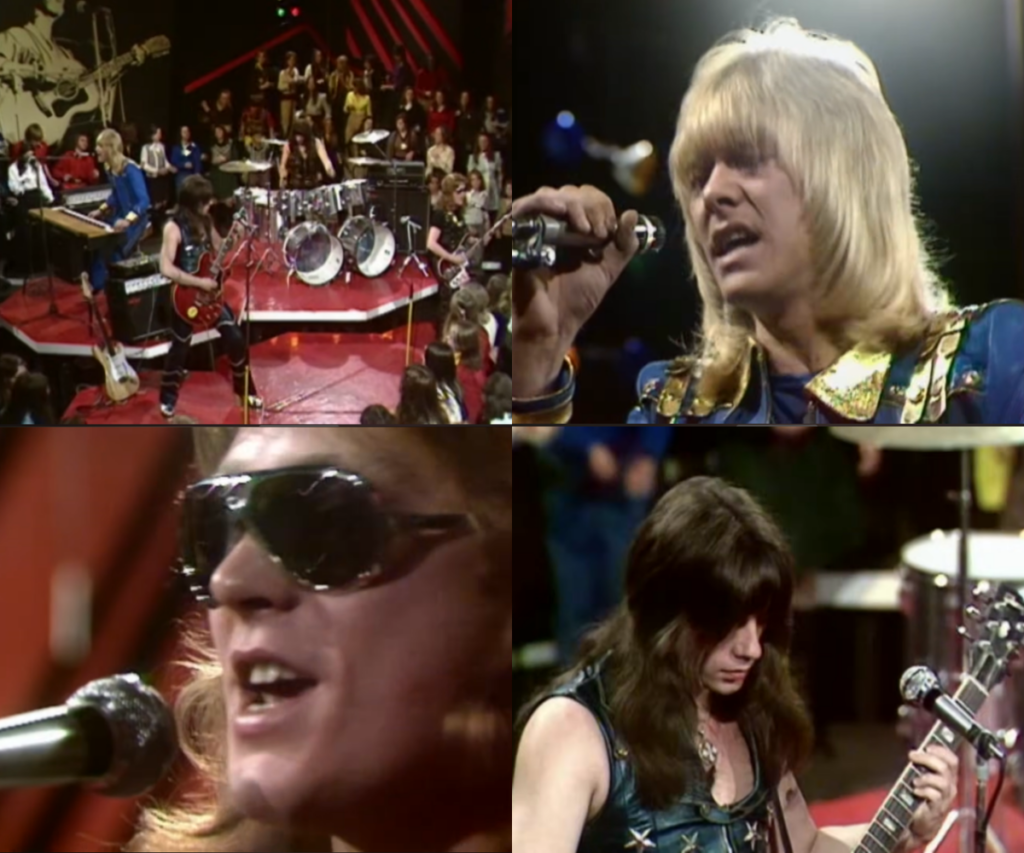
A fleeting television moment that captured The Sweet at their raw, glittering peak—where pop spectacle met the restless pulse of glam rock
There are performances that live on not because they topped the charts, but because they preserved a moment in time so vividly that it refuses to fade. Sweet’s appearance performing “Solid Gold Brass” on The Geordie Scene on November 30, 1974, is one of those rare fragments—less a commercial milestone, more a living document of a band standing right at the crossroads between manufactured pop brilliance and something far more forceful, more self-defined.
By late 1974, The Sweet were already a dominant presence in the UK charts. With hits like “Block Buster!” reaching No.1 on the UK Singles Chart in 1973, and “Teenage Rampage” climbing to No.2 in early 1974, they had become synonymous with glam rock’s bold theatrics. Yet “Solid Gold Brass”, taken from their album Desolation Boulevard (released in 1974 in the UK), told a slightly different story. Unlike their earlier chart-topping singles written by the famed songwriting duo Nicky Chinn and Mike Chapman, this track leaned more heavily into the band’s own musical identity. It wasn’t released as a major standalone single in the UK charts, and therefore didn’t carry a notable chart position upon release—but its importance lies elsewhere. It was a statement piece.
What made this particular television performance so compelling was its stripped-down immediacy. On The Geordie Scene, there were no elaborate stage tricks, no overwhelming production—just the band, their instruments, and a sound that felt louder, heavier, and more urgent than the polished singles that had made them famous. Brian Connolly’s vocals carried a rougher emotional edge, while Andy Scott’s guitar work cut through with a clarity that hinted at the harder rock direction the band would soon embrace more fully.
The song itself, “Solid Gold Brass,” is often overlooked when placed alongside The Sweet’s more commercially successful hits, yet it reveals something essential about their evolution. Lyrically, it touches on the pressures and illusions of fame—how success can feel both triumphant and strangely hollow at the same time. There is a sense of distance in the words, as if the band is already aware that the glitter surrounding them might not last forever. It is not a lament, but neither is it celebratory. Instead, it exists in that uneasy space between recognition and doubt.
Watching that 1974 performance now, one cannot help but notice how the band seemed to be negotiating their identity in real time. They were still dressed in the flamboyant style that defined glam rock—platform boots, vivid colors, unmistakable stage presence—but musically, something was shifting. The energy was less about spectacle and more about sound. It was as if they were quietly pushing against the boundaries that had been set for them, searching for something more enduring than chart positions.
In the broader context of their career, this moment sits just before a period of transformation. By the mid to late 1970s, The Sweet would begin moving toward a heavier rock style, distancing themselves from the bubblegum pop image that had initially defined their success. Songs like “Fox on the Run” and later works would reflect that transition more clearly, but “Solid Gold Brass”—especially in this live television setting—feels like the turning point where that change first became visible.
There is a quiet poignancy in revisiting performances like this. Not because they are perfect, but because they are honest. They capture artists in motion, not yet settled, not yet certain of where they are heading. And perhaps that is why this particular recording continues to resonate. It reminds us that behind every polished hit lies a series of moments like this—unpolished, searching, and deeply human.
In the end, The Sweet did not just leave behind a catalog of hits; they left behind glimpses of their journey. And in that November performance of “Solid Gold Brass,” we are allowed to witness one of those fleeting, revealing moments—when the shine of glam rock met the weight of something more real, and for a brief time, both existed side by side.