
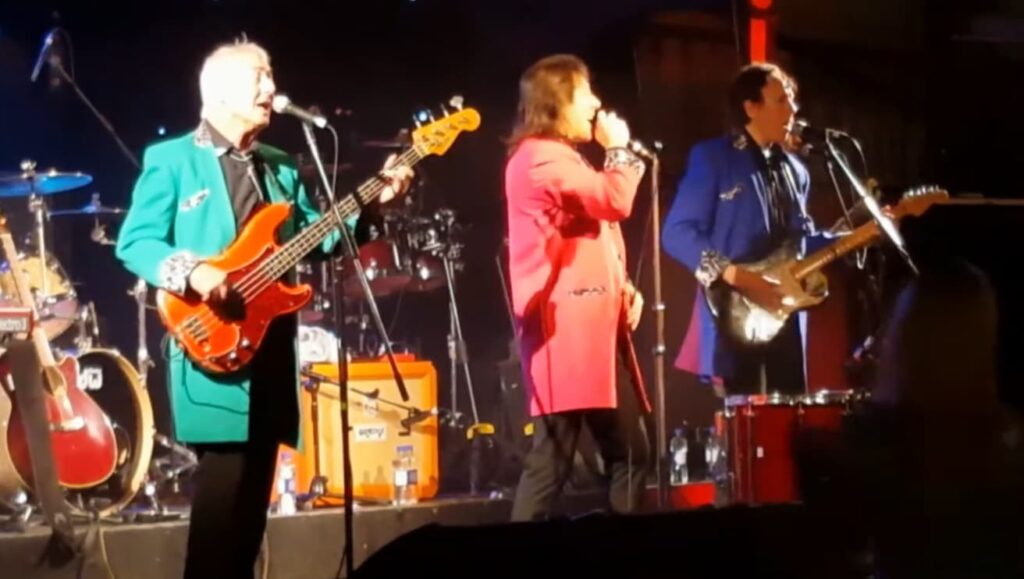
A celebration of memory and movement—“Solid Gold Weekender” is less a performance than a living echo of an era that refuses to fade
By the time Showaddywaddy stepped onto the stage at Seacroft, Hemsby in 2015 for the “Solid Gold Weekender”, they were no longer simply a band performing songs—they had become custodians of a feeling, a sound, and a shared past that stretched back to the mid-1970s. Known for their revival of 1950s rock and roll blended with glam-era polish, the group had already secured their place in music history decades earlier, with a remarkable run of hits including “Under the Moon of Love” (UK No. 1, 1976) and “Three Steps to Heaven” (UK No. 2, 1975).
Yet this particular performance in 2015 was never about chart positions or commercial triumphs. It was about continuity. About how music, once woven into the fabric of everyday life, continues to exist long after the charts have moved on. The “Solid Gold Weekender” events themselves had become something of a sanctuary—gatherings where time softened, and the distance between past and present felt almost negligible.
When Showaddywaddy performed on that stage, their sound carried the unmistakable warmth that had defined them since their formation in Leicester in 1973. The twin-lead vocal approach, the shimmering harmonies, and the steady, danceable rhythms all remained intact. But there was something deeper beneath the surface. The songs were no longer just energetic throwbacks—they had taken on the weight of years, shaped by countless performances and the quiet passage of time.
There is a particular kind of honesty that emerges when artists continue to perform long after their commercial peak. It is no longer about proving anything. Instead, it becomes an act of preservation. In the case of Showaddywaddy, their appearance at Seacroft, Hemsby felt like a reaffirmation of why those songs mattered in the first place. Not because they dominated the charts, but because they endured in memory.
The audience at such gatherings often carries their own stories into the room. Songs that once played on radios in the background of ordinary days now return with a different resonance. A melody that once accompanied youth now carries the quiet awareness of time passing. And in that setting, Showaddywaddy’s music becomes more than entertainment—it becomes a bridge between moments that might otherwise feel disconnected.
Unlike a traditional single or album release, “Solid Gold Weekender” (2015) does not come with chart statistics or official rankings. Its significance lies elsewhere. It exists in the shared experience of those who were there, in the collective recognition of songs that have outlived their original context. It is a reminder that music does not lose its meaning simply because it is no longer new.
What makes performances like this particularly moving is their refusal to modernize for the sake of relevance. Showaddywaddy never abandoned the essence of what they were. They remained rooted in the rock and roll revival sound that first brought them success, trusting that authenticity would carry them forward. And it did.
There is also a certain quiet dignity in that consistency. In a world where trends shift rapidly, the decision to remain unchanged can feel almost radical. And yet, standing on that stage in 2015, Showaddywaddy demonstrated that longevity is not about reinvention, but about staying true to a sound that still resonates.
Watching such a performance, one is reminded that music has a way of holding onto moments that might otherwise slip away. A chorus, a rhythm, a familiar voice—it all returns, not exactly as it was, but close enough to stir something that never quite left.
In the end, “Solid Gold Weekender” is not defined by a single song or a measurable achievement. It is defined by presence. By the simple act of continuing. And in that continuation, Showaddywaddy offers something rare—a sense that while time moves forward, some things remain gently, stubbornly, and beautifully the same.