
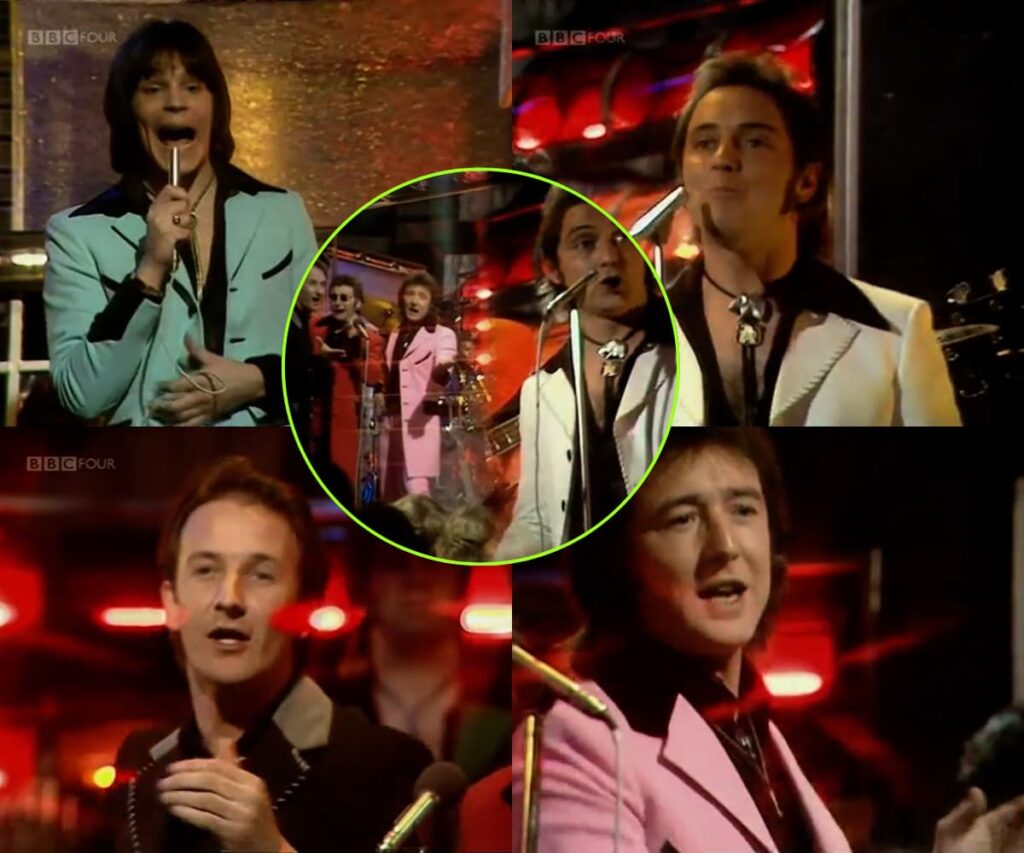
A question left unanswered—where young love meets the quiet ache of not knowing why it slips away
By April 1978, Showaddywaddy had already built a reputation for breathing new life into the golden sounds of the 1950s. Their appearance on Top of the Pops on April 6, 1978, performing “I Wonder Why”, was not simply another televised moment—it was a careful return to the emotional core of early rock and roll, delivered to an audience living in a very different musical age. Originally recorded by Dion and the Belmonts in 1958, the song had reached No. 22 on the US Billboard charts and became one of the defining tracks of the doo-wop era.
When Showaddywaddy revived “I Wonder Why”, they were not chasing chart dominance with this particular performance. Instead, they were preserving something fragile—a feeling, a question, a tone that risked being lost amid the louder, faster-moving sounds of the late 1970s. Their version, released during a period when the band consistently placed hits in the UK Singles Chart, reflected their broader success, even if this specific track was more about homage than reinvention.
Watching that Top of the Pops performance today, there is an immediacy that feels almost disarming. The harmonies are tight, polished, yet never overly refined. There is still a trace of the street-corner sincerity that defined the original recording. The lead vocal does not attempt to overshadow the group; instead, it blends into the collective sound, reminding us that doo-wop was never about one voice alone—it was about voices leaning into each other, filling the spaces between words.
Lyrically, “I Wonder Why” is built on a question that never quite finds its answer. “I wonder why I love you like I do”—it sounds simple, almost naïve at first glance. But beneath that simplicity lies something more complicated. The song does not celebrate love in the way many romantic songs do. It questions it, circles around it, and ultimately accepts that some feelings resist explanation. In that sense, it captures a very particular kind of emotional truth—the kind that does not resolve neatly.
Showaddywaddy understood that truth, and they chose not to overcomplicate it. Their arrangement remains faithful to the spirit of the original, allowing the melody to carry the weight. There is a certain warmth in their delivery, a sense that they are not merely performing the song, but remembering it. And that distinction matters. Because “I Wonder Why” is not just about love—it is about the memory of love, about the way certain questions linger long after the moment has passed.
In 1978, the music world was filled with contrast. Punk had already shaken the foundations of the industry, disco was dominating dance floors, and new wave was beginning to emerge. In the middle of all this, a band like Showaddywaddy stood almost apart, holding onto a sound that belonged to another time. Their performance on Top of the Pops felt like a quiet act of defiance—not loud or confrontational, but steady in its refusal to let go of something meaningful.
There is also something deeply human in the way the song unfolds in this version. The repetition of the central question does not feel redundant. Instead, it feels necessary, as though the act of asking is more important than the answer itself. It reflects a kind of emotional honesty that does not try to resolve uncertainty, but simply acknowledges it.
Over time, performances like this have taken on a different kind of significance. They are no longer just moments of entertainment. They become markers of continuity, reminders that certain melodies, certain emotions, do not disappear—they simply find new voices.
And in that quiet persistence, “I Wonder Why” continues to resonate. Not because it offers clarity, but because it does not. It leaves the question open, suspended in a space where memory and feeling meet. Showaddywaddy, in that brief moment on a television stage in April 1978, did not try to answer it. They simply gave it back to the listener, unchanged, and perhaps a little more tender than before.