
A borrowed rhythm turned into something personal—where confidence in love feels both certain and quietly fragile
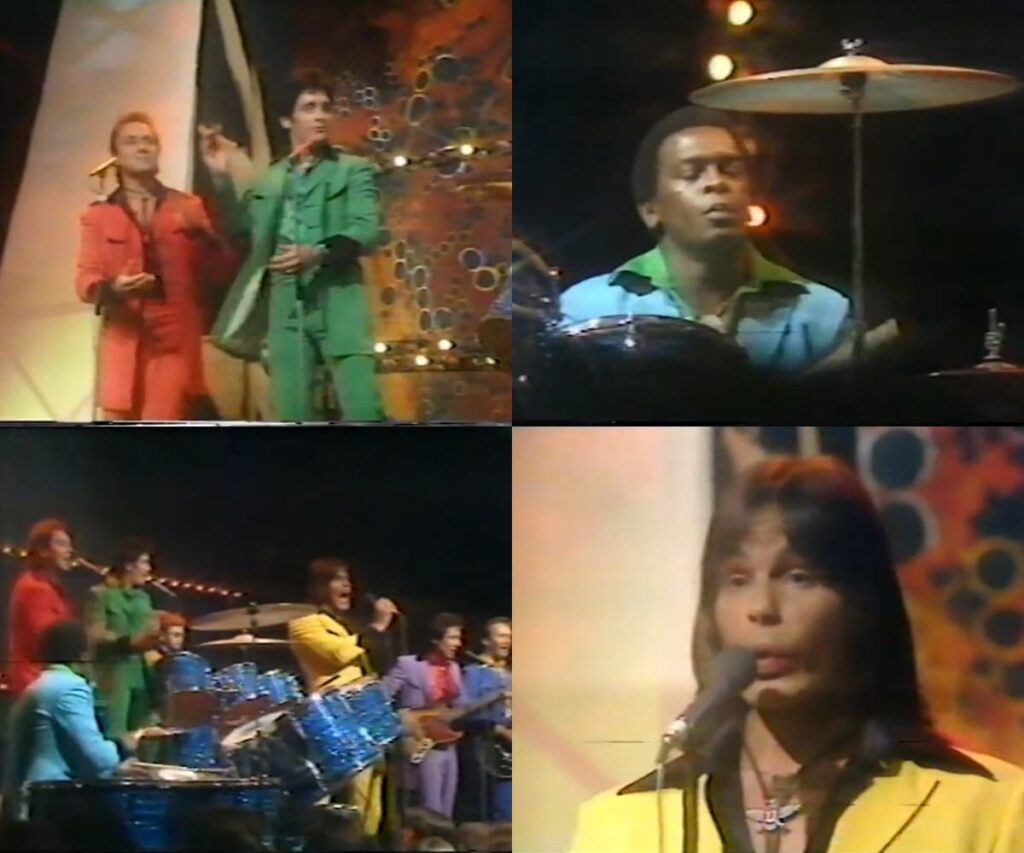
By the summer of 1977, Showaddywaddy had become one of the most reliable chart acts in the United Kingdom, bridging the past and present with a sound that felt both nostalgic and alive. Their performance of “You Got What It Takes” on Top of the Pops on July 28, 1977, came at a moment when the single had already proven its strength, reaching No. 2 on the UK Singles Chart. It was one of their biggest hits, confirming that their revivalist approach was not simply a novelty, but a connection that audiences continued to embrace.
The song itself carries a lineage that stretches back nearly two decades. Originally recorded in 1959 by Marv Johnson, “You Got What It Takes” reached No. 10 on the Billboard Hot 100 and became an early success for Motown’s emerging songwriting and production style. Written by Berry Gordy, Gwen Gordy, Billy Davis, and Marv Johnson, the track was rooted in the optimism and rhythmic clarity that would soon define an entire era of American music.
When Showaddywaddy revisited the song in 1977, they did not attempt to modernize it in the conventional sense. Instead, they leaned into its original spirit—tight harmonies, a steady beat, and a sense of joyful assurance that love, despite its uncertainties, can still feel within reach. Their version carries a slightly heavier rhythmic drive, shaped by the production sensibilities of the 1970s, yet it never loses the simplicity that made the original so enduring.
Watching their Top of the Pops performance, there is a sense of balance that defines the moment. The band appears confident, almost effortless, yet there is nothing careless in the way the song is delivered. Every harmony is placed with intention, every gesture aligned with the rhythm. It reflects years of experience, of understanding not just how to perform a song, but how to inhabit it.
Lyrically, “You Got What It Takes” is built on affirmation. It speaks of belief in another person, of recognizing something intangible yet undeniable. But beneath that affirmation lies a subtle vulnerability. To say that someone “has what it takes” is also to admit uncertainty—that such assurance must be spoken, repeated, reinforced. Showaddywaddy’s version captures this duality with quiet precision. The brightness of the melody suggests confidence, while the repetition hints at something more fragile beneath the surface.
In 1977, the musical landscape was shifting rapidly. Punk rock was challenging established norms, disco was dominating clubs, and popular music seemed to be moving toward sharper contrasts. In this environment, Showaddywaddy stood apart, not by resisting change outright, but by offering continuity. Their music did not ignore the present—it simply chose to carry the past forward into it.
That is what makes their rendition of “You Got What It Takes” particularly resonant. It is not just a cover. It is a reminder that certain emotional truths do not age. The idea that love requires both belief and doubt, that confidence and uncertainty can exist side by side, remains as relevant as ever.
There is also something quietly reflective in revisiting this performance today. The polished stage, the familiar format of Top of the Pops, the sense of occasion—it all belongs to a time when music was experienced collectively, when a song’s success was measured not only in chart positions but in shared moments.
And perhaps that is where the true meaning of “You Got What It Takes” begins to settle. It is not simply about the person being addressed in the song. It is about the act of believing itself—the willingness to trust in something that cannot be fully explained.
Showaddywaddy, in that July 1977 performance, did not attempt to redefine the song. They allowed it to remain what it had always been: a statement of feeling, clear and uncomplicated, yet layered with the quiet complexities that come with time. And in doing so, they offered something that continues to resonate—not just a melody, but a moment of recognition, carried forward without losing its original shape.