
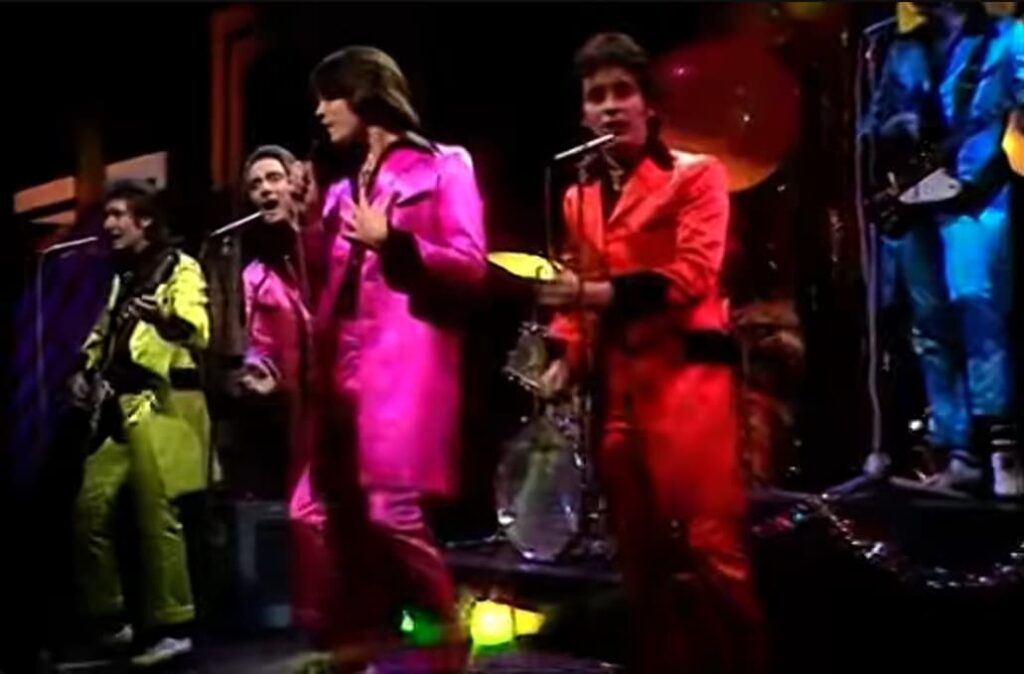
A bright, irresistible promise of love—“You Got What It Takes” turns simple devotion into something joyful, immediate, and unforgettable
When Showaddywaddy brought “You Got What It Takes” to the stage of Top of the Pops Christmas Special in 1977, they were already standing at the height of their popularity, riding a remarkable streak of UK chart success. Originally released earlier that year as a single, the song climbed to No. 2 on the UK Singles Chart, reaffirming the group’s unique ability to revive the spirit of 1950s rock and roll while keeping it fresh for a new generation. It was a time when their sound—polished yet nostalgic—felt both familiar and exciting, a rare balance that few bands managed to sustain.
The song itself was not new. “You Got What It Takes” had its roots in earlier decades, first recorded by Marv Johnson in 1959, later interpreted by artists like Bobby Vee and The Dave Clark Five. But in the hands of Showaddywaddy, it took on a different kind of life—brighter, more exuberant, and shaped by the theatrical energy that defined their performances. Their version did not merely revisit the past; it reintroduced it with a sense of celebration, as if the song had been waiting for this exact moment to return.
The Top of the Pops Christmas Special appearance added another layer to its story. These year-end broadcasts were more than just television programs; they were cultural rituals, moments when music and memory intertwined in a particularly vivid way. To see Showaddywaddy perform “You Got What It Takes” in that setting was to witness a band fully aware of its role—not just as entertainers, but as carriers of a sound that connected generations. The festive backdrop, the sense of occasion, the shared familiarity of the song—all of it combined into something quietly meaningful.
At its core, “You Got What It Takes” is a song about certainty. Not the dramatic, overwhelming kind of love often found in ballads, but something simpler and more immediate. The lyrics speak of recognition—that moment when affection feels undeniable, when the presence of another person seems to answer a question that had not yet been fully asked. It is direct, almost unadorned in its message, and perhaps that is precisely why it resonates.
What sets Showaddywaddy’s version apart is the way they deliver that simplicity. There is no attempt to complicate the emotion or deepen it beyond what it naturally is. Instead, they embrace its lightness. The rhythm moves with an easy confidence, the harmonies feel effortless, and the vocals carry a sense of joy that never feels forced. It is music that does not ask to be analyzed too closely—it invites you to feel it, to remember where you were when songs like this filled the air without effort.
And yet, with the passage of time, even a song as buoyant as this begins to carry a different weight. Listening now, decades removed from that 1977 performance, one becomes aware of how much has changed—and how much has not. The melody remains intact, the chorus still lifts in the same way, but the listener brings something new to it: experience, memory, perhaps a quiet awareness of time’s steady movement.
That is the enduring strength of “You Got What It Takes.” It exists comfortably in two worlds. In one, it is a lively, infectious pop record from the late 1970s, perfectly suited to television stages and festive celebrations. In the other, it becomes a small vessel of memory, carrying with it the echoes of a time when music felt immediate and uncomplicated.
Showaddywaddy never set out to reinvent music—they understood something more subtle. That sometimes, the most powerful thing a song can do is remind us of what has always been there. A melody, a voice, a feeling that returns without warning, as clear as it once was.
And so that performance on a Christmas evening in 1977 lingers—not because it was grand or groundbreaking, but because it was sincere. Because for a few minutes, everything aligned: the song, the moment, and the quiet recognition that some feelings never really change.