
A song of forgotten names finds new breath in two voices, where memory becomes responsibility and silence is gently broken.
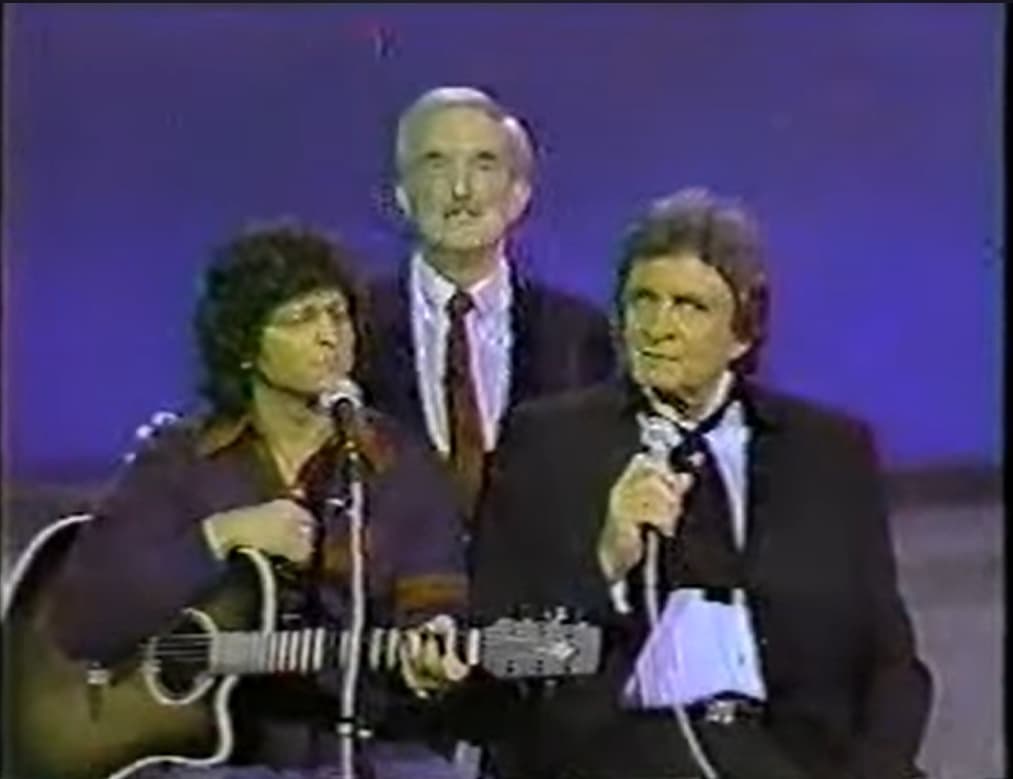
When Johnny Cash and Johnny Rodriguez performed “Deportee (Plane Wreck at Los Gatos)” on Nashville Now in 1987, the moment carried a weight far beyond the stage. This was not a chart-driven performance, nor a revival of a commercial hit. The song itself, written in 1948 by Woody Guthrie with music later added by Martin Hoffman, had never been designed for the charts. Instead, it lived in a different space—one shaped by memory, injustice, and the quiet insistence that certain stories should not disappear.
The origin of “Deportee” lies in a real tragedy: the 1948 plane crash at Los Gatos Canyon in California, which killed 32 people, including 28 Mexican farm workers being deported back to Mexico. Newspaper reports at the time named the American crew members, but referred to the Mexican victims simply as “deportees,” leaving them anonymous even in death. This omission moved Woody Guthrie to write the song as a protest against that erasure, giving voice—if not names—to those who had been denied both recognition and dignity.
By the time Johnny Cash and Johnny Rodriguez brought the song to Nashville Now nearly four decades later, its meaning had only deepened. Johnny Cash, long known for his affinity with songs about the overlooked and the marginalized, approached the material with a solemn restraint. His voice, already marked by time and experience, carried a gravity that required no embellishment. Johnny Rodriguez, with his own Mexican American heritage, added another dimension—one that felt personal, rooted not just in interpretation but in lived connection.
Together, they created a performance that did not seek to dramatize the tragedy, but to acknowledge it. The arrangement is sparse, almost deliberately so. There is no attempt to modernize or expand the song’s structure. Instead, the focus remains on the lyrics, on the quiet repetition of lines that gradually reveal their full weight. The phrase “you won’t have your names when you ride the big airplane” lingers not as a poetic image, but as a statement of fact—one that still resonates long after the music fades.
Unlike many of the songs associated with Johnny Cash, “Deportee” did not chart in a conventional sense. Its significance lies elsewhere. It belongs to a tradition of American folk and country music that values storytelling over commercial success, that measures impact not in sales but in memory. In performing it on a national television program, Cash and Rodriguez brought that tradition into a space where it could reach a wider audience, reminding listeners that some stories remain unfinished, no matter how much time has passed.
There is a quiet dignity in the way both artists handle the material. They do not impose themselves on the song. They allow it to remain what it is—a narrative shaped by loss and injustice, carried forward through music. The contrast between their voices adds to this effect. Cash’s deep, measured delivery anchors the performance, while Rodriguez brings a subtle warmth that softens the edges without diminishing the song’s seriousness.
Looking back, this 1987 performance stands as more than a collaboration between two respected artists. It represents a moment where music serves its oldest purpose—not entertainment, but remembrance. In a world where stories can easily be forgotten or reduced to statistics, “Deportee” insists on something more. It asks not for sympathy, but for recognition.
And in that quiet insistence, the song continues to endure. Not because it changes, but because it refuses to let certain truths fade into silence. Through the voices of Johnny Cash and Johnny Rodriguez, those truths are carried forward—steady, unadorned, and impossible to ignore once they have been heard.