
A quiet farewell wrapped in calm reassurance, where love chooses dignity over longing and learns to let go without bitterness.
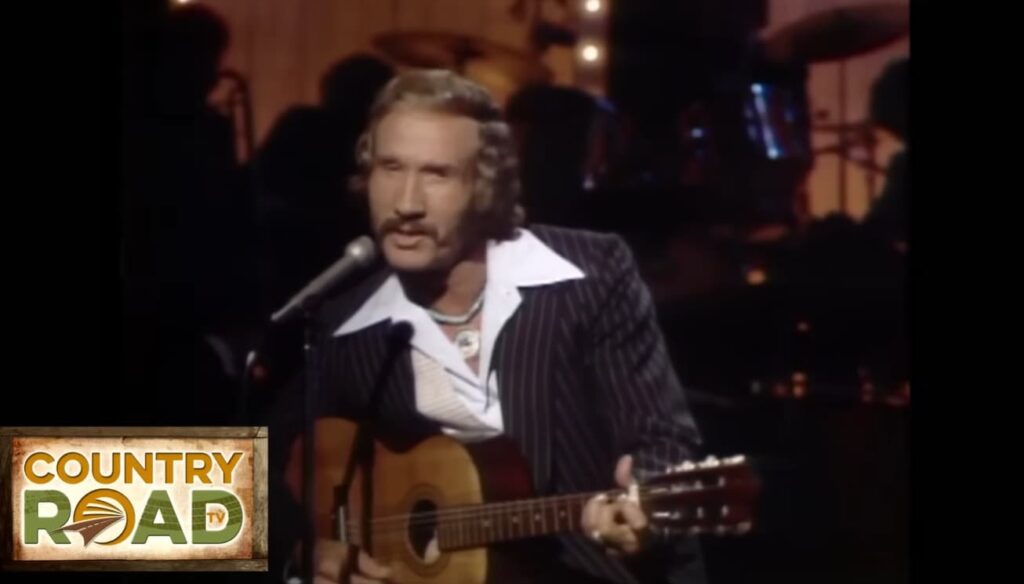
When Marty Robbins performed “Don’t Worry About Me” on Country Road TV, it felt less like a performance and more like a moment suspended in time. By then, Robbins was no longer simply the chart dominating voice behind “El Paso” or the polished storyteller of Gunfighter Ballads and Trail Songs. He had become something quieter, more reflective. And in this setting, with the cameras close and the arrangement stripped of excess, “Don’t Worry About Me” revealed itself not as a standard, but as a confession spoken gently into the air.
The song itself has a long lineage, originally written in 1939 by Rube Bloom and Ted Koehler. It had been interpreted by many before Robbins, including voices from jazz and pop traditions, yet it never belonged fully to any single genre. It was a song built on restraint, on the quiet ache of parting without accusation. Unlike the dramatic heartbreak narratives that often filled the charts, “Don’t Worry About Me” found its strength in understatement. It did not ask for sympathy. It offered release.
Because of its origins in the pre rock era, the song did not chart for Marty Robbins in the same way his original recordings did. There are no Billboard country rankings tied to his rendition, no numerical marker to define its reach. And yet, in many ways, that absence feels appropriate. This is not a song that lives in numbers. It lives in the spaces between words, in the pauses where the singer seems to gather himself before continuing.
On Country Road TV, Robbins approaches the song with remarkable control. His voice, still unmistakably clear, carries a softness that suggests experience rather than decline. He does not embellish the melody. He allows it to unfold naturally, almost as if he were remembering it rather than performing it. That distinction matters. Because in this version, every line feels considered, weighed against a lifetime of songs about love found and lost.
There is something deeply human in the way Robbins delivers the central message. “Don’t worry about me” is not sung as a statement of strength, nor as a shield against pain. Instead, it feels like a kindness extended to someone who is leaving. A way of easing their burden, even as the singer himself remains behind. It is this quiet generosity that gives the song its enduring resonance.
For listeners familiar with Marty Robbins’ earlier work, the contrast is striking. The dramatic narratives of his Western ballads, the vivid characters and sweeping melodies, are replaced here by something far more intimate. There are no gunfighters, no deserts, no cinematic arcs. Just a voice, a melody, and the simple act of letting go.
And yet, the storytelling remains. It is simply turned inward. Robbins does not need elaborate imagery to convey emotion. A slight hesitation in his phrasing, a gentle lowering of his tone at the end of a line—these become the details that carry the story forward. In this way, the performance on Country Road TV feels almost like a conversation overheard rather than a song presented.
Looking back, this rendition of “Don’t Worry About Me” stands as a reminder of what made Marty Robbins such a compelling artist. It was never just the hits or the chart positions, though he had plenty of both. It was his ability to inhabit a song completely, to find its emotional center and hold it steady without forcing it outward.
There is a certain stillness to this performance that lingers long after it ends. No grand finale, no dramatic flourish. Just a quiet resolution, as if the song has come to terms with itself. And perhaps that is its lasting gift. In a world that often demands louder expressions of feeling, “Don’t Worry About Me” offers something rarer—a moment of calm acceptance, carried by a voice that understands exactly how much can be said by saying very little.
 Oldies Songs