
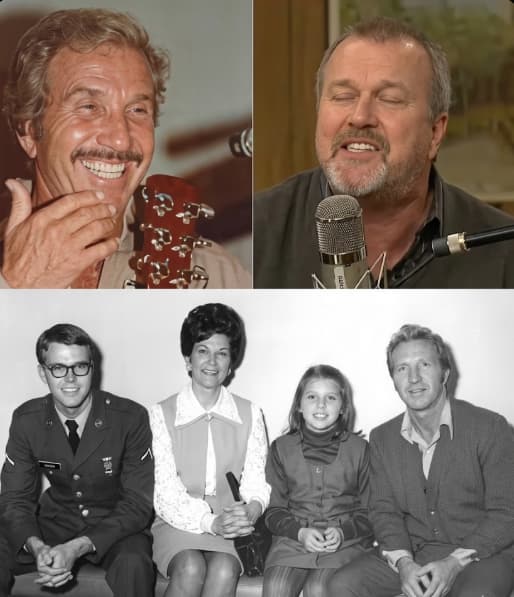
Marty Robbins – “Love from the Desert”: The Enduring Union of the Silver-Screen Cowboy and His Greatest Treasure
In the glittering, often fickle world of show business, where stars frequently burn bright and fade just as fast, the story of Marty Robbins and his wife, Marizona Baldwin, stands as a rare and beautiful anomaly. It is a narrative of steadfast devotion that began long before the gold records, the Grammy Awards, or the standing ovations at the Grand Ole Opry. If Marty’s life was an epic Western film, then Marizona was the soul of the story—the “greatest treasure” he discovered not in a hidden canyon or a buried chest, but in the heart of the Arizona desert. Their marriage, which lasted from 1948 until his passing in 1982, provided the emotional anchor that allowed the “Gentle Giant” to soar to the highest peaks of musical fame.
The “backstory” of this legendary union is as humble and authentic as a Robbins ballad. They met in the late 1940s in Phoenix, back when Marty was a young veteran recently returned from the U.S. Navy, performing in local clubs and on radio stations like KPHO. Marizona wasn’t just a spouse; she was his first believer, his steady compass during the lean years when “making it” was just a distant dream. While Marty’s career eventually saw him dominate the Billboard charts with an astonishing 94 hits, including 16 number-one singles, the most significant “ranking” in his life was always his role as a husband and father. To the sophisticated reader, their story is a poignant reminder that behind every great public figure is often a private, unbreakable bond that makes everything else possible.
The Silent Strength Behind the “Velvet Voice”
For those of us who have spent a lifetime observing the ebb and flow of human relationships, the depth of Marty’s love for Marizona is most visible in his music. He didn’t just sing about love; he sang about partnership. When he penned “My Woman, My Woman, My Wife” in 1970, it wasn’t a calculated move for a hit; it was a soul-baring tribute to the woman who had stood by him through poverty, health crises, and the relentless demands of a touring life.
“Lord, give her my share of Heaven if I’ve earned any here in this life…”
These lyrics, which earned him a Grammy for Best Country Song, reflect the vulnerability of a man who realized that his fame was a shared achievement. Marizona was the one who managed the home, raised their children, Ronny and Janet, and provided the “foundation” he so famously sang about. In an era where the “outlaw” lifestyle often tore families apart, Marty’s public and private devotion to his wife offered a different kind of heroism—the heroism of loyalty.
A Legacy of Love That Transcends the Stage
As we look back at the archival photos of the couple—Marty in his tailored Western suits and Marizona with her classic, understated elegance—we see a reflection of an era that valued longevity and commitment. The desert may have been the place of Marty‘s birth, but Marizona was the oasis that sustained him. Their love story provides the essential “why” behind the warmth in his voice. You can hear it in every tender note of his ballads; there is a sense of security and peace that only comes from knowing you have a home to return to.
Today, their legacy continues through their children and the timeless music that Marizona helped inspire. For the listener who cherishes the “old ways,” their story is a testament to the fact that the most valuable things in life aren’t the ones we chase on a stage, but the ones we hold close in the quiet moments. Marty Robbins may have been a titan of the music industry, but in his own heart, he was simply a man from the desert who was lucky enough to find his greatest treasure early in the journey.
 Music Legend