
A living bridge between generations, where reverence for tradition becomes a shared heartbeat rather than a museum piece
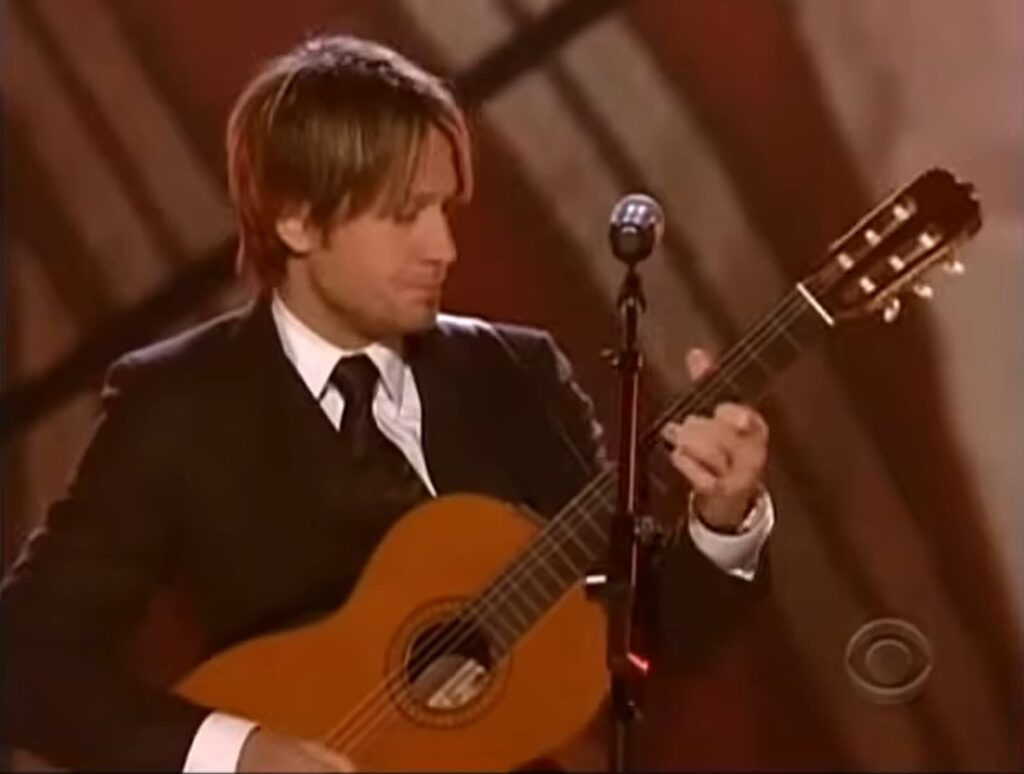
When Keith Urban stepped onto the stage to perform the “Marty Robbins Medley” at the George Strait – ACM Artist of the Decade All Star Concert, the moment carried weight far beyond applause or spectacle. This was not a chart driven performance, nor was it meant to introduce a new song into rotation. It was an act of remembrance, respect, and continuity. In honoring Marty Robbins, Urban was also acknowledging the deeper roots of country music itself, the kind built on story, restraint, and emotional clarity.
The performance took place during the ACM Artist of the Decade All Star Concert, held in 2009 to honor George Strait, whose influence on country music had defined an era. The event itself was historic, bringing together artists across generations to pay tribute to Strait’s legacy. Within that framework, Keith Urban’s decision to perform a medley of Marty Robbins songs was both thoughtful and symbolic. Robbins was one of Strait’s earliest and most profound influences, particularly in the realm of narrative driven Western ballads.
The “Marty Robbins Medley” was not released as a commercial single and did not appear on any chart, nor was it intended to. Its value lay elsewhere. It existed in the moment, within the shared understanding of what Robbins represented. Songs such as El Paso and Big Iron, staples of Robbins’s catalog, were woven together not as nostalgia, but as living stories. These were songs that once topped the charts, with El Paso famously reaching Number One on the Billboard Hot 100 in 1960, a rare achievement for a country ballad built almost entirely on narrative.
Keith Urban approached the medley with clear reverence. Rather than modernizing the material or reshaping it to fit his own sonic identity, he allowed the songs to speak in their original emotional language. His performance balanced technical skill with humility. The guitar lines were precise but restrained. His vocal delivery was respectful, never overpowering the stories themselves. It was evident that he understood his role not as a reinterpreter, but as a caretaker for a few precious minutes.
The story behind this tribute reaches back decades. Marty Robbins was one of country music’s great storytellers, a singer who treated songs like short films, complete with characters, tension, and moral consequence. His influence on artists like George Strait was foundational. Strait carried Robbins’s commitment to narrative into a new era, proving that traditional storytelling could thrive in modern country music. Urban’s medley, performed in honor of Strait, completed that lineage in a single gesture.
The meaning of the performance lies in its quiet message. Country music is not sustained by innovation alone. It survives because each generation listens backward as well as forward. By choosing Marty Robbins, Urban reminded the audience that the genre’s emotional core remains unchanged. Love, loss, honor, and consequence still matter. Stories still matter.
Musically, the medley honored Robbins’s Western ballad tradition. These songs demand space and patience. They cannot be rushed. Urban respected that pacing, allowing the narrative to unfold naturally. The audience response reflected recognition rather than surprise. This was familiar ground, revisited with care.
Within the larger context of the George Strait – ACM Artist of the Decade All Star Concert, the medley served as a moment of grounding. Amid celebrations of success and longevity, it pointed back to origin. It reminded everyone present that Strait’s achievements did not emerge in isolation. They were shaped by voices like Robbins’s, voices that valued storytelling over trend.
For Keith Urban, the performance also revealed something essential about his artistry. Though often associated with contemporary country and crossover appeal, he has always carried deep respect for the genre’s past. The “Marty Robbins Medley” was a public acknowledgment of that respect, offered without explanation or embellishment.
Long after the lights dimmed, the meaning of that performance remains. It stands as proof that tribute, when done with sincerity, can feel less like looking backward and more like carrying something forward. In honoring Marty Robbins, Keith Urban honored the idea that country music is a conversation across time.
That is why this medley endures in memory. It was not about reinvention. It was about continuity. A reminder that some songs, and some voices, never truly leave us. They simply wait for the right moment, and the right hands, to be heard again.