
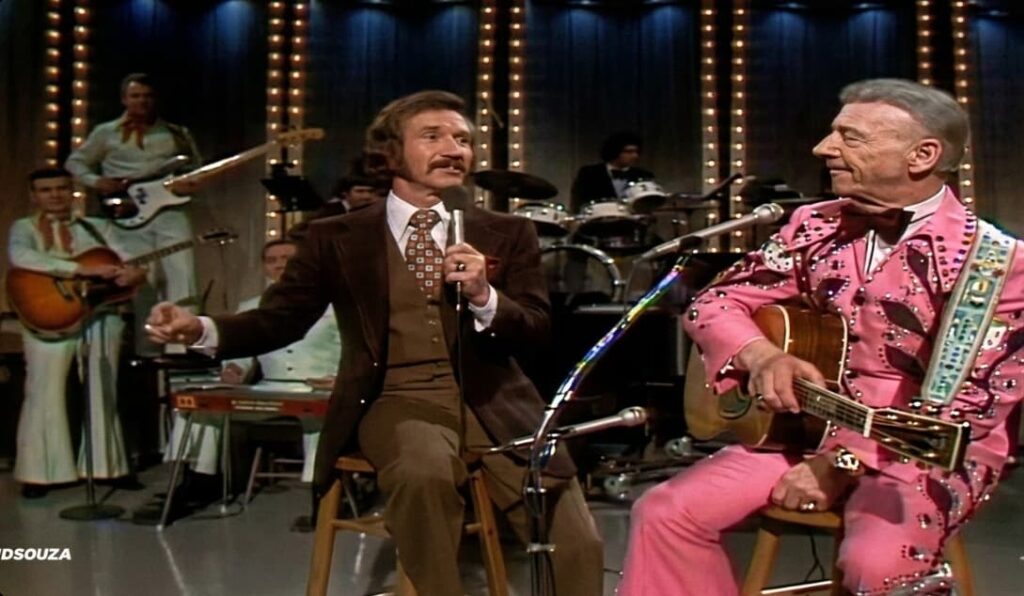
Hank Snow and Marty Robbins on The Marty Robbins Show: A Meeting of the Singing Ranger and the Desert Balladeer
For those of us who grew up with the steady rhythm of the Grand Ole Opry and the flickering glow of the television on a Saturday night, there was a particular kind of reverence reserved for the moment Hank Snow stepped onto The Marty Robbins Show. This wasn’t just a guest appearance; it was a meeting of the “Singing Ranger”—the man who had carried the torch of traditional country music from the Canadian maritimes to the heart of Tennessee—and Marty Robbins, the versatile king of the Western ballad. Together, they represented the bedrock and the evolution of the genre, two men who shared a deep, abiding love for the story-song and a level of musicianship that remains a high-water mark for the industry.
The historical timing of their collaborations, spanning from the late 1960s into the Spotlight era of the late 70s, captured a fascinating dynamic. Hank Snow was already a legend, having been a mainstay of the Opry since 1950, with a career defined by impeccable diction, a distinctive baritone, and some of the finest flat-picking guitar work in the business. When he appeared with Marty, the “story” was one of profound mutual respect. Marty Robbins often spoke of his admiration for the veterans who paved the way, and there was no veteran more respected than Hank. To watch them together was to see a masterclass in the “professionalism” of the old school—sharp suits, perfectly tuned guitars, and a commitment to the audience that never wavered.
For the mature viewer, seeing Hank Snow on Marty’s stage evokes a powerful, heart-tugging nostalgia. It reminds us of a time when “country” was built on travelogues and tales of the rails. Hank’s signature hits, like “I’m Movin’ On” and “I’ve Been Everywhere,” were more than just songs; they were the soundtrack to an America that was still wide-open and full of mystery. For a generation that remembers the first time they tried to keep up with the rapid-fire lyrics of a Hank Snow record, seeing him trade lines with Marty Robbins was a deeply moving experience. It speaks to a time when we valued the “craft” of the entertainer—the ability to deliver a complex lyric with absolute clarity and a steady beat.
The meaning of their time together on screen is rooted in the concept of “Musical Integrity.” Both Marty and Hank were famous for their high standards. Hank Snow was a perfectionist who demanded the best from his band, The Rainbow Ranch Boys, and Marty shared that same relentless drive for excellence. When they joked together between sets—Hank with his dignified, slightly formal Canadian charm and Marty with his quick-witted, easygoing warmth—there was an underlying sense of brotherhood. They were two men who had seen the industry change a thousand times, yet they remained true to the soul of the music. For the reflective heart, this performance is a reminder that while trends come and go, the power of a simple, honest story told by a great voice is eternal.
Musically, the highlights were often the guitar duets. While we think of them primarily as singers, both Marty and Hank were exceptional guitarists. Seeing them sit with their acoustics, trading licks and exploring the “shuffled” rhythms that defined their era, was a rare treat. Hank’s precise, melodic picking provided a beautiful contrast to Marty’s rhythmic, Spanish-influenced style. It was a sound that felt as timeless as the plains and as steady as a steam engine crossing the desert.
Reflecting on these episodes today, we are reminded of the dignity that Hank Snow and Marty Robbins brought to the genre. They proved that country music could be both traditional and sophisticated, rooted in the past but always moving forward. Their time together on The Marty Robbins Show remains a shining example of the “Golden Age” of television—a memory of two legends who didn’t just sing songs; they shared a way of life with us, one honest note at a time.
 Music Legend