
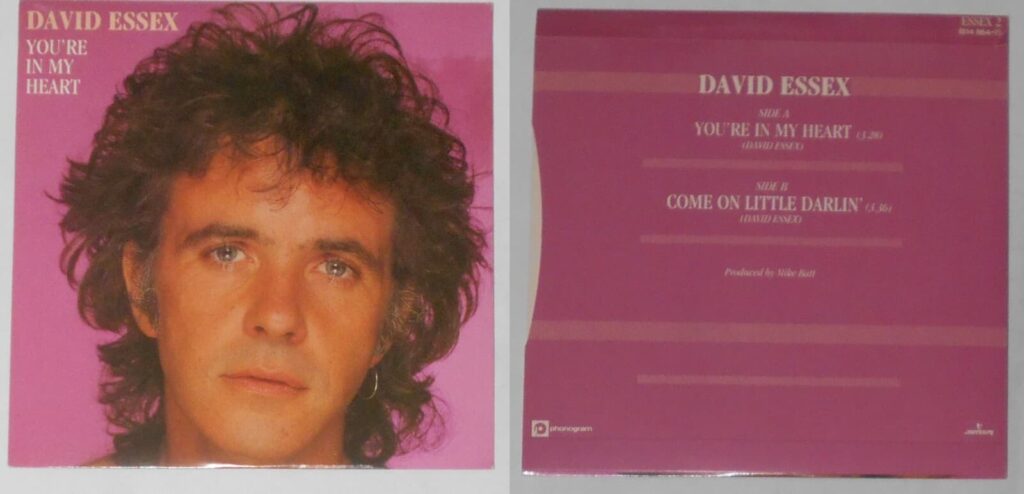
A tender invitation from a young voice, capturing the fragile hope and restless innocence of an era on the brink of change
When “Come On Little Darlin’” first appeared in 1970, it announced David Essex not with bombast or bravado, but with an earnest, open heart. Released as his debut single and included on his first album Rock On, the song quickly found its place in the public imagination. It climbed to No. 2 on the UK Singles Chart, an extraordinary achievement for a new artist at the very beginning of his journey. Only “In the Summertime” by Mungo Jerry kept it from the top spot, yet its commercial position tells only part of the story. What mattered more was how naturally this song settled into people’s lives, sounding less like a performance and more like a conversation held late at night.
At its core, “Come On Little Darlin’” is built on simplicity. The melody unfolds gently, almost tentatively, supported by a warm arrangement that never overwhelms the vocal. David Essex, still barely out of his teens, sings with a voice that carries both uncertainty and quiet confidence. There is no theatrical exaggeration here. Instead, there is the sense of someone discovering how to speak honestly through music, learning in real time that restraint can be more powerful than display.
The song’s lyrics are deceptively straightforward. A plea, an invitation, a soft insistence repeated like a mantra. Yet beneath those words lies a deeper emotional texture. This is not the voice of conquest or certainty. It is the sound of someone standing at the edge of experience, asking rather than demanding, hoping rather than assuming. That emotional posture resonated strongly in 1970, a year when popular music was increasingly polarized between raw rebellion and polished escapism. “Come On Little Darlin’” occupied a quieter middle ground, one rooted in personal feeling rather than cultural statements.
The story behind the song reflects that same balance. David Essex had been working steadily as an actor and performer, but music offered him a different form of expression. With “Come On Little Darlin’”, he stepped into the recording world without disguises. The production favors warmth over innovation, clarity over experimentation. Acoustic textures, subtle percussion, and a measured tempo give the song room to breathe. It never rushes its message, trusting the listener to lean in rather than be pulled along.
What gives the song lasting meaning is its emotional honesty. The narrator does not promise transformation or forever. He offers presence, companionship, and the possibility of shared feeling. That modesty is its strength. Over time, the song has come to represent a particular emotional moment many recognize instantly, the period when desire is still wrapped in politeness, when longing has not yet hardened into expectation.
Placed within the broader arc of David Essex’s career, “Come On Little Darlin’” stands as a foundational statement. Later hits like “Rock On” and “Hold Me Close” would reveal different facets of his artistry, bolder rhythms, darker moods, and greater commercial ambition. But this debut remains unique for its gentleness. It shows an artist before image and legacy take shape, when the voice is still closely aligned with the person behind it.
Listening now, the song carries a subtle sense of time passed. Its sound belongs unmistakably to the early seventies, yet its emotional language remains familiar. It reminds us of evenings colored by possibility rather than certainty, of moments when asking felt more meaningful than declaring. “Come On Little Darlin’” does not insist on remembrance, but it invites it quietly, the way it always has.
In the end, this song endures because it understands the power of understatement. David Essex did not need to shout to be heard. With “Come On Little Darlin’”, he simply spoke, and the world listened.