
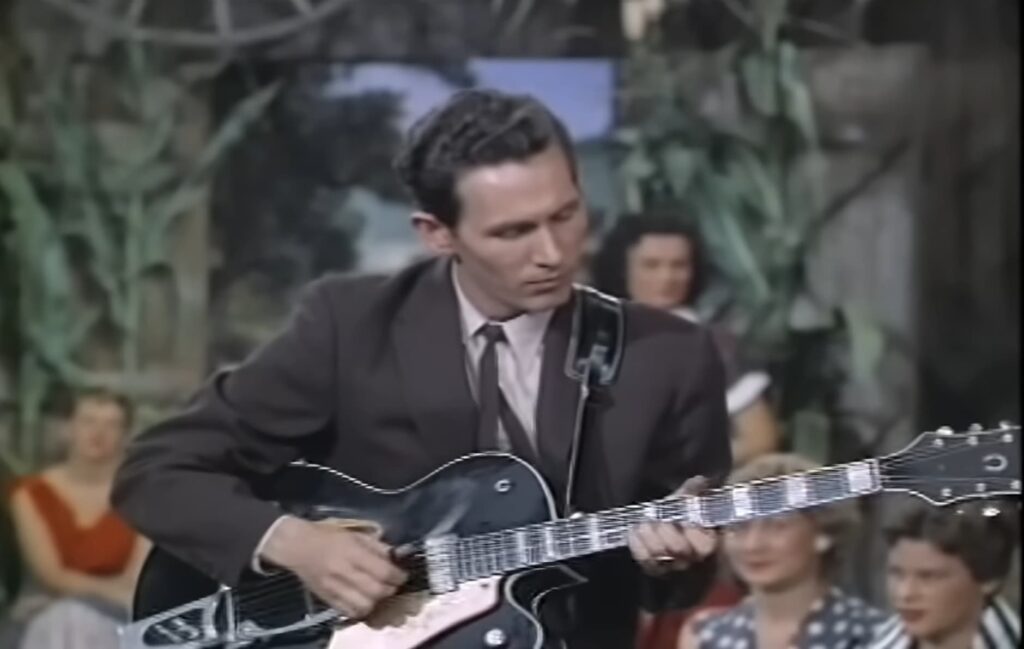
A Wordless Lament in Six Strings — When Memory Speaks Through Melody Alone
Few instrumental pieces capture longing with the quiet dignity of “Dark Eyes” as interpreted by Chet Atkins. Released during the fertile years of his RCA recordings, Atkins’ rendition of this traditional Russian melody became one of those understated treasures that never stormed the pop charts, yet quietly carved its place in the hearts of listeners who understood the language of nuance. Unlike mainstream singles designed for chart dominance, “Dark Eyes” was never a Billboard Hot 100 contender. Instead, it belonged to the more refined spaces of country instrumental albums and adult listening audiences, appearing in Atkins’ live repertoire and various compilations throughout the 1950s and 1960s, including performances tied to albums such as “Chet Atkins in Three Dimensions” (1957) and later concert recordings that showcased his mastery.
Originally known as “Ochi Chyornye,” “Dark Eyes” dates back to 19th-century Russia, with lyrics attributed to Ukrainian poet Yevhen Hrebinka and music adapted from a composition by Florian Hermann. The song had long been associated with passionate, almost gypsy-like romanticism—intense, dramatic, and emotionally raw. By the time Chet Atkins approached it, the piece had already traveled continents, languages, and generations. What he offered was not reinvention, but refinement.
Atkins, often referred to as “Mr. Guitar,” was already a towering figure in American music when he performed “Dark Eyes.” By the mid-1950s, he had helped shape the Nashville Sound, smoothing country music’s rougher edges into something more polished and accessible. His instrumental hit “Yakety Axe” would later reach No. 4 on the Billboard Country Chart in 1965, and he had already established himself as both a virtuoso guitarist and an influential producer. Yet in “Dark Eyes,” there is no flash for its own sake. There is restraint, elegance, and above all, feeling.
The meaning of “Dark Eyes” has always revolved around desire tinged with sorrow—the kind of love that burns intensely but carries the shadow of inevitability. In its lyrical form, it speaks of captivating eyes that both enchant and wound. Without uttering a single word, Atkins manages to preserve that emotional paradox. His fingerstyle technique—clean, articulate, and impossibly controlled—allows the melody to breathe. Each note feels deliberate, as though placed with careful thought rather than technical display.
Listening closely, one notices how Atkins balances melody and accompaniment simultaneously, his thumb providing a steady bass foundation while his fingers trace the yearning upper lines. This signature “Travis picking” style, which he perfected and popularized, gives “Dark Eyes” a sense of movement—like a quiet train rolling through twilight countryside. There is melancholy here, but not despair. Instead, there is acceptance, even grace.
In the broader context of his career, Atkins’ interpretation reflects his lifelong respect for melody above spectacle. During an era when rock and roll was beginning to dominate airwaves, he remained committed to musical craftsmanship. Albums such as “Finger-Style Guitar” (1956) and “Chet Atkins at Home” (1957) demonstrated his ability to make the guitar sing in ways that rivaled any vocalist. “Dark Eyes” fits seamlessly into that tradition.
What makes this piece endure is its universality. Though rooted in Eastern European romanticism, under Atkins’ touch it feels almost Southern—warm, reflective, and deeply human. There is something profoundly intimate about instrumental music when played this way. Without lyrics to guide interpretation, the listener fills the silence with personal memory. A glance once exchanged. A farewell never fully spoken. A chapter closed but never forgotten.
Over the decades, Chet Atkins received 14 Grammy Awards and was inducted into the Country Music Hall of Fame in 1973. His influence stretched far beyond country, touching jazz, pop, and even classical circles. Yet accolades tell only part of the story. The true measure of his artistry lies in recordings like “Dark Eyes,” where technique serves emotion rather than ego.
Even now, when the world seems louder and faster than ever, this recording invites stillness. It asks the listener to pause, to remember that sometimes the deepest emotions are expressed not in grand gestures, but in quiet phrases carried on six strings. In “Dark Eyes,” Chet Atkins did not simply perform a melody—he preserved a mood, suspended in time, where longing and beauty coexist in perfect balance.