
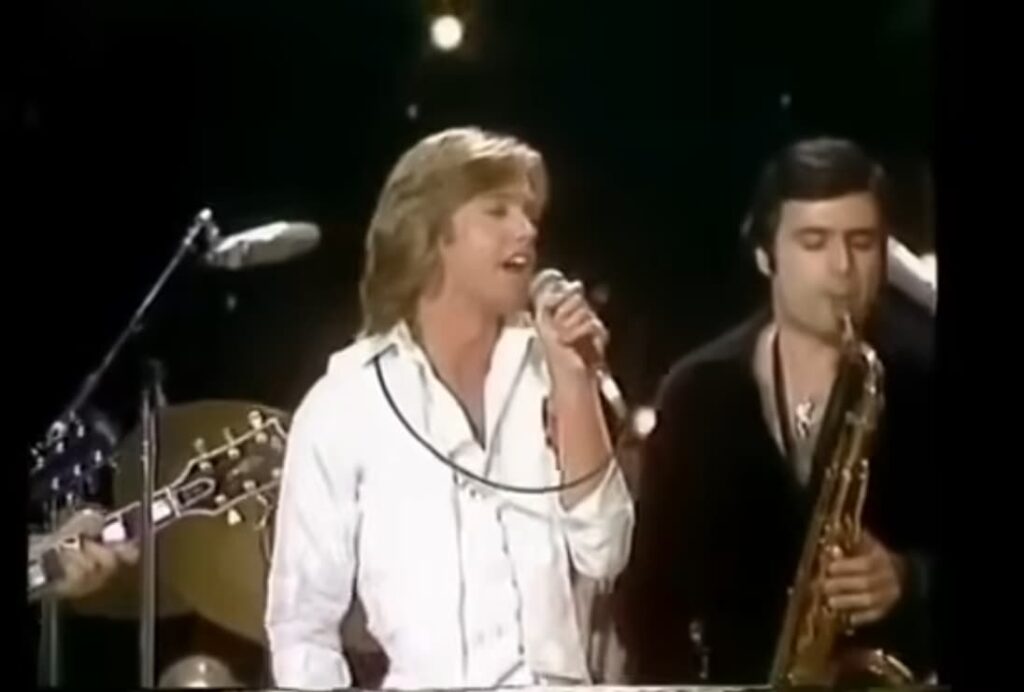
A spirited celebration of youthful energy, “That’s Rock ’n’ Roll” captured the exuberant heart of late-1970s pop culture and confirmed Shaun Cassidy as one of the era’s brightest young stars.
When Shaun Cassidy stepped onto the stage to perform That’s Rock ‘n’ Roll in a live appearance connected with the Grammy Awards, it felt like a vivid snapshot of the late 1970s—an era when pop music, television, and youth culture collided in dazzling fashion. The song itself had already become a defining moment in Cassidy’s career. Released in 1977 as the second single from his album Shaun Cassidy, the track quickly climbed the charts, reaching No. 3 on the Billboard Hot 100 and helping the album achieve No. 1 on the Billboard 200. In the United States alone, the record sold millions of copies, making Cassidy one of the most visible young performers of that year.
Interestingly, “That’s Rock ’n’ Roll” was not originally written for Cassidy. The song had been composed and recorded earlier by Eric Carmen, a former member of The Raspberries, who first included it on his 1975 solo album Eric Carmen. Carmen’s version possessed a smooth, melodic pop-rock style, but when Shaun Cassidy recorded it two years later, the song gained a new dimension. His youthful voice, bright stage presence, and the polished production of the late 1970s transformed the track into an anthem of teenage exuberance.
By 1977, Cassidy had already begun to build a remarkable following. Known to television audiences through the hit series The Hardy Boys/Nancy Drew Mysteries, he represented a rare blend of television star and pop idol. The success of “That’s Rock ’n’ Roll” strengthened that connection between music and screen, as fans who watched him on television now heard his voice dominating the radio.
The lyrics of “That’s Rock ’n’ Roll” celebrate the simple magic of music itself. Rather than telling a complex story, the song describes the emotional spark that occurs when the right melody meets the right moment. It speaks of guitars ringing out, rhythms pulsing through crowded rooms, and the shared excitement of discovering music that feels entirely new. In many ways, the song serves as a tribute to the spirit of rock ’n’ roll—an art form that has always thrived on enthusiasm, energy, and the thrill of youth.
When Cassidy performed the song live in connection with the Grammy Awards, that sense of celebration became even more apparent. The stage lights, the eager crowd, and the unmistakable opening chords created an atmosphere of joyful anticipation. Cassidy’s voice carried a confident brightness, reflecting a performer who understood exactly what the audience had come to hear. Each chorus seemed to echo with the collective excitement of listeners who had embraced the song during its rapid rise on the charts.
There is also something quietly nostalgic about hearing “That’s Rock ’n’ Roll” today. The late 1970s represented a moment when pop music felt vibrant and open to endless experimentation. Disco rhythms, rock guitars, and polished studio production all shared space on the same radio stations. Amid that colorful musical landscape, Cassidy’s version of the song stood out because it captured a universal feeling—the sheer joy of discovering music that makes the world feel a little brighter.
Over time, many artists who achieved sudden fame during that decade watched the spotlight shift elsewhere. Yet songs like “That’s Rock ’n’ Roll” continue to carry the spirit of their era. Listening again to that lively performance, one can almost picture the glow of television screens, the excitement of live broadcasts, and the sound of a young singer stepping confidently into the spotlight.
In the end, Shaun Cassidy’s performance reminds us of something essential about music history. Trends may change, new styles may appear, and generations of listeners may come and go. But the excitement contained in a truly joyful rock ’n’ roll song never fades.
Because when the guitars begin to ring and the chorus rises once more, the message of “That’s Rock ’n’ Roll” still feels as clear as it did in 1977: music, at its heart, is meant to be shared, celebrated, and remembered.