
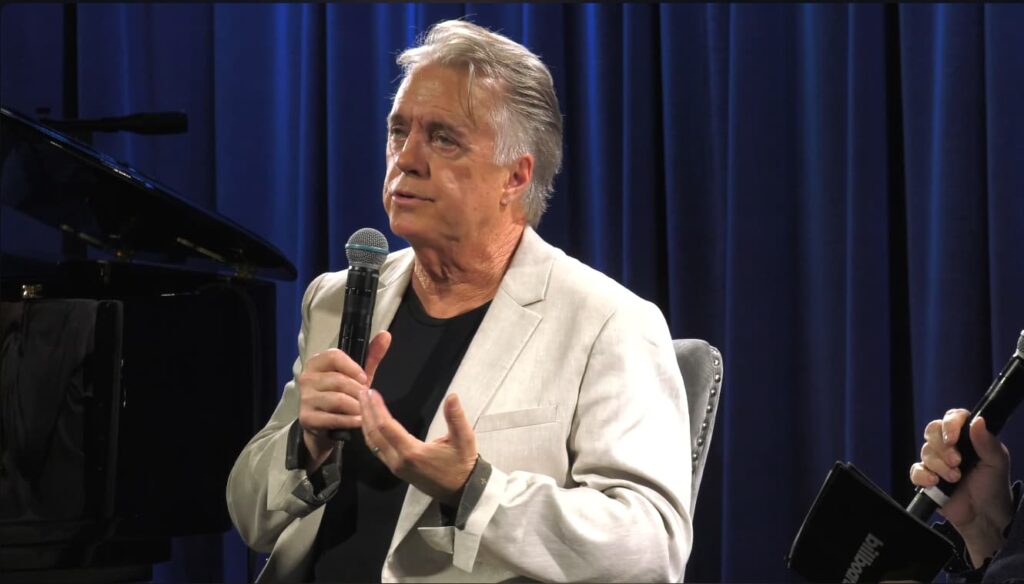
A reflective evening where music, memory, and new beginnings met on the same stage as Shaun Cassidy revisited his past while quietly introducing the sound of his future.
On September 4, 2025, the intimate hall of the Clive Davis Theater became the setting for a rare and thoughtful musical gathering. Hosted by the GRAMMY Museum, the event “An Evening With Shaun Cassidy” welcomed audiences into a conversation that was less about nostalgia and more about reflection, craft, and the quiet persistence of creativity. In a room that holds only about two hundred seats, the distance between performer and listener disappears. Every story lands more personally, every memory sounds a little closer to the heart.
For those who remember the remarkable cultural moment of Shaun Cassidy in the late nineteen seventies, the evening carried a gentle sense of time folding in on itself. Cassidy first rose to international fame in 1977 when his debut album Shaun Cassidy produced the chart topping single “Da Doo Ron Ron.” That song reached No. 1 on the Billboard Hot 100, turning the young performer into one of the defining pop voices of the era. At the same time, television audiences knew him as Joe Hardy in the popular series The Hardy Boys, where music and television fame seemed to move together in the same bright spotlight.
Yet the evening at the GRAMMY Museum was not simply a retelling of familiar success. Instead, it unfolded like a long conversation about the life that happens after the applause fades. Sitting comfortably before the audience, Cassidy spoke about the many chapters of his career, from teenage pop idol to respected songwriter, producer, and television creator. The tone was calm and thoughtful, almost like a musician looking through an old notebook filled with melodies that still carry meaning.
One of the most anticipated moments of the event arrived when Cassidy offered a special preview of two new songs, giving listeners a glimpse into the direction of his current music. These performances were not about recapturing the sound of the past. Instead, they revealed a songwriter who has spent decades learning how to shape stories through melody. The songs carried a quieter emotional weight, suggesting reflection rather than youthful urgency. In that sense, the music felt like a continuation of the same artistic voice, simply matured by time.
During the discussion portion of the evening, Cassidy explored the creative process that has guided him through so many different forms of storytelling. Music, he explained, remains the most personal form of expression. While television writing and producing allow for collaboration and structure, a song often begins alone with a guitar, a line of lyrics, or even just a feeling that refuses to disappear. That idea seemed to resonate deeply in the room. Creativity, after all, is rarely about fame. It is about the quiet persistence of imagination.
What made the night particularly meaningful was the sense that Cassidy was not revisiting the past merely to celebrate it. Instead, he treated those early successes as part of a much longer artistic journey. The same voice that once sang youthful pop melodies has spent decades learning new ways to tell stories, whether through music, scripts, or stage performances. The audience could feel that continuity.
The Clive Davis Theater, named after the legendary music executive Clive Davis, has hosted many conversations about music history. Yet evenings like this remind listeners that history is never entirely finished. Artists continue to evolve long after the era that first introduced them to the world.
By the end of the night, the atmosphere in the room had shifted from simple curiosity to something closer to quiet appreciation. The previewed songs suggested that Shaun Cassidy remains deeply connected to the craft that first brought him into the spotlight nearly half a century ago. Fame may come and go, trends may change, but the instinct to write and sing stories that matter tends to stay.
In that small theater in Los Angeles, the past and present of a remarkable career shared the same stage. And for a couple of hours, music once again became what it has always been at its best: a conversation between memory and possibility.