
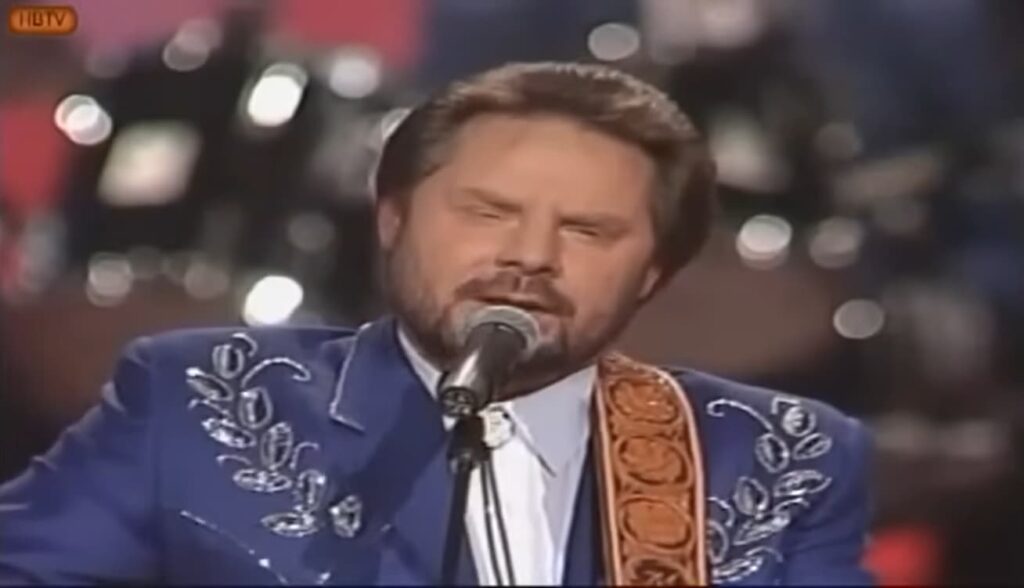
A song that lingers like a late-night confession, where heartbreak stretches so long it begins to feel like a lifetime
When Moe Bandy released “Till I’m Too Old To Die Young” in 1987, it arrived quietly, without the fanfare that often accompanies major hits, yet it carried a weight that many listeners immediately recognized. The song climbed to No. 6 on the Billboard Hot Country Singles chart, marking one of the final Top 10 successes of Bandy’s long and steady career. It was included on the album You Haven’t Heard the Last of Me, a title that, in retrospect, feels less like a statement of defiance and more like a gentle promise—one last chapter told with honesty rather than urgency.
By the late 1980s, Moe Bandy had already built his reputation as one of country music’s most faithful traditionalists. While the genre was gradually shifting toward a more polished, crossover sound, Bandy remained rooted in the classic honky-tonk style that had defined his earlier successes. Songs like “Bandy the Rodeo Clown” (No. 7, 1975) and “Hank Williams, You Wrote My Life” (No. 2, 1979) had established him as a storyteller of working-class sorrow, where heartbreak was not dramatized but simply accepted as part of living.
“Till I’m Too Old To Die Young” fits squarely within that tradition, yet it carries a deeper sense of weariness. Written by songwriter Sonny Throckmorton, the song tells the story of a man who finds himself abandoned, left to sit with the slow passing of time and the lingering ache of love that refuses to fade. There is no resolution offered, no promise of healing. Instead, there is only endurance—the quiet, stubborn act of continuing to live with something that never quite lets go.
What gives the song its enduring power is not its narrative alone, but the way Bandy delivers it. His voice, never overly ornate, carries a natural restraint that makes the emotion feel unforced. Each line unfolds with a kind of patience, as though the singer understands that some feelings cannot be rushed. The title itself—“Till I’m Too Old To Die Young”—captures a paradox that resonates deeply: the idea of living long enough that even despair becomes familiar, almost companionable.
There is a sense, too, that the song reflects a broader moment in country music. By 1987, the genre was beginning to embrace a new generation of artists, and the raw, traditional sound that Bandy represented was slowly moving to the margins. Yet songs like this serve as reminders of what country music once held at its core: stories of ordinary lives, told without embellishment, where pain is neither hidden nor exaggerated.
Listening to Moe Bandy in this recording, one can hear not just the character in the song, but the passage of time within the voice itself. There is a maturity there, a lived-in quality that suggests experience rather than performance. It is the sound of someone who understands that heartbreak is rarely dramatic in real life. More often, it is quiet, repetitive, and deeply personal.
The arrangement of the song mirrors this emotional landscape. Gentle steel guitar lines drift in and out, never overwhelming the vocal, while the rhythm remains steady, almost indifferent. It is as if the music itself acknowledges that life continues, regardless of what is felt within it.
Over the years, “Till I’m Too Old To Die Young” has not always been the most discussed entry in Moe Bandy’s catalog, yet it remains one of his most affecting. It does not rely on novelty or grand gestures. Instead, it offers something more enduring: recognition. The kind that comes when a song articulates a feeling that has long been understood but rarely expressed so plainly.
In the end, what lingers is not just the story of a man left behind, but the quiet acceptance that some chapters of life do not close neatly. They simply continue, carried forward in memory, in routine, and in the soft echo of a voice that refuses to pretend everything will be alright. And perhaps that is where the song finds its true meaning—not in resolution, but in the courage to remain, even when nothing has changed.