
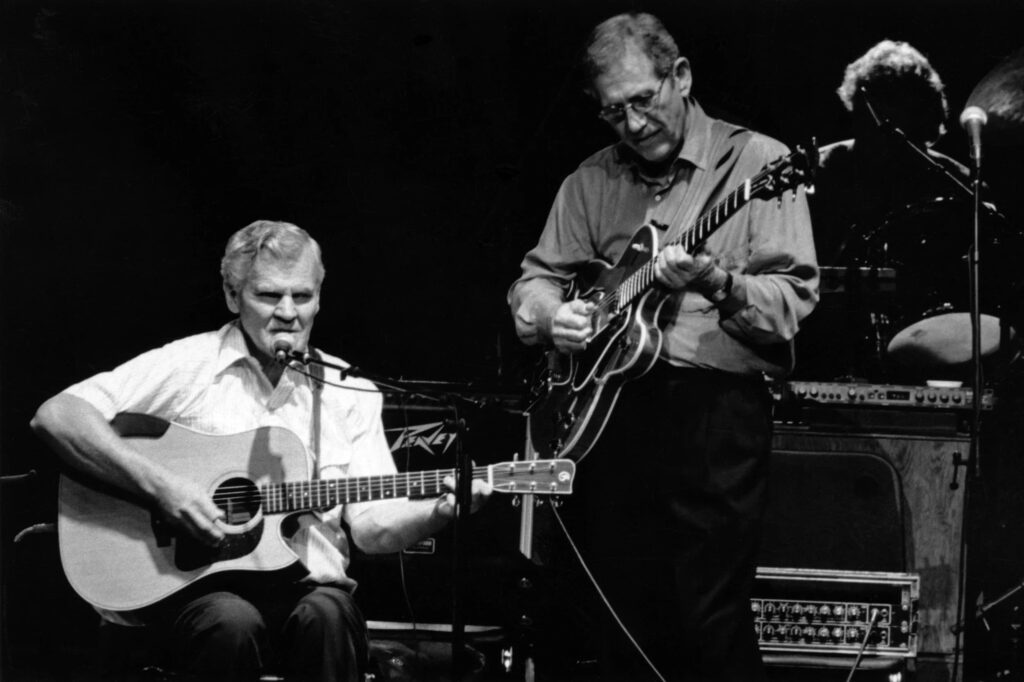
Two Masters in Quiet Conversation — A Night Where Doc Watson and Chet Atkins Let the Guitar Speak What Words Never Could
When Doc Watson and Chet Atkins appeared together on The Tonight Show in 1980, it was more than a television performance. It was a rare meeting of two distinct musical worlds—Appalachian folk and Nashville sophistication—brought together not through spectacle, but through mutual respect and a shared understanding of what music can say when it is left unadorned.
By 1980, both men had long secured their places in American music history. Doc Watson, born Arthel Lane Watson, had already become a defining figure in folk and bluegrass, known for his revolutionary flatpicking style on the acoustic guitar. His recordings in the 1960s had helped revive traditional American music, and his work would eventually earn him multiple Grammy Awards, including honors for both traditional folk and instrumental performance.
Across from him sat Chet Atkins, a towering figure in country music, not only as a guitarist but also as a producer who helped shape the “Nashville Sound.” His smooth, fingerstyle technique—often referred to simply as “Chet’s style”—brought elegance and restraint to country recordings at a time when the genre was evolving rapidly. Atkins would go on to receive 14 Grammy Awards and was later named a Grammy Lifetime Achievement Award recipient, a testament to his lasting influence.
Their collaboration had already been captured in the album Reflections (1979), which won the Grammy Award for Best Country Instrumental Performance. That record was not about competition or display. It was about conversation—two guitars, two approaches, meeting somewhere in the middle.
And that spirit carried into their 1980 appearance on The Tonight Show.
There is something striking about the simplicity of the performance. No elaborate staging, no attempt to modernize or dramatize. Just two men seated with their instruments, allowing the music to unfold naturally. In an era increasingly defined by production and polish, this moment feels almost defiant in its quietness.
Doc Watson’s playing carries the earth with it. There is a directness in his touch, a clarity that feels rooted in front porches and long roads, in songs passed down rather than written. Every note has purpose, but never urgency. It arrives exactly when it should.
Chet Atkins, on the other hand, brings a kind of architectural precision. His fingers move with an ease that conceals extraordinary complexity. The bass lines walk steadily beneath delicate melodies, creating a fullness that never overwhelms. Where Watson speaks plainly, Atkins refines—but neither overshadows the other.
What makes this performance so enduring is the absence of ego. There is no need to prove anything. Each listens as much as he plays. There are moments when one guitar steps forward, only to gently recede, making space for the other. It is a balance that cannot be rehearsed into existence. It comes from years of understanding not just music, but silence.
The choice of material, often rooted in traditional melodies, reinforces this sense of continuity. These are not songs bound to a single moment in time. They are pieces that have traveled, much like the two men performing them, gathering meaning along the way.
Watching them in 1980, there is also an awareness of something deeper than technique. Both artists had lived enough to know that music is not about perfection. It is about connection. The slight imperfections, the subtle variations in tempo, the human touch—these are not flaws. They are the very things that make the performance feel alive.
In that studio setting, under the soft glow of television lights, the noise of the world seems to fall away. What remains is the sound of wood and steel, fingers and memory, tradition and interpretation meeting in a quiet exchange.
For those who listened then, and for those who return to it now, this performance offers something increasingly rare.
It does not ask for attention.
It rewards it.
And in the space between those two guitars, played by Doc Watson and Chet Atkins, there is a reminder that the most lasting music is often the kind that speaks softly, yet stays with you long after the final note has faded.