
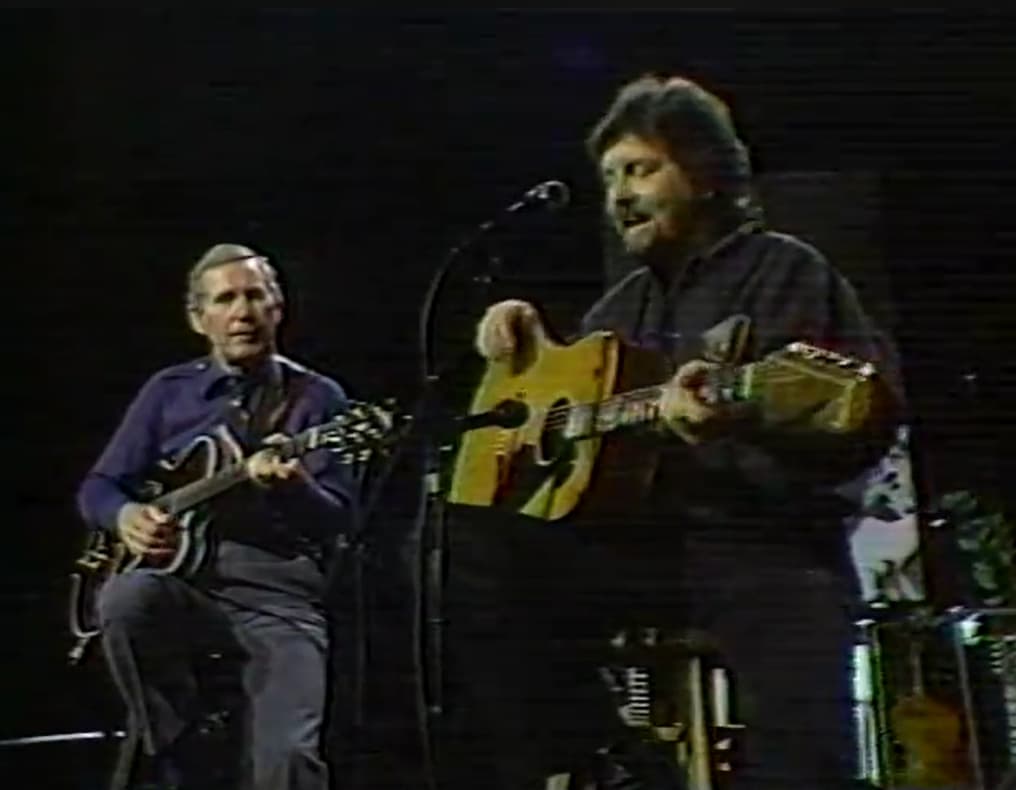
A Rolling Guitar Rhythm That Carries the Spirit of Motion, Memory, and American Roots
When “Cannonball Rag” found its way into the hands of Chet Atkins, it became more than an instrumental—it became a signature, a calling card, a quiet declaration of mastery that needed no words to be understood. Though the piece itself predates Atkins, originally composed and recorded by Merle Travis in the 1940s, it was Chet Atkins’ interpretation that carried it into a wider, more enduring legacy. His version, recorded in the early 1950s and later featured on albums such as “Chet Atkins’ Gallopin’ Guitar” (1953), did not chart as a traditional hit on the Billboard Hot 100—instrumentals of this kind rarely did—but its influence extended far beyond chart positions, becoming one of the most recognizable guitar instrumentals in country and American roots music.
To understand “Cannonball Rag”, one must first understand the sound that Chet Atkins cultivated—a sound often referred to as the “Nashville style,” where technical precision meets melodic warmth. His approach to the guitar was deeply rooted in fingerpicking, a technique he refined from the groundwork laid by Merle Travis. Yet Atkins brought something uniquely his own: a smoothness, a control, and a quiet elegance that transformed even the most intricate passages into something that felt effortless.
The title itself, “Cannonball Rag”, evokes movement—something fast, rhythmic, almost mechanical. One can easily imagine the steady, rolling momentum of a train cutting across open land, its wheels creating a hypnotic pulse against the tracks. In Atkins’ hands, that motion becomes audible. The alternating bass line mimics the steady chug of the engine, while the higher melodic lines dance above it, light and fluid, like scenery passing by in soft focus.
Unlike lyrical songs that tell their stories through words, “Cannonball Rag” speaks entirely through feel. There is a kind of understated joy in its phrasing, but also a sense of discipline. Every note is placed with intention. Nothing lingers longer than it should, yet nothing feels rushed. It is music that understands balance—between speed and restraint, complexity and clarity.
For many listeners, especially those who encountered Chet Atkins during the rise of television appearances and early country recordings, this piece became synonymous with his identity. It was often used as a demonstration of his skill, but it never felt like a display for its own sake. Instead, it carried the quiet confidence of someone who had long ago mastered his instrument and no longer needed to prove it.
There is also something deeply reflective about revisiting “Cannonball Rag” today. In an era where music is often layered, produced, and digitally shaped, the clarity of Atkins’ playing stands apart. There are no effects to hide behind, no embellishments to distract. What remains is the pure sound of fingers on strings, captured with an honesty that feels increasingly rare.
The significance of Chet Atkins’ version lies not in commercial metrics, but in its lasting influence. Generations of guitarists—across country, rock, and even jazz—have studied this piece, drawn to its intricate yet accessible structure. It serves as both a lesson and an inspiration, a reminder that technical brilliance does not have to come at the expense of musicality.
Perhaps what makes “Cannonball Rag” endure most is its ability to evoke without explaining. It does not tell the listener what to feel. Instead, it creates space—for memory, for imagination, for quiet appreciation. It can accompany a moment of stillness just as easily as it can suggest movement and travel.
In the broader arc of Chet Atkins’ career, this instrumental stands as a cornerstone. While he would go on to produce countless recordings and shape the sound of Nashville itself, “Cannonball Rag” remains one of the clearest windows into his artistry. It captures him not as a producer, not as an industry figure, but as a musician—focused, precise, and deeply attuned to the expressive potential of his instrument.
And so, long after the first notes were recorded, the song continues to roll forward, much like the train it seems to echo—steady, unhurried, and impossible to forget.