
A Love Caught Between Freedom and Commitment — “I Don’t Want To Have To Marry You” as a Gentle Negotiation of the Heart
When Jim Ed Brown and Helen Cornelius released “I Don’t Want To Have To Marry You” in 1976, they offered something quietly refreshing to country music—a duet that did not rush toward romance, but instead paused to question it. The song climbed to No. 1 on the Billboard Hot Country Singles chart, marking one of the most significant milestones in their celebrated partnership. It also became the title track of their 1976 album, I Don’t Want To Have To Marry You, solidifying their place among the most beloved duos of the era.
Written by Fred Imus and Phil Sweet, the song arrived at a time when country music was beginning to explore more conversational, relatable themes. Yet even within that context, this composition stood apart. It did not lean on heartbreak or longing alone. Instead, it found its voice in hesitation—a rare and honest admission that love does not always arrive neatly packaged with certainty.
By the mid-1970s, Jim Ed Brown was already a well-established figure in country music, having transitioned from his earlier success with The Browns into a respected solo career. Helen Cornelius, on the other hand, brought a fresh, expressive presence that complemented Brown’s steady, reassuring tone. Together, they formed a partnership that felt natural rather than constructed, their voices blending in a way that suggested conversation rather than performance.
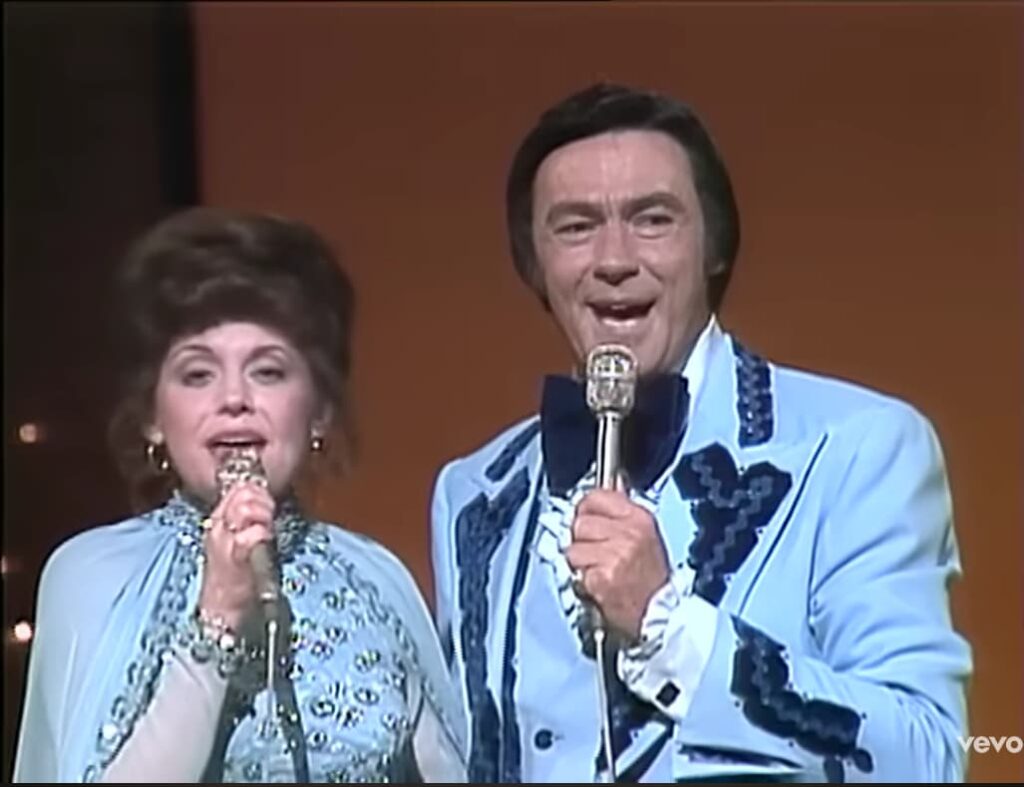
In live renditions of “I Don’t Want To Have To Marry You”, that conversational quality becomes even more pronounced. There is a subtle interplay between the two singers—an exchange that feels less like a scripted duet and more like two individuals gently negotiating the terms of their emotions. Brown’s delivery carries a quiet sincerity, grounded and reflective, while Cornelius responds with warmth and a touch of playful resistance. Neither voice dominates. Instead, they meet in the middle, allowing the song’s meaning to unfold organically.
The premise of the song is deceptively simple. Two people acknowledge their feelings, yet both hesitate at the idea of marriage—not out of fear, but out of a desire to preserve something unpressured, something unforced. In a genre where commitment is often portrayed as the ultimate resolution, this perspective feels almost radical. It suggests that love can exist fully in the present, without needing to be immediately defined by permanence.
There is a kind of wisdom in that restraint.
Listening closely, one begins to understand that the song is not rejecting commitment. Rather, it is questioning the necessity of rushing toward it. It recognizes that the strongest connections are sometimes those that are allowed to grow at their own pace, without expectation.
In the context of a live performance, this message takes on even greater depth. The audience becomes part of the exchange, drawn into the gentle push and pull between the two voices. There are moments of lightness, even humor, but beneath them lies a deeper current—a recognition of how complicated, and how fragile, human relationships can be.
The arrangement itself remains understated, allowing the vocals to carry the emotional weight. Soft instrumentation frames the melody without distracting from it, reinforcing the sense that this is a song built on nuance rather than grand gestures.
Over time, “I Don’t Want To Have To Marry You” has endured not because it offers answers, but because it reflects a truth that many quietly understand. Love is not always a straight path. It is filled with pauses, reconsiderations, and moments where certainty feels just out of reach.
And perhaps that is why the song continues to resonate.
In the voices of Jim Ed Brown and Helen Cornelius, there is no urgency, no demand for resolution. There is only a shared understanding that what they have—whatever it may be—is worth holding onto, even if it cannot yet be defined.
In that space between question and answer, between feeling and decision, the song finds its lasting power.
It does not insist.
It simply lingers.
 Oldies Songs