
A Gentle Confession of Desire, Wrapped in Patience and Southern Grace
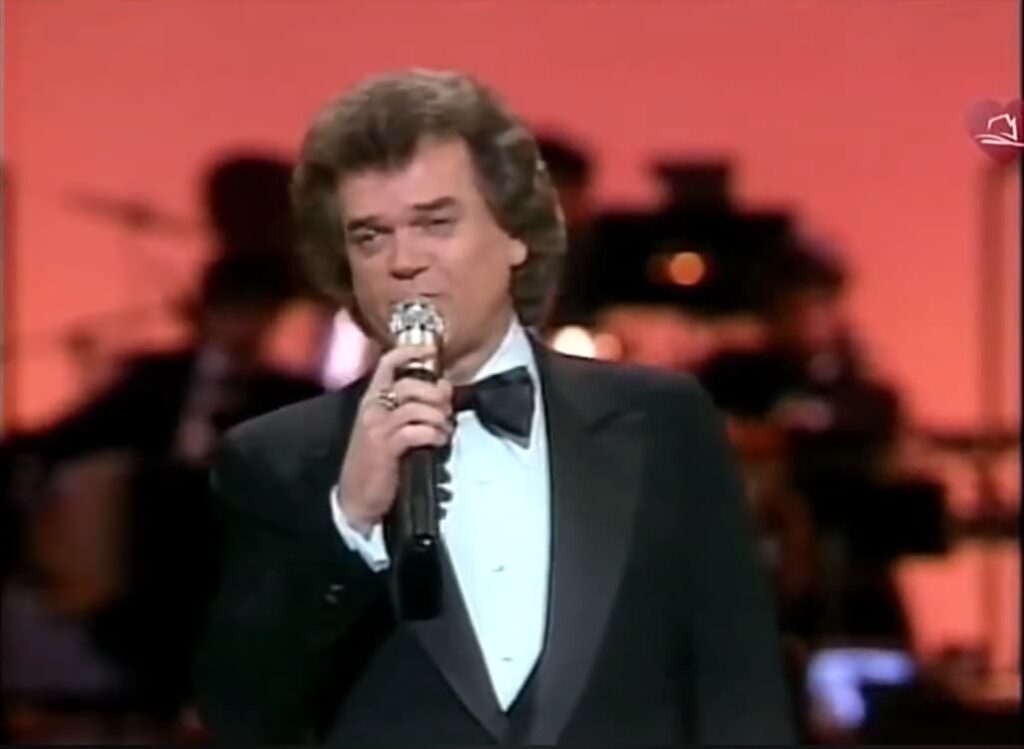
When Conway Twitty stepped onto the stage at the 3rd Annual Music City News Top Country Hits Of The Year to perform “Slow Hand,” he was not merely revisiting a chart-topping success—he was embodying a philosophy of love that had already begun to feel timeless, even in its own moment. Released in 1982 as part of the album “Dream Maker,” the song quickly climbed to the pinnacle of the country charts, securing the No. 1 spot on the Billboard Hot Country Singles chart and reaffirming Twitty’s remarkable ability to translate intimacy into melody.
By the time “Slow Hand” reached audiences, it already carried a quiet history. The song had first been recorded by the pop group The Pointer Sisters in 1981, where it achieved crossover success, reaching No. 2 on the Billboard Hot 100. Yet, in Twitty’s hands, the song shed its polished pop exterior and found a deeper, more grounded emotional core. His version did not rush; it lingered, breathed, and allowed every word to settle like a memory revisited in the stillness of late evening.
Watching that live performance, one could sense how completely Conway Twitty understood the weight of restraint. There was no urgency in his delivery, no need to impress with vocal theatrics. Instead, he leaned into the song’s central idea: that love, when it is real, does not need to be hurried. The phrase “slow hand” became more than a lyrical hook—it became a quiet rebellion against a world that often moves too fast to notice the subtleties of human connection.
The early 1980s marked a period when country music was balancing tradition with a growing polish, and “Dream Maker” stood as a reflection of that transition. The album itself produced multiple hits, but “Slow Hand” held a special place, perhaps because it spoke to something universal yet rarely articulated so gently. It was about touch, yes, but also about intention. About choosing patience over impulse, and depth over immediacy.
There is something particularly striking about how Conway Twitty approached the song in live settings. At the Music City News event, his performance carried an almost conversational quality, as if he were not singing to an audience but sharing a private understanding with each listener individually. His voice—rich, steady, and unmistakably his—wrapped around the melody with a kind of quiet authority. It was the voice of someone who had lived long enough to know that the most meaningful moments are often the ones that unfold slowly.
The story behind the song’s success is also a testament to Twitty’s enduring connection with his audience. By 1982, he was already a seasoned artist with a long string of hits behind him, yet “Slow Hand” proved that he could still capture new emotional territory without abandoning the essence of what made him beloved. It was not about reinvention; it was about refinement.
And perhaps that is why the song continues to resonate. It does not rely on grand gestures or dramatic declarations. Instead, it offers something quieter, more reflective. It reminds us of a time when a song could speak softly and still be heard clearly, when a voice like Conway Twitty’s could carry not just a melody, but a lifetime of understanding.
In the end, “Slow Hand” is less about romance in its fleeting sense and more about the enduring nature of connection. It lingers like a familiar tune heard through an open window on a warm night—unhurried, sincere, and deeply human. And in that live performance, under the lights of a country music celebration, Conway Twitty did not just sing the song—he allowed it to breathe, to settle, and to remind us that sometimes, the most powerful expressions are the ones that take their time.
 Oldies Songs