
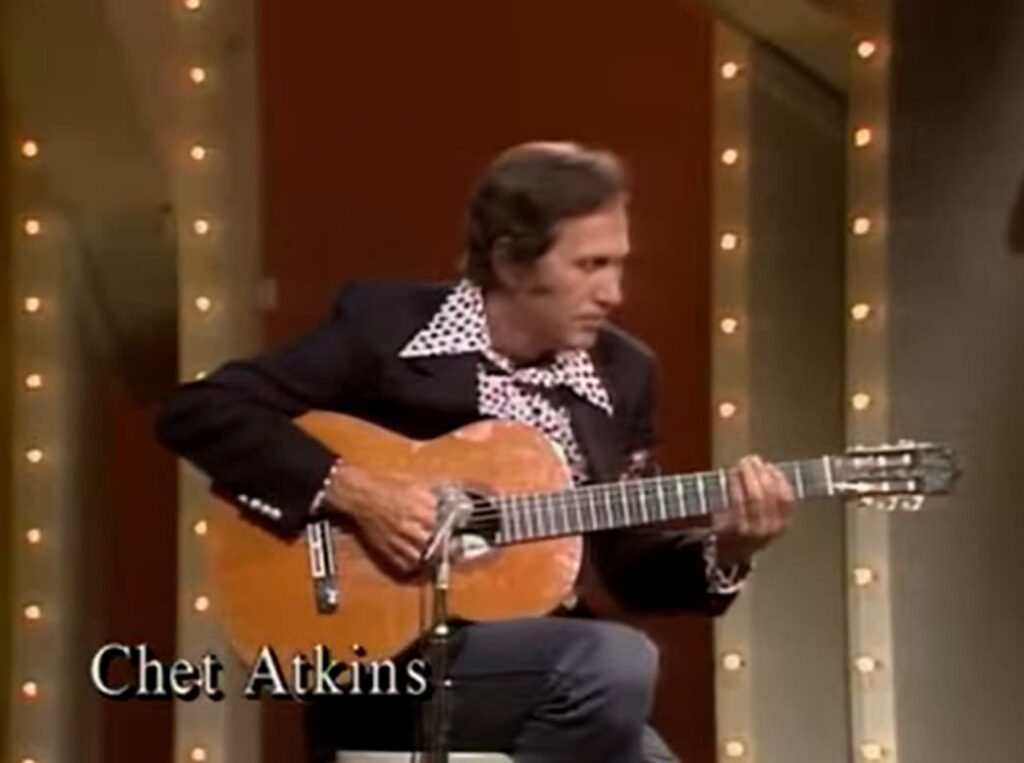
A Ragtime Classic Reimagined, Where Precision Meets Playfulness in Every Measured Note
When Chet Atkins turned his attention to “The Entertainer,” he was not simply revisiting a well-known melody—he was engaging in a quiet dialogue with history itself. Originally composed in 1902 by Scott Joplin, the piece stood as one of the defining works of ragtime, a genre built on syncopation, elegance, and rhythmic wit. Decades later, it would experience a remarkable revival when it was used in the 1973 film The Sting, with pianist Marvin Hamlisch’s adaptation reaching No. 3 on the Billboard Hot 100 in 1974. Yet, in the hands of Chet Atkins, “The Entertainer” took on a different life—less theatrical, more intimate, and unmistakably personal.
By the time Atkins recorded and performed his interpretation, he had already established himself as one of the most respected guitarists of the 20th century. Known for his refined fingerstyle technique and his role in shaping the Nashville Sound, Chet Atkins approached music not as a platform for display, but as a craft to be carefully shaped. His version of “The Entertainer” reflects that philosophy. It does not attempt to compete with the piano-driven brilliance of Joplin’s original or Hamlisch’s celebrated arrangement. Instead, it translates the piece into the language of the guitar, where each note must be earned through touch and control.
There is something quietly remarkable about how Atkins manages this transformation. Ragtime, by its nature, relies heavily on the independence of the left and right hands—bass and melody moving in playful tension. On the guitar, this becomes an even greater challenge, requiring a level of coordination that few can achieve with such ease. Yet in Atkins’ hands, the complexity disappears. What remains is a sense of flow, as though the melody had always belonged to the instrument.
The meaning of “The Entertainer” shifts subtly in this context. Where the original composition carried the lively spirit of early 20th-century dance halls, Atkins’ interpretation feels more reflective. The tempo is measured, the phrasing deliberate. There is still joy in the music, but it is a quieter kind of joy—one that comes not from exuberance, but from understanding. It is the difference between hearing a song for the first time and returning to it after many years, when each note carries not just sound, but memory.
The story behind Atkins’ connection to such material lies in his lifelong respect for melody and structure. He often gravitated toward compositions that demanded both technical precision and emotional restraint. “The Entertainer” offered both. It allowed him to demonstrate his skill without overshadowing the composition itself—a balance that defined much of his work.
Although Atkins’ version was not released as a charting pop single, his recordings consistently found success within the Billboard Country Albums chart, and his influence extended far beyond commercial rankings. His interpretations of standards like “The Entertainer” became part of a broader legacy—one that earned him multiple Grammy Awards and the admiration of generations of musicians.
Listening to his rendition today, one cannot ignore the sense of time embedded within it. The piece itself spans eras—from Joplin’s ragtime origins to its 1970s revival, and finally to Atkins’ interpretation. Each version adds a layer, a perspective, a different way of understanding the same melody. And in Atkins’ hands, the song becomes something almost meditative—a reminder that even the most lively compositions can carry moments of stillness.
There is also a certain humility in the way Chet Atkins approaches the piece. He does not attempt to reinvent it completely, nor does he treat it as untouchable. Instead, he meets it halfway, allowing his own voice to emerge naturally within its structure. This balance between respect and individuality is what gives his version its lasting appeal.
In the end, “The Entertainer” as performed by Chet Atkins is not about spectacle. It is about craftsmanship, about the quiet satisfaction of doing something well simply for the sake of doing it well. It reminds us that music does not always need to surprise to be meaningful; sometimes, it only needs to be understood.
And as the final notes settle into silence, there is a lingering impression—not of applause or grand conclusion, but of something gently completed. A conversation between past and present, carried through strings and fingertips, leaving behind a melody that continues to resonate long after the sound itself has faded.